freaklikeme wrote:
The Tele-Tessar 200/4? My biggest concern there would be difference in bokeh between it and the Sonnar.
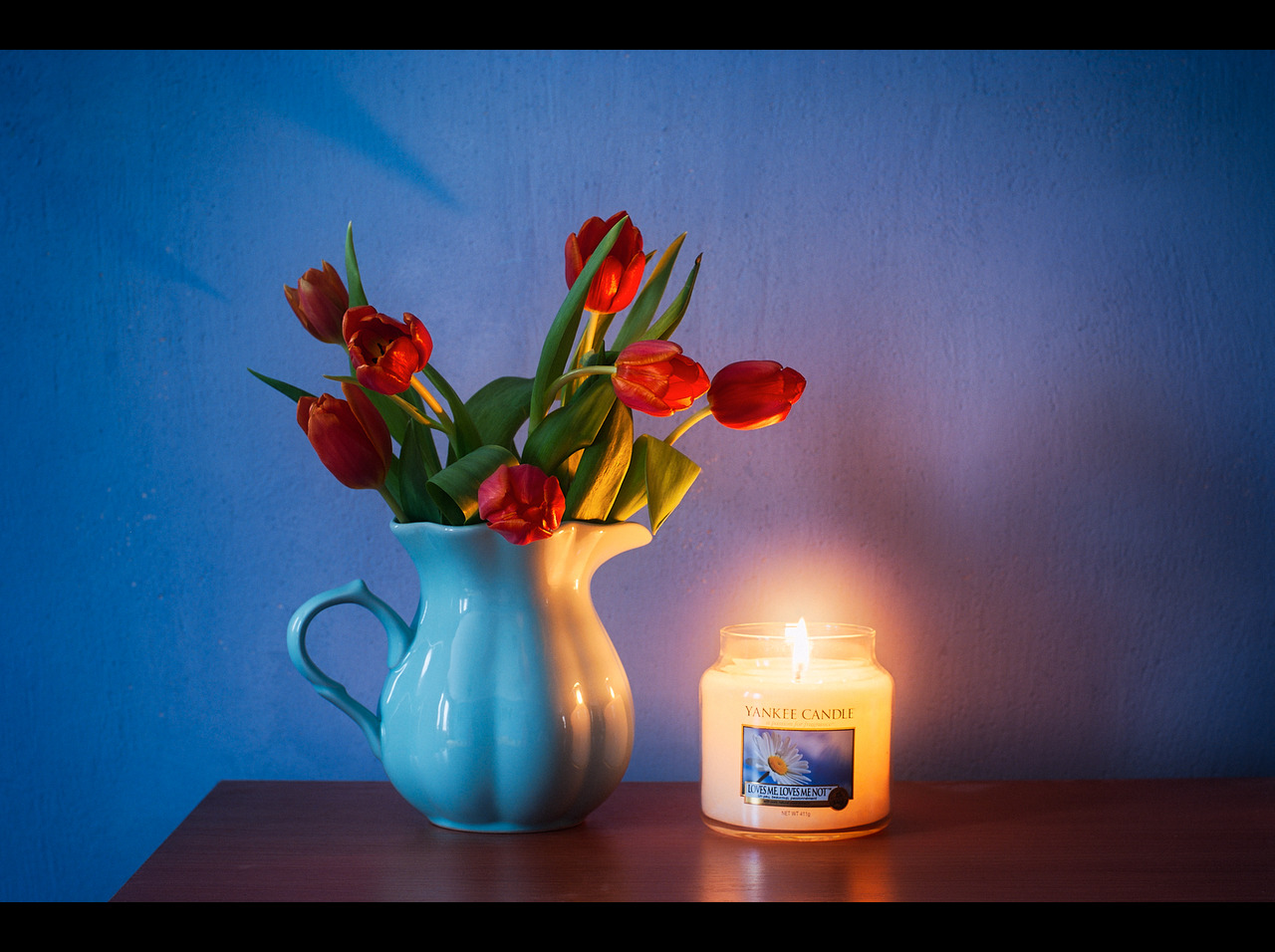
Here's a couple of shots from the Tele-Tessar 200/4. It's the only 200 I've used, so I can't really say much about it except that I like it very much. It's very small for a 200, and I like the way it renders out of focus backgrounds. But it has loads of PF, which I've tried to correct as best I can in these shots. The first two are taken with a Sony A7, the last with a NEX-7. I think all of them are wide open, but I'm not entirely sure about the first one.
freaklikeme wrote:
Interesting. I thought when you saw improvements in both sagittal and tangential, then the relatively poor wide aperture performance was CA, but if the separation between the two increased when stopping down, it was astigmatism. So can you only measure astigmatism with a monochromatic MTF?
Monochromatic light helps a lot in studying lens aberrations, but is not always necessary. Interpretation of the wide open (polychromatic) MTF is treacherous terrain, because lens performance is then typically limited by a mixture of several aberrations. There are, however, a few rules of thumb that help to interpret stopped-down MTF.
Spherical aberration and longitidunal CA affect the entire field. These two aberrations are the only ones which affect the image center, and improve upon stopping down.
Coma, astigmatism, and field curvature lower the MTF off axis, but the blur due to these aberrations becomes less upon stopping down. Which is another way of saying that the MTF goes up.
Lateral CA lowers the tangential MTF off axis, and does not improve upon stopping down. Sometimes the tangential MTF even drops a bit because of peculiarities with the shape of the line spread function.
Older generation telephoto lenses are typically limited by both types of CA. These lenses become much more contrasty and sharp when a color filter is attached, as B&W photographers experienced in the old days. (A rare case of a filter actually improving image quality.) Excellent image quality can also be obtained if the subject is fairly monochromatic, such as a landscape with red rocks or a field of grass. In general, however, the perfomance of these lenses is well behind the performance of today's telephoto options.
This is the C/Y 180 f2.8 wide open again. My neighbour’s Border Collie temporarily in charge of the quad bike and studiously ignoring me and also the excitable dog being restrained by my left arm!
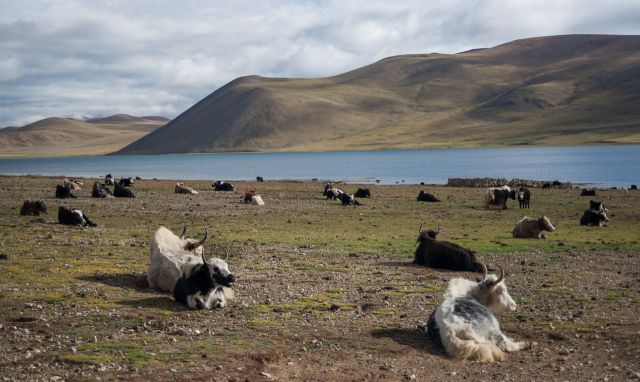
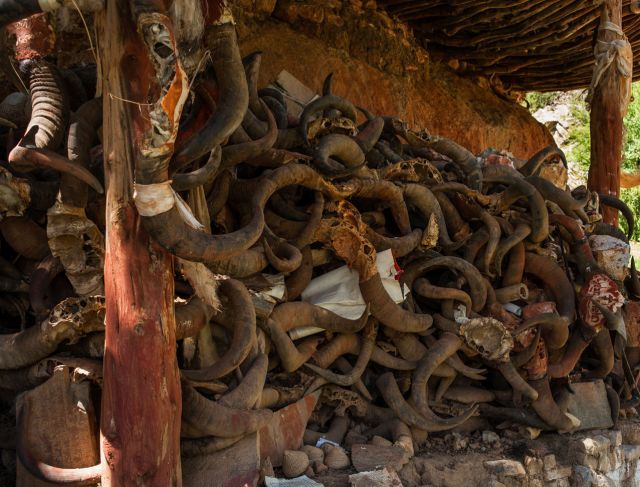
The first shows a herd of domestic yak. The second shows a ceremonial tray at an 11th century monastery, full of yak horns. Almost all these horns belong to large males and the smaller female horns of the rare wild yak, the male of which stands 2m at the shoulder, weighs 1000kg and has horns up to 39" across. They are making a comeback, a guide told me they saw about 500 on an expedition a couple of years back; but this display is very old. a900 / CY 35-70.
Toothwalker wrote:
Monochromatic light helps a lot in studying lens aberrations, but is not always necessary. Interpretation of the wide open (polychromatic) MTF is treacherous terrain, because lens performance is then typically limited by a mixture of several aberrations. There are, however, a few rules of thumb that help to interpret stopped-down MTF.
Spherical aberration and longitidunal CA affect the entire field. These two aberrations are the only ones which affect the image center, and improve upon stopping down.
Coma, astigmatism, and field curvature lower the MTF off axis, but the blur due to these aberrations becomes less upon stopping down. Which is another way of saying that the MTF goes up.
Lateral CA lowers the tangential MTF off axis, and does not improve upon stopping down. Sometimes the tangential MTF even drops a bit because of peculiarities with the shape of the line spread function.
Older generation telephoto lenses are typically limited by both types of CA. These lenses become much more contrasty and sharp when a color filter is attached, as B&W photographers experienced in the old days. (A rare case of a filter actually improving image quality.) Excellent image quality can also be obtained if the subject is fairly monochromatic, such as a landscape with red rocks or a field of grass. In general, however, the perfomance of these lenses is well behind the performance of today's telephoto options.
Thanks as always for the education, Toothwalker. Your site is an excellent resource as well.
To illustrate for myself what you explained, I used the Hassy F Tele-Tessar 250/4, which, if you just compare the relevant portions of it's MTF with the C/Y Sonnar 180 and 200/3.5, looks to have the same problem. When I compared at screen resolution shots taken at varying apertures, it looked like one would expect- increasingly sharp results from 4-11, but when I started zooming in (not even as close as 1:1) I could see the color problems growing as the aperture was stopped down.
It's interesting, but I'm not sure how much of an impact it will have on this purchase. I am happy with the mono conversions I've made with the TT 250, and I purchased the C/Y lenses because I generally prefer mono conversions with them over any of my other lenses.
freaklikeme wrote:
Thanks, Peter. Love the lamb shots, but you are not making resistance simple.
Sorry about that! Also seems to work quite well with extension tubes (unlike the 135mm !) so I will post some examples soon, quite a versatile lens. Oops sorry, there I go again, making things difficult for you.