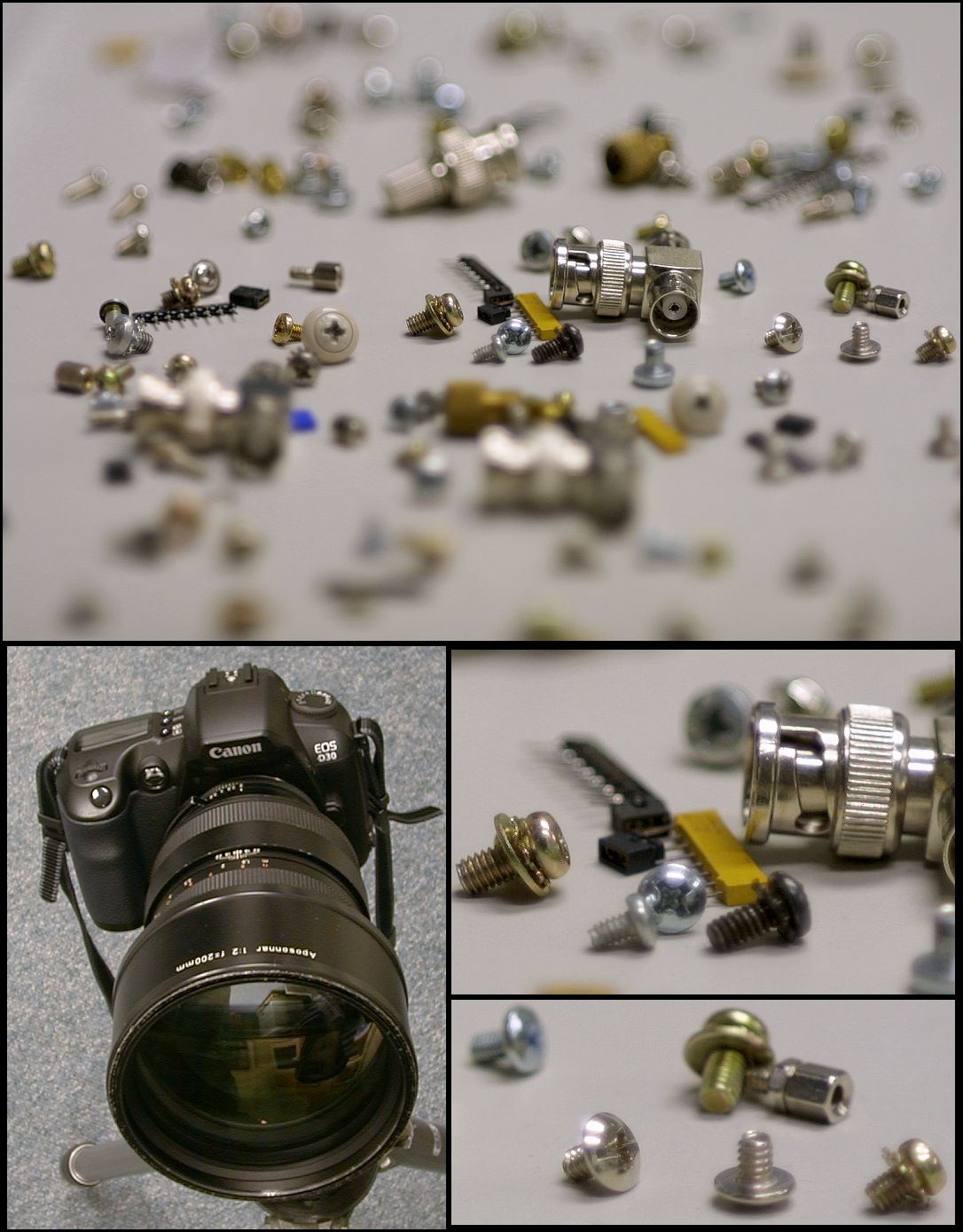
Can this lens hold to modern standards? Apparently it used special glass, but Zeiss didn’t specify how many elements were special. At the time, it was rated as apo-chromatic, does it still stands today?
How would you rate the lens in terms of sharpness at 2.0, bokeh and overall rendering? Compared to something like the Nikkor AF-S 200mm f/2 ED IF VR.
Is it a good idea to permanently convert this lens to Canon EF with a focus confirmation chip?
Is it a good idea to manual focus a lens of 2.7 kg? Will it work well with focus confirmation?
I already used:
Olympus OM 180mm 2.0
Canon EF 200mm 1.8L
Nikon AF-S 200mm 2.0G VRI
Canon EF 200mm 2.0L IS
Olympus OM 250mm 2.0
Even without having used the Zeiss 2/200 I would strongly recommend getting either the most recent Canon or Nikon.
They are significantly cheaper, offer AF, are smaller/lighter and most probably optically superior.
The recent Nikon and Canon lenses are also apochromatic, it is not a stand out feature in this class of lenses.
I do agree with BastianK: unless you have a good reason to prefer the Contax, experience with manually focusing such long lenses and will stick to static subjects, I would rather buy an AF one.
About the weight and dimensions:
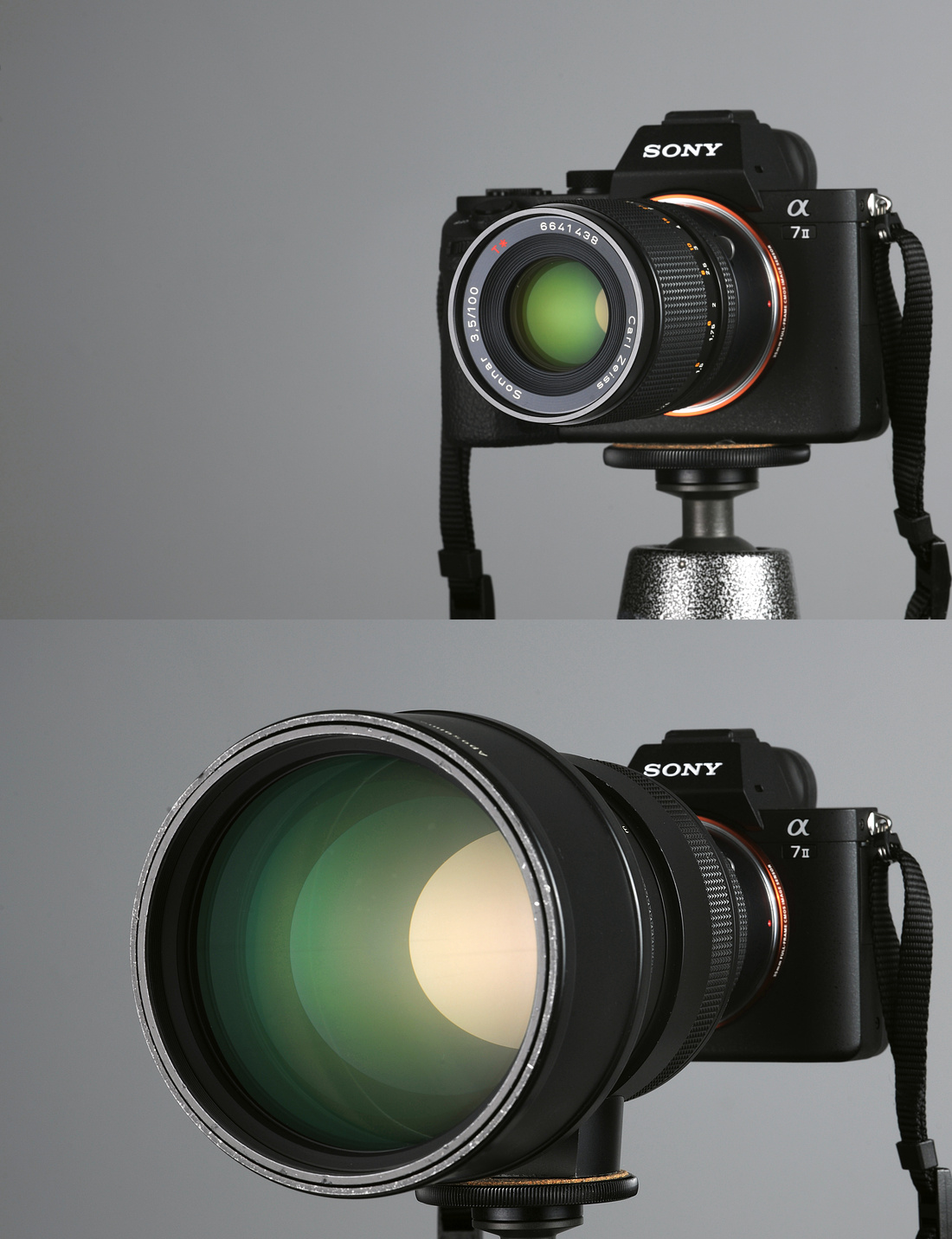
Zeiss 2/200 weights 2.7 kg hood included. Dimensions are 182 mm L x 120 mm W.
Nikon 200 f/2 VR weights 2.9 kg, without the hood. Dimensions are 204 mm L x 124 mm W.
Canon 200 f/1.8 weights 3.3 kg hood included. Dimensions are 208mm L x 130 mm W.
Nikon 200mm 2.0 VR I in good condition are around $3.500, lens introduced in 2004.
Canon 200mm 1.8 in good condition are around $3.000-3.500. Lens introduced in 1988, focus by wire. So, if AF dies the lens would be useless.
Basically this lenses are in the range of the Contax Zeiss 2/200 from 1992, which is probably better optically than the Canon 200mm 1.8L.
Canon optical formula seems more complex than Zeiss, but they count the protective glass and filter in their specifications, Zeiss and Nikon do not.
Igor Sotelo wrote:
Basically this lenses are in the range of the Contax Zeiss 2/200 from 1992, which is probably better optically than the Canon 200mm 1.8L.
Why would you even think that?
I have absolutely zero reason to believe that.
I’m well used with manual focus on Nikon DSLR cameras. Before that, for 3 decades I used manual focus lenses. However, I’m not sure one can hand hold the Contax lens and focus, maybe not without a monopod or a tripod.
But manual focus may be tricky on the Contax 2/200. In the 180mm 2.8 ED AI-S or the APO Sonnar 2/135 the slightest movement of focus ring will change the the lights in a Nikon body. From the pictures, it seems the Contax 2/200 focus throw is only around 90 degrees, which further complicates the focusing.
BastianK wrote:
Why would you even think that?
I have absolutely zero reason to believe that.
Because they had 4 years to check Canon’s design, also with what Zeiss charged for their lenses, they could had access to better quality special glass. Zeiss also seems to have more know how than Canon in lenses.
Igor Sotelo wrote:
Because they had 4 years to check Canon’s design, also with what Zeiss charged for their lenses, they could had access to better quality special glass. Zeiss also seems to have more know how than Canon in lenses.
Those are very "interesting" arguments.
I guess I will not waste my time further indulging into this discussion.
Igor Sotelo wrote:
Because they had 4 years to check Canon’s design, also with what Zeiss charged for their lenses, they could had access to better quality special glass. Zeiss also seems to have more know how than Canon in lenses.
This is something you want to believe but it does not make it true. People who actually used these lenses do not concur (see the links).
BTW, one could also say that Canon building much more lenses than Zeiss can afford the same glass at a lower price because of the quantity they order. Or that they know better how to optimize their productions lines to lower the cost.
And they built excellent lenses over the years, some as good as Zeiss or Leica so choosing a specific one because of the brand is not rational.
pmeheut wrote:
This is something you want to believe but it does not make it true. People who actually used these lenses do not concur (see the links).
BTW, one could also say that Canon building much more lenses than Zeiss can afford the same glass at a lower price because of the quantity they order. Or that they know better how to optimize their productions lines to lower the cost.
And they built excellent lenses over the years, some as good as Zeiss or Leica so choosing a specific one because of the brand is not rational.
Here’s another link where Ching-Kuang Shene in his tests from 2018 of his collection of 180/200mm fast primes, concludes the Contax Zeiss Aposonnar 2/200 is the best lens in his opinion (test includes also Nikkor AF-S 200mm f/2.0 ED IF VR):
I enjoy manual focusing, so that’s not an important factor. When AF appeared, honestly I remember wondering, what for?
It can be adapted to Canon EF with a mount on top of the actual one with larger screws. Also one could use simple adapters for Canon or Sony. I’m not sure how it goes when the lens is stopped down on Canon DSLR’s, though.
In the thread from 2011, someone references to a 2004 thread to show how bad is the bokeh, but the links to the photos expired and apparently he used a Canon D30, if I recall right, a 3 MP crop sensor camera.
It would be interesting to see the opinion of someone that has used the Contax Zeiss 2/200.
One cannot expect a lens designed decades ago to outperform the latest offerings, and performance of the Aposonnar 200/2 was already being matched by similar superteles from Canon, Nikon and Leica when it was released. I'm a CZ fanatic but this chubby has wretched b/g bokeh, and a stiff price. LCA is well corrected, however. The biggest problem is the very narrow DOF that makes manual focus difficult for anything dynamic—live stage for example.
Sony A7ii, CZ Aposonnar wide open. Of course, it is well built and looks impressive.
In this shooting scenario I now use something with AF like the Nikkor 300/2.8 AF-I or 70-200/2.8E.
I have an Olympus OM 180mm f/2. I wouldn't use any other MF lens of this speed & focal length simply because its the only one that's less than 2kg.
The most effective way to shoot such lenses is in burst mode to assure at least a couple in focus shots. I got the Olympus for a price that I'll likely never see again. I sometimes debate whether selling it for a profit and getting an AF version would be the smart move.
Maybe isn’t a great moment to buy a 200mm f/2 lens right now. Except for the Nikkor 200mm f/2 ED IF AI-S launched in 1977, that’s not good @ f/2, all other options are very expensive.
rico wrote:
One cannot expect a lens designed decades ago to outperform the latest offerings, and performance of the Aposonnar 200/2 was already being matched by similar superteles from Canon, Nikon and Leica when it was released. I'm a CZ fanatic but this chubby has wretched b/g bokeh, and a stiff price. LCA is well corrected, however. The biggest problem is the very narrow DOF that makes manual focus difficult for anything dynamic—live stage for example.
Igor Sotelo wrote:
Could you please post a picture to see how the bokeh looks. It looks fine in the second photo, was that at f/2?
Do you think one won’t miss a 200mm f/2 with a 85mm 1.2L, 70-200mm 2.8L IS II and 300mm 2.8L? Or it produces special rendering.
Is it a good idea to convert the Zeiss 2/200 for Contax permanently to Canon EF? Will an adapter bend?
All pics were wide open. The AS200 has a large rear "shark fin" that damages the EF mirror box. I stopped using it on my Canon bodies for that reason. When the mirrorless A7ii arrived I could finally mount all my C/Y lenses without concern. The Canon R and Nikon Z are also suitable. If you want super-shallow DOF then there are other options near this FL like the latest 135/1.8 teles from Sony and Sigma, or move up to 300/2.8. The exact need for 200/2 seems pretty infrequent.
Canon D30 (APS-C), CZ AS200 wide open. This is the only bokeh test I have online. Note the sharpness and color correction is fine, even off-axis. Foreground bokeh is also good, but b/g has so-called "ni sen" bokeh where the point spread exhibits a bright ring and chromatic nonunifority. Modern designs fix these problems.
rico wrote:
All pics were wide open. The AS200 has a large rear "shark fin" that damages the EF mirror box. I stopped using it on my Canon bodies for that reason. When the mirrorless A7ii arrived I could finally mount all my C/Y lenses without concern. The Canon R and Nikon Z are also suitable. If you want super-shallow DOF then there are other options near this FL like the latest 135/1.8 teles from Sony and Sigma, or move up to 300/2.8. The exact need for 200/2 seems pretty infrequent.
Canon D30 (APS-C), CZ AS200 wide open. This is the only bokeh test I have online. Note the sharpness and color correction is fine, even off-axis. Foreground bokeh is also good, but b/g has so-called "ni sen" bokeh where the point spread exhibits a bright ring and chromatic nonunifority. Modern designs fix these problems....Show more →
Thanks for posting. Those artifacts in the background seem strange, indeed. I remember one YouTuber calls those artifacts speculars and APO lenses aren’t supposed to show them.
Leitax has some tool to check if the lens will obstruct the mirror of 5D/6D cameras and if so have some procedures to reduce to profile of the lens. Honestly wouldn’t feel right to modify such a fine lens as the Contax Zeiss Aposonnar 2/200. It seems that buying an C/Y to FE adapter and using my Sony A7R II would eventually be the better route.
I have the APO Sonnar 2/135 for my Nikon DSLR’s, Optical Limits made their tests, it shows similar bokeh to the Nikkor AF-S 200mm f/2.0G ED IF VR when composed similarly. The Nikkor AF-S 105mm f/1.4E ED has indistinguishable bokeh when composed similarly.
Perhaps a 200mm f/2 lens isn’t a must have, specially at actual prices. Hopefully those go down once the Z and RF versions get launched. I doubt the Contax lens will reduce in price, but Nikon and Canon versions will probably.