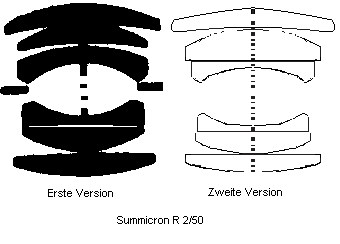
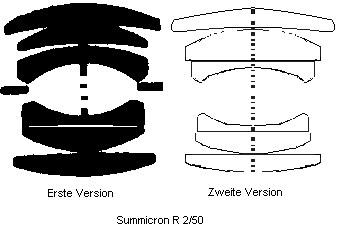
\"The current Summicron-R is almost identical in optical construction with its counterpart in the M-system. It is one of the two or three best standard lenses in the world. The predecessor from 1964 was balanced for high contrast at wide openings. The disadvantage of the design was a slight shift of focus when stopping down, that resulted in the best sharpness zone shifting from center to a zone outside of the center. The current version is a bit less contrasty at full aperture, but performs better when stopping down, and its image quality is more evenly distributed over the whole image area. Stopped down to f/4 the lens already delivers its best performance.\" Source: Erwin Puts
\"The current Summicron-R is almost identical in optical construction with its counterpart in the M-system. It is one of the two or three best standard lenses in the world. The predecessor from 1964 was balanced for high contrast at wide openings. The disadvantage of the design was a slight shift of focus when stopping down, that resulted in the best sharpness zone shifting from center to a zone outside of the center. The current version is a bit less contrasty at full aperture, but performs better when stopping down, and its image quality is more evenly distributed over the whole image area. Stopped down to f/4 the lens already delivers its best performance.\" Source: Erwin Puts
\"The current Summicron-R is almost identical in optical construction with its counterpart in the M-system. It is one of the two or three best standard lenses in the world. The predecessor from 1964 was balanced for high contrast at wide openings. The disadvantage of the design was a slight shift of focus when stopping down, that resulted in the best sharpness zone shifting from center to a zone outside of the center. The current version is a bit less contrasty at full aperture, but performs better when stopping down, and its image quality is more evenly distributed over the whole image area. Stopped down to f/4 the lens already delivers its best performance.\" Source: Erwin Puts
\"The current Summicron-R is almost identical in optical construction with its counterpart in the M-system. It is one of the two or three best standard lenses in the world. The predecessor from 1964 was balanced for high contrast at wide openings. The disadvantage of the design was a slight shift of focus when stopping down, that resulted in the best sharpness zone shifting from center to a zone outside of the center. The current version is a bit less contrasty at full aperture, but performs better when stopping down, and its image quality is more evenly distributed over the whole image area. Stopped down to f/4 the lens already delivers its best performance.\" Source: Erwin Puts
\"The current Summicron-R is almost identical in optical construction with its counterpart in the M-system. It is one of the two or three best standard lenses in the world. The predecessor from 1964 was balanced for high contrast at wide openings. The disadvantage of the design was a slight shift of focus when stopping down, that resulted in the best sharpness zone shifting from center to a zone outside of the center. The current version is a bit less contrasty at full aperture, but performs better when stopping down, and its image quality is more evenly distributed over the whole image area. Stopped down to f/4 the lens already delivers its best performance.\" Source: Erwin Puts
\"The current Summicron-R is almost identical in optical construction with its counterpart in the M-system. It is one of the two or three best standard lenses in the world. The predecessor from 1964 was balanced for high contrast at wide openings. The disadvantage of the design was a slight shift of focus when stopping down, that resulted in the best sharpness zone shifting from center to a zone outside of the center. The current version is a bit less contrasty at full aperture, but performs better when stopping down, and its image quality is more evenly distributed over the whole image area. Stopped down to f/4 the lens already delivers its best performance.\" Source: Erwin Puts
\"The current Summicron-R is almost identical in optical construction with its counterpart in the M-system. It is one of the two or three best standard lenses in the world. The predecessor from 1964 was balanced for high contrast at wide openings. The disadvantage of the design was a slight shift of focus when stopping down, that resulted in the best sharpness zone shifting from center to a zone outside of the center. The current version is a bit less contrasty at full aperture, but performs better when stopping down, and its image quality is more evenly distributed over the whole image area. Stopped down to f/4 the lens already delivers its best performance.\" Source: Erwin Puts
\"The current Summicron-R is almost identical in optical construction with its counterpart in the M-system. It is one of the two or three best standard lenses in the world. The predecessor from 1964 was balanced for high contrast at wide openings. The disadvantage of the design was a slight shift of focus when stopping down, that resulted in the best sharpness zone shifting from center to a zone outside of the center. The current version is a bit less contrasty at full aperture, but performs better when stopping down, and its image quality is more evenly distributed over the whole image area. Stopped down to f/4 the lens already delivers its best performance.\" Source: Erwin Puts
\"The current Summicron-R is almost identical in optical construction with its counterpart in the M-system. It is one of the two or three best standard lenses in the world. The predecessor from 1964 was balanced for high contrast at wide openings. The disadvantage of the design was a slight shift of focus when stopping down, that resulted in the best sharpness zone shifting from center to a zone outside of the center. The current version is a bit less contrasty at full aperture, but performs better when stopping down, and its image quality is more evenly distributed over the whole image area. Stopped down to f/4 the lens already delivers its best performance.\" Source: Erwin Puts
\"The current Summicron-R is almost identical in optical construction with its counterpart in the M-system. It is one of the two or three best standard lenses in the world. The predecessor from 1964 was balanced for high contrast at wide openings. The disadvantage of the design was a slight shift of focus when stopping down, that resulted in the best sharpness zone shifting from center to a zone outside of the center. The current version is a bit less contrasty at full aperture, but performs better when stopping down, and its image quality is more evenly distributed over the whole image area. Stopped down to f/4 the lens already delivers its best performance.\" Source: Erwin Puts
\"The current Summicron-R is almost identical in optical construction with its counterpart in the M-system. It is one of the two or three best standard lenses in the world. The predecessor from 1964 was balanced for high contrast at wide openings. The disadvantage of the design was a slight shift of focus when stopping down, that resulted in the best sharpness zone shifting from center to a zone outside of the center. The current version is a bit less contrasty at full aperture, but performs better when stopping down, and its image quality is more evenly distributed over the whole image area. Stopped down to f/4 the lens already delivers its best performance.\" Source: Erwin Puts
\"The current Summicron-R is almost identical in optical construction with its counterpart in the M-system. It is one of the two or three best standard lenses in the world. The predecessor from 1964 was balanced for high contrast at wide openings. The disadvantage of the design was a slight shift of focus when stopping down, that resulted in the best sharpness zone shifting from center to a zone outside of the center. The current version is a bit less contrasty at full aperture, but performs better when stopping down, and its image quality is more evenly distributed over the whole image area. Stopped down to f/4 the lens already delivers its best performance.\" Source: Erwin Puts
\"The current Summicron-R is almost identical in optical construction with its counterpart in the M-system. It is one of the two or three best standard lenses in the world. The predecessor from 1964 was balanced for high contrast at wide openings. The disadvantage of the design was a slight shift of focus when stopping down, that resulted in the best sharpness zone shifting from center to a zone outside of the center. The current version is a bit less contrasty at full aperture, but performs better when stopping down, and its image quality is more evenly distributed over the whole image area. Stopped down to f/4 the lens already delivers its best performance.\" Source: Erwin Puts
\"The current Summicron-R is almost identical in optical construction with its counterpart in the M-system. It is one of the two or three best standard lenses in the world. The predecessor from 1964 was balanced for high contrast at wide openings. The disadvantage of the design was a slight shift of focus when stopping down, that resulted in the best sharpness zone shifting from center to a zone outside of the center. The current version is a bit less contrasty at full aperture, but performs better when stopping down, and its image quality is more evenly distributed over the whole image area. Stopped down to f/4 the lens already delivers its best performance.\" Source: Erwin Puts
\"The current Summicron-R is almost identical in optical construction with its counterpart in the M-system. It is one of the two or three best standard lenses in the world. The predecessor from 1964 was balanced for high contrast at wide openings. The disadvantage of the design was a slight shift of focus when stopping down, that resulted in the best sharpness zone shifting from center to a zone outside of the center. The current version is a bit less contrasty at full aperture, but performs better when stopping down, and its image quality is more evenly distributed over the whole image area. Stopped down to f/4 the lens already delivers its best performance.\" Source: Erwin Puts
\"The current Summicron-R is almost identical in optical construction with its counterpart in the M-system. It is one of the two or three best standard lenses in the world. The predecessor from 1964 was balanced for high contrast at wide openings. The disadvantage of the design was a slight shift of focus when stopping down, that resulted in the best sharpness zone shifting from center to a zone outside of the center. The current version is a bit less contrasty at full aperture, but performs better when stopping down, and its image quality is more evenly distributed over the whole image area. Stopped down to f/4 the lens already delivers its best performance.\" Source: Erwin Puts
Oct 09, 2008 at 06:33 PM
Previous versions of georgweb's message #6257782 « summicron R 50mm »