snapsy wrote: Pixel Perfect wrote: duncangr wrote: snapsy wrote: speedmaster20d wrote:
this should debunk the claim / speculation about A1 II is reading in 12 or 8 rows.
I think it's best to refrain from framing speculations / rumors as facts without solid proof.
Thanks for performing this test! While I said it was unlikely the a7rVI was reading only a single row at a time, it's even more unlikely for the A1. It's implausible the A1 is achieving its readout speeds with a single row readout - that would represent almost half an order of magnitude improvement in sensor technology, over just a single sensor generation. The fact the Z9 sensor has 12-row readouts makes it A1 not having exceedingly unlikely - the Z9 sensor has identical readout speeds as the A1 when normalized for their slight row count differences, indicating they're share the same core sensor IP.
I'm much more apt to believe the absence of the stair-case artifact in your A1 test indicates this particular ceiling fan / speed / arrangement / image noise is failing to manifest it or, more unlikely, that Sony is using one of the alternate, novel readout schemes I referenced from their patent and that this changed for the A1 II vs A1 I sensor.
I recently used an R5m2 shooting swallows and the jagis on the wings were clearly visible and awful.
I have seen this on the A9 where they are barely visible but have never seen this on any A1/A1ii or A9iii images - and I have many thousands from the A1 - the edges all appear to be consistently smooth like the edges in the fan images above.
A9 Jaggies
R5M2 Jaggies
EDIT:
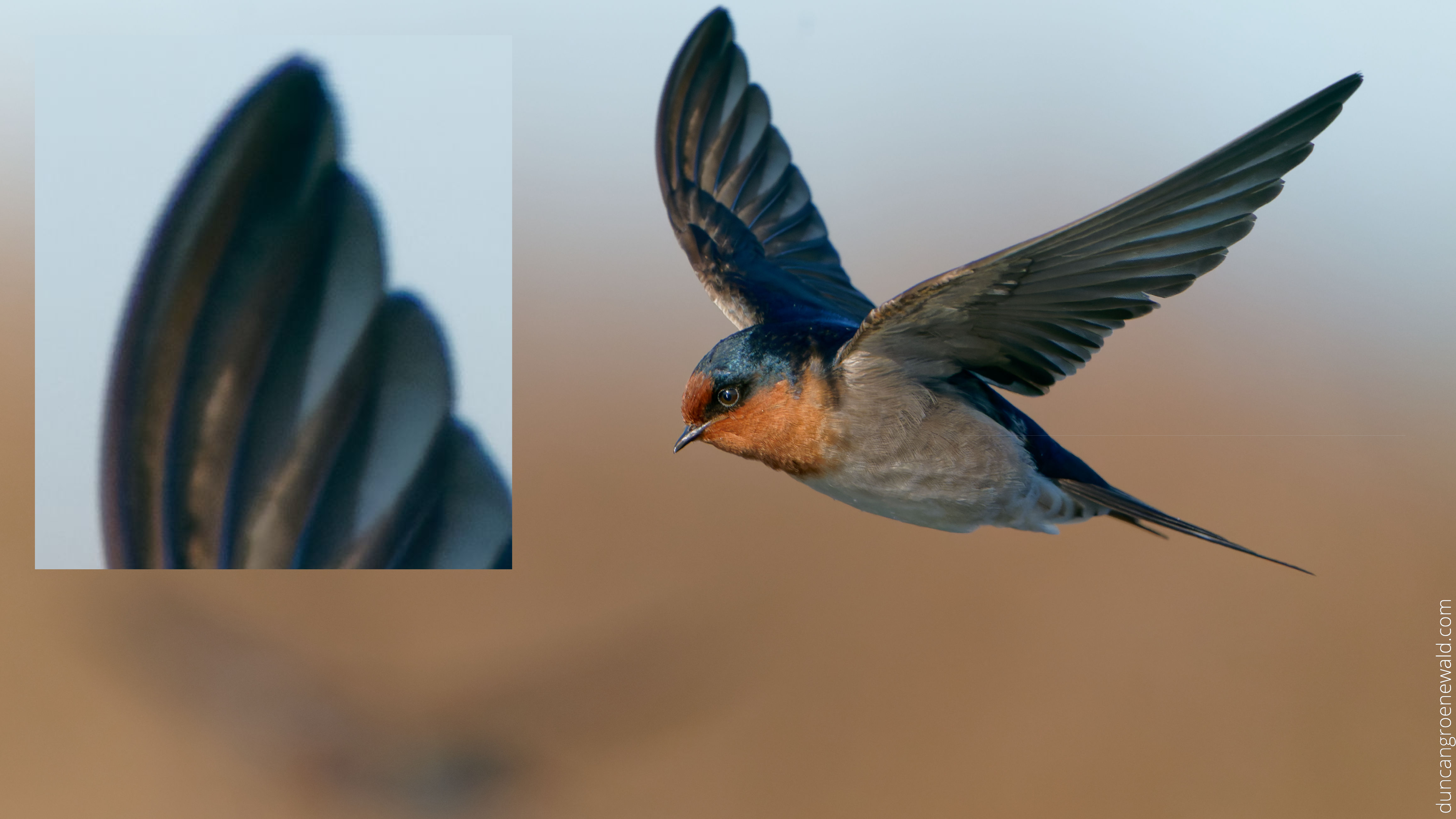
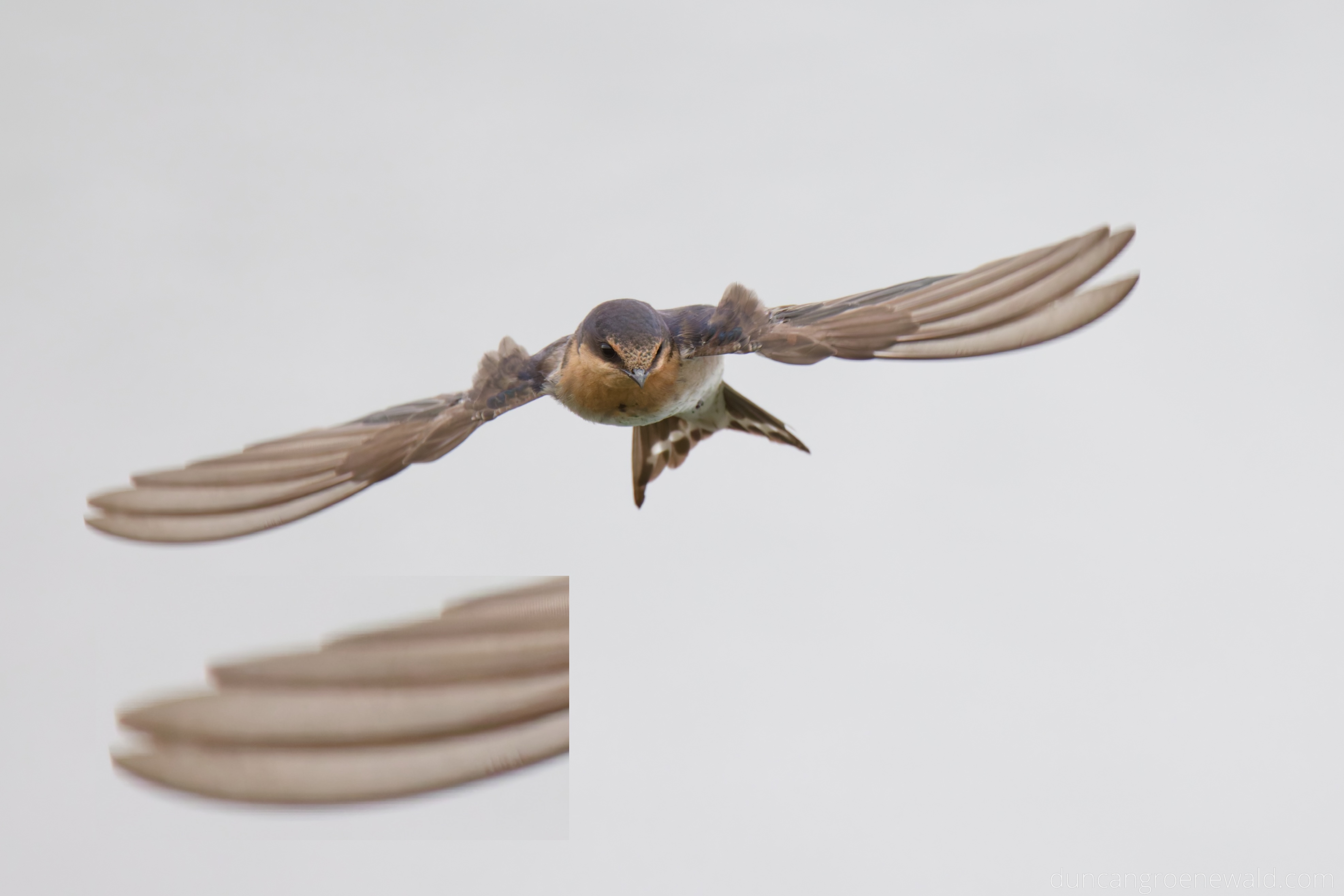
Couldn't find any evidence of these artifacts in the Z9 swallow images either.
Z9 sensor is a variant of the A1 sensor so no surprise there. I assume that R5II image is at high magnification and I can barely see the "horrible" jaggies and I doubt anyone would notice them at 100%. They look less than the A9 jaggies. I never ever noticed jaggies at all on my A9 in 40000 shots, but I never looked beyond 100%.
Z8/Z9 exhibits the 12-row staircase pattern, both in Jim Kasson's test and also in third-party flash photography. Which brings into question whether the Z8/Z9 share the same core sensor IP as the A1, which is something I previously assumed based on their nearly-identical readout times after normalizing for their row count differences.
it's too bad the blog owner is not here to comment. When I read his comments he does not claim to know what is causing this issue
"’I’m having a hard time figuring out just what’s happening, although it is pretty clear to me that the camera is performing analog to digital conversion on more than one row at a time."
as we know now the conversion can happen in parallel so this his second part of the statement can be true but neither is he saying nor can we conclude that the charge transfer itself is happening for groups of row... or that it is responsible for this artifact
I don't think we can explain this bizarre artifact very simply. In fact the patten looks as if there is something different between even and odd columns in those 12 rows... it seems as if one group of rows did not even readout or had their level shifter mess up .... but somehow it only shows up with moving light....
If we had access to the raw images, we could split each image into 2 images, one for even columns and one for off columns to see if the bands appear in just one or both images to shed more light....
It is very difficult to say what is causing this, but it this looks some kind of design bug, some kind unwanted effect that is not result of just rolling shutter.... whatever it was it seems to have been fixed ?
I am having a hard time even coming up with a theory
snapsy wrote: Pixel Perfect wrote: duncangr wrote: snapsy wrote: speedmaster20d wrote:
this should debunk the claim / speculation about A1 II is reading in 12 or 8 rows.
I think it's best to refrain from framing speculations / rumors as facts without solid proof.
Thanks for performing this test! While I said it was unlikely the a7rVI was reading only a single row at a time, it's even more unlikely for the A1. It's implausible the A1 is achieving its readout speeds with a single row readout - that would represent almost half an order of magnitude improvement in sensor technology, over just a single sensor generation. The fact the Z9 sensor has 12-row readouts makes it A1 not having exceedingly unlikely - the Z9 sensor has identical readout speeds as the A1 when normalized for their slight row count differences, indicating they're share the same core sensor IP.
I'm much more apt to believe the absence of the stair-case artifact in your A1 test indicates this particular ceiling fan / speed / arrangement / image noise is failing to manifest it or, more unlikely, that Sony is using one of the alternate, novel readout schemes I referenced from their patent and that this changed for the A1 II vs A1 I sensor.
I recently used an R5m2 shooting swallows and the jagis on the wings were clearly visible and awful.
I have seen this on the A9 where they are barely visible but have never seen this on any A1/A1ii or A9iii images - and I have many thousands from the A1 - the edges all appear to be consistently smooth like the edges in the fan images above.
A9 Jaggies
R5M2 Jaggies
EDIT:
Couldn't find any evidence of these artifacts in the Z9 swallow images either.
Z9 sensor is a variant of the A1 sensor so no surprise there. I assume that R5II image is at high magnification and I can barely see the "horrible" jaggies and I doubt anyone would notice them at 100%. They look less than the A9 jaggies. I never ever noticed jaggies at all on my A9 in 40000 shots, but I never looked beyond 100%.
Z8/Z9 exhibits the 12-row staircase pattern, both in Jim Kasson's test and also in third-party flash photography. Which brings into question whether the Z8/Z9 share the same core sensor IP as the A1, which is something I previously assumed based on their nearly-identical readout times after normalizing for their row count differences.
it's too bad the blog owner is not here to comment. When I read his comments he does not claim to know what is causing this issue
"’I’m having a hard time figuring out just what’s happening, although it is pretty clear to me that the camera is performing analog to digital conversion on more than one row at a time."
as we know now the conversion can happen in parallel so this his second part of the statement can be true but neither is he saying nor can we conclude that the charge transfer itself is happening for groups of row... or that it is responsible for this artifact
I don't think we can explain this bizarre artifact very simply. In fact the patten looks as if there is something different between even and odd columns in those 12 rows... it seems as if one group of rows did not even readout or had their level shifter mess up .... but somehow it only shows up with moving light....
If we had access to the raw images, we could split each image into 2 images, one for even columns and one for off columns to see if the bands appear in just one or both images to shed more light....
It is very difficult to say what is causing this, but it this looks some kind of design bug, some kind unwanted effect that is not result of just rolling shutter.... whatever it was it seems to have been fixed ?
snapsy wrote: Pixel Perfect wrote: duncangr wrote: snapsy wrote: speedmaster20d wrote:
this should debunk the claim / speculation about A1 II is reading in 12 or 8 rows.
I think it's best to refrain from framing speculations / rumors as facts without solid proof.
Thanks for performing this test! While I said it was unlikely the a7rVI was reading only a single row at a time, it's even more unlikely for the A1. It's implausible the A1 is achieving its readout speeds with a single row readout - that would represent almost half an order of magnitude improvement in sensor technology, over just a single sensor generation. The fact the Z9 sensor has 12-row readouts makes it A1 not having exceedingly unlikely - the Z9 sensor has identical readout speeds as the A1 when normalized for their slight row count differences, indicating they're share the same core sensor IP.
I'm much more apt to believe the absence of the stair-case artifact in your A1 test indicates this particular ceiling fan / speed / arrangement / image noise is failing to manifest it or, more unlikely, that Sony is using one of the alternate, novel readout schemes I referenced from their patent and that this changed for the A1 II vs A1 I sensor.
I recently used an R5m2 shooting swallows and the jagis on the wings were clearly visible and awful.
I have seen this on the A9 where they are barely visible but have never seen this on any A1/A1ii or A9iii images - and I have many thousands from the A1 - the edges all appear to be consistently smooth like the edges in the fan images above.
A9 Jaggies
R5M2 Jaggies
EDIT:
Couldn't find any evidence of these artifacts in the Z9 swallow images either.
Z9 sensor is a variant of the A1 sensor so no surprise there. I assume that R5II image is at high magnification and I can barely see the "horrible" jaggies and I doubt anyone would notice them at 100%. They look less than the A9 jaggies. I never ever noticed jaggies at all on my A9 in 40000 shots, but I never looked beyond 100%.
Z8/Z9 exhibits the 12-row staircase pattern, both in Jim Kasson's test and also in third-party flash photography. Which brings into question whether the Z8/Z9 share the same core sensor IP as the A1, which is something I previously assumed based on their nearly-identical readout times after normalizing for their row count differences.
it's too bad the blog owner is not here to comment. When I read his comments he does not claim to know what is causing this issue
"’I’m having a hard time figuring out just what’s happening, although it is pretty clear to me that the camera is performing analog to digital conversion on more than one row at a time."
as we know now the conversion can happen in parallel so this his second part of the statement can be true but neither is he saying nor can we conclude that the charge transfer itself is happening for groups of row... or that it is responsible for this artifact
I don't think we can explain this bizarre artifact this simply. In fact the patten looks as if there is something different between even and odd columns in those 12 rows.
If we had access to the raw images, we could split each image into 2 images, one for even columns and one for off columns to see if the bands appear in just one or both images to shed more light....
It is very difficult to say what is causing this, but it this looks some kind of design bug, some kind unwanted effect that is not result of just rolling shutter.... whatever it was it seems to have been fixed