Re: The End of Printing - Digital Picture Frame (near) Perfection
Jim Dockery wrote:
This is the culmination of a lot of thought over the years on, "What to do with all the dang pictures I take?!!". For the most part I am the only one who sees most of them while I'm processing (at times I call my wife down to my computer room to view). In many ways that is enough - like most of you I get a lot of pleasure from the whole process, but it does make me wonder why I spend so much money and time on it. I share some phone shots to update friends and family while we are on trips, and I post Google Albums to share with my climbing/ski partners after a trip. I also make computer slide shows for those partners, and to show mostly to my wife on our TV. After that though they get filed away on various back-ups that I rarely revisit.
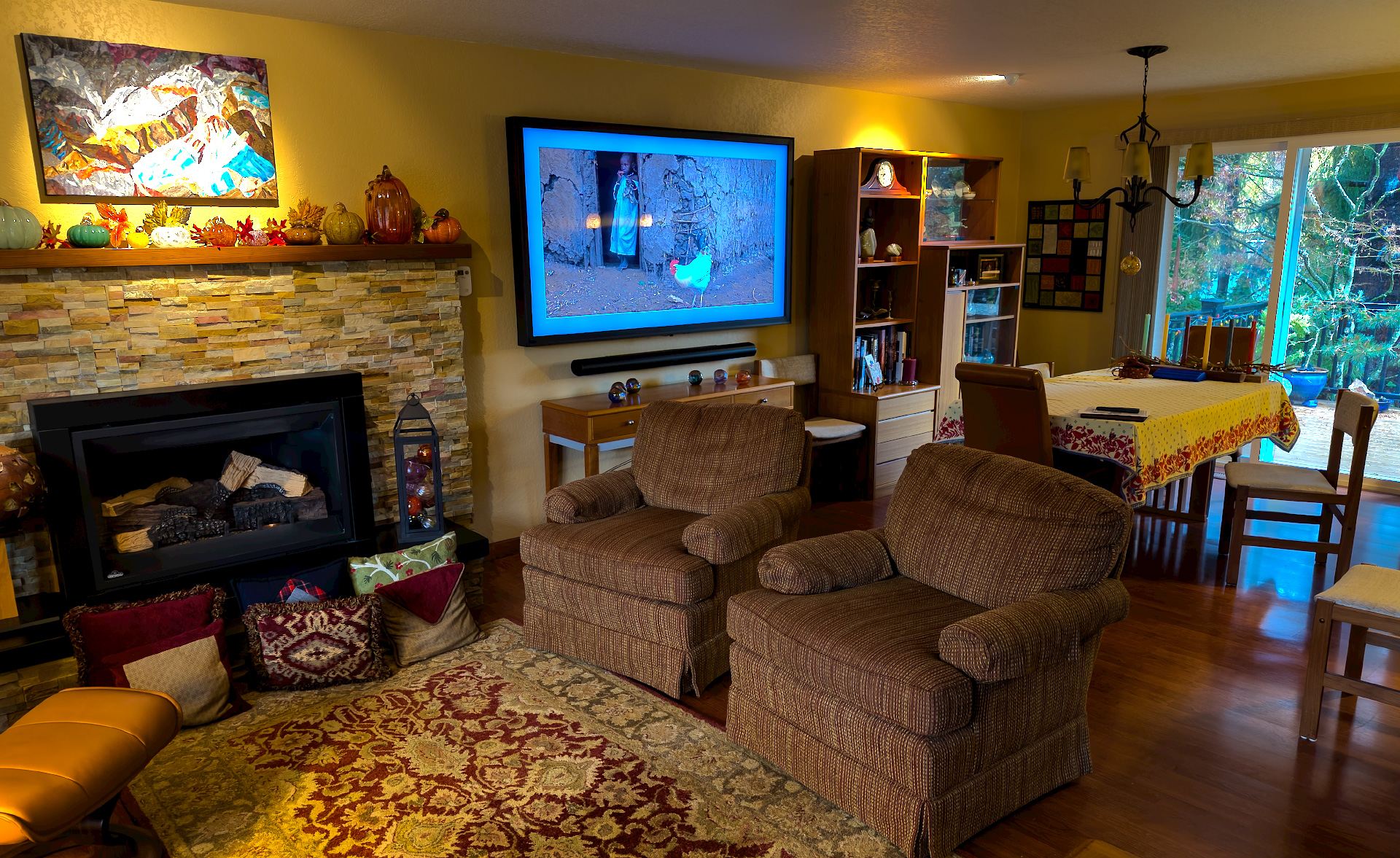
I've done a lot of printing over the years, so our walls have many of my pictures, but I sold my Epson 7900 years ago and haven't printed any of my new work. My wife and I have been talking about getting a large acrylic print made for our living room, but couldn't decided on a picture. The cost would mean it would likely be a once in a life time purchase. The digital frame set-up shown below cost much more, but can show unlimited pictures, and of course doubles as a TV.
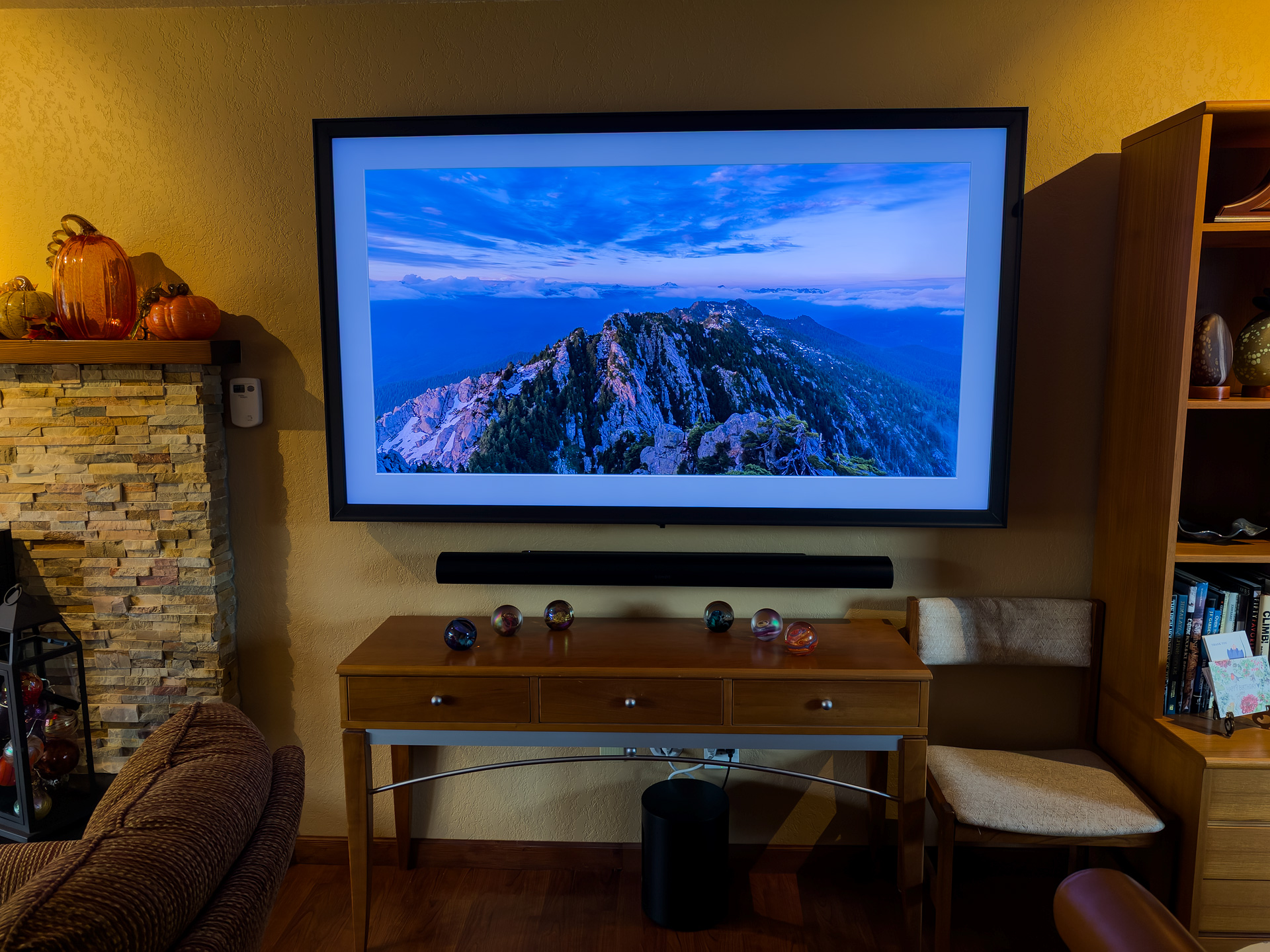
A while back I posted about setting up a TV as a digital picture frame. At the time I was undecided on brand and size, but had decided against Samsung's The Frame. When I called B&H to discuss they gave me a good price on a 75" Sony Bravia 9 along with a Sonos sound system (Arc Ultra soundbar, mini-sub, 2 x Era 300) so I decided to get us an early Christmas present.
I hired an excellent installer to mount the TV and sound bar with hidden wires using this system. The TV is mounted using a Sanus Full Motion Mount so that on the rare occasions that my wife and I might want to watch TV in this room we can pull it out and turn it toward our seating.
We had the TV up for a week running the media player on the TV to show my pictures that were loaded on a memory stick in the USB port on back of the TV. I was blown away by the picture quality - pretty much the way I processed them on my computer. There are some refections if many nearby lights are turned on (more than Samsung's matte finish) but with window light it is perfection.
The final touch was installing the Leon Studio Frame that runs an art mode (with optional mats) on the TV with an on/off based on motion detection. It took a while to dial in the software, and I'm disappointed with the 20 picture limit on how many of your own pictures you can upload to the TV at a time, but they can be pretty easily changed at any time from a memory stick. It would be great if they could set-up a cloud based gallery where you could upload more pictures. I've written them with this idea.
Sonos soundbar under TV
One constraint in using this system is to maximize the screen a 16/9 ratio works best. I have 4K crop set up in Photoshop now and an action to save the resulting jpg to a folder dedicated to TV pictures. It is fun to go back and find the best crop on my older pictures.
A few things…
While a photograph, properly made and processed, can look great on a screen… it will never look the same as a printed photograph. As a friend notes, the screen image “glows from within” while the top-lit print relies on the brightness of the underlying paper and the capability of inks. So a screen image will never look exactly like a printed image and vice versa.
While I’m not at all against using a screen to display photographs, the experience is different in some other ways, too, at least if you use the screen presentation as most people seem to — to cycle through a set of best photographs. A single print on the wall has a physical presence, and because it is always there awaiting your active engagement with it, it eventually becomes a part of your environment in a very specific way. On the other hand, a screen used to present a rotating set of images doesn’t have this kind of “solidity” — it is more of a show than an image.
I don’t know it it an asset or a liability, but it is easier to make a photograph that looks good on a screen than to make one that looks good as a print.
As to the “end of printing,” while it may well mark an end to your ptinting (and I can understand your perspective) I think it would be premature to predict that the we are seeing the end of singular prints.
YMMV.
- - -
Imagemaster wrote:
That must be such a hardship for you, an expert on everything.
Now THAT is spectacularly ironic!
Nov 18, 2025 at 10:39 PM
Previous versions of gdanmitchell's message #16931681 « The End of Printing - Digital Picture Frame (near) Perfection »