Stefan Official
Offline
Upload & Sell: Off
|
 Buying a High-End Camera at a Lower Price – My Experience with Panamoz and Grey Imports Buying a High-End Camera at a Lower Price – My Experience with Panamoz and Grey Imports | |
First of all, I hope that posting this here in the forum is okay. I want to clarify that I receive nothing from the mentioned retailer. This is not an advertisement—I'm just very satisfied with my purchase and can absolutely recommend it. My recommendation is based on my personal experience after receiving and thoroughly testing the hardware.
The decision to buy a high-quality camera is often associated with high costs, especially in countries like Germany, where prestige and brand value play a significant role. After extensive research, I found a way to purchase a brand-new Sony A7R V and a Sony 28-70mm f/2.0 at a price €1,800 and €900 cheaper than the German market price. In this report, I want to share my experience of how buying through Panamoz worked wonderfully, why grey imports can be a sensible option, and what to watch out for.
But how is this even possible?
There are specialized international retailers who buy cameras in large quantities from Japan. Since export sales are exempt from VAT, the cameras are then shipped to Hong Kong, a duty-free zone. In Hong Kong, there are neither customs duties nor sales taxes. From there, the cameras are sent to the small offices or warehouses of these dealers, which are spread across different continents. In my case, there is a small office in Bonn. For us as customers, the shipping appears just like a regular domestic shipment—we only see the last part of the journey, making it seem like a standard local delivery.
But why are the cameras so cheap?
In Japan, the home market of Sony, Fuji, Canon, Nikon, and other manufacturers, competition is fierce. Photography is deeply embedded in Japanese culture, and many people there own high-quality cameras. Unlike in Germany, the trend of using smartphones for photography has not taken over as strongly. Photography is considered an art form in Japan. Additionally, the Japanese place great importance on price-performance ratio; prestige and status symbols are not as prominent as in Germany.
As a result, price differences between entry-level and high-end cameras in Japan are often only around €500, whereas in Germany, the price hike can quickly reach €3,000 or more.
In Germany, unfortunately, prestige plays a much greater role. Buyers often choose a camera that is only slightly better but not €3,000 better than an entry-level model—simply to own a ‘high-end’ product. The feeling of owning something luxurious, indulging oneself, prestige, and status symbols are deeply ingrained here. This mentality may have been shaped by our automotive industry, which thrives on status symbols. You wouldn’t believe how defensive people get when you tell them that you bought their camera for €2,000 less or that the real difference between models isn’t as big as the price suggests.
Production and Pricing Strategy
Sony, for example, manufactures many of its cameras in Thailand, where the daily wage is about €10. The production costs are relatively low. However, when selling in Germany, a price of €4,000 or €8,000 is set as soon as the camera is perceived as a prestige item in a given country.
Manufacturers operate globally but restrict regional sales as if their products were made locally. Large corporations do everything to maximize their profits!
What are Grey Imports?
The term "grey import" has been burdened with negative connotations by major corporations for decades. They suggest that these cameras are not intended for the local market, differ in some way, and do not come with a warranty. Yes, those mysterious, ominous differences—people don’t buy what they don’t understand. This tactic effectively deters many consumers, which is exactly what companies want to achieve.
The reality is different: These cameras come from the same production lines, and their serial numbers are well known to the manufacturers. Language settings are artificially restricted in the firmware, so that German is only available if the camera is officially designated for the German market. However, German menus are often poorly translated, with long or strangely abbreviated terms. That’s why I recommend setting the camera to English—it’s much more comprehensible.
There are tools for Sony cameras (probably also for the other manufacturers) to add all 39 languages to the Sony firmware: https://github.com/ma1co/Sony-PMCA-RE
Even if I don't need it, my camera now has German available again.
A good guide can be found here, sounds more difficult than it is:
https://www.reddit.com/r/SonyAlpha/comments/18fb0d8/language_unlock_on_newer_alpha_cameras_a6400/?utm_source=embedv2&utm_medium=post_embed&embed_host_url=https://www.grillsportverein.de/forum/threads/erfahrungsbericht-meine-neue-kamera-und-der-kauf-ueber-panamoz-hongkong-mit-1800eur-preisvorteil.377431/&rdt=55133
I spent about 30 minutes downloading, setting up the USB stick and booting Linux and changing the camera firmware.
There are a few small errors in the instructions with the commands under Linux, nothing dramatic, here is the corrected version from me:
sudo su
sudo apt update
sudo apt install git
sudo apt install python3-tk
sudo apt install python3-pip
git clone https://github.com/ma1co/Sony-PMCA-RE
cd Sony-PMCA-RE
python3 -m venv venv
source venv/bin/activate
pip install -r requirements.txt
./pmca-gui.py
How Manufacturers Control Markets to Their Advantage
By establishing a fixed dealer network with binding price agreements, allowing only official German retailers to receive the German menu language, and rejecting warranty claims for grey imports, companies effectively eliminate price competition. This way, Sony, Canon, and the like can dictate prices according to market demand—with only minor competition between them.
Yes, major corporations operate globally, produce where it’s cheapest, but sell regionally as if their products were made locally. However, consumers can also act globally when making purchases—there is nothing unethical about grey imports.
With a price saving of €2,700, I simply feel ripped off by the local market. That’s where my patience ends.
Why Panamoz?
After a lot of research, I decided in favour of Panamoz (tip: switch to euros). This dealer offers a 3-year warranty, while a few other reputable dealers are often a little cheaper but without a warranty. Panamoz has been active for 16 years, has absolutely excellent reviews and is very accommodating. If a repair is necessary, Panamoz either covers the costs or replaces the camera. The support is very fast and you get an answer to all your mails without any text blocks,
Final Prices Include All Taxes & Duties
The prices displayed on the Panamoz website are final consumer prices that already include all necessary import duties and taxes for the EU. Panamoz handles everything—you don’t have to worry about customs, additional VAT, or hidden costs.
Do you remember prestige and status in Germany? Entry-level cameras and inexpensive lenses are often just as expensive in Japan as they are in Germany. But always at the high-end, e.g. a telephoto lens as a fixed focal length, from then on you can really save money.
Update: Camera & Lens Tested in Detail
I have now put my Sony A7R V and the Sony 28-70mm f/2.0 through extensive testing—which I would also do if I had bought it in Germany.
Camera Inspection
Everything is perfect:
Build quality: No gaps, no creaking, flawless fit and finish.
Shutter sound: Sounds clean and consistent.
Button feel: Well-defined pressure points.
Display & EVF: No dead pixels.
Autofocus: Spot on—even at f/1.4, no front/back focus.
No dust visible at f/16.
Image stabilization & noise performance: Exactly as expected.
🔹 Final Verdict: 100/100 points. I am extremely picky, but there is not a single flaw. Sony, you did well.
Lens Inspection
Packaging: Everything was perfectly packed.
Build quality:
Optically flawless—no dust inside or outside.
Smooth, silent focusing.
Well-defined buttons & switches.
Adjustable zoom resistance—something I haven’t seen before in my lenses.
Image quality: First test photos show no weaknesses.
Delivery Time
The camera took 12 days, the lens arrived in just 7 days from Hong Kong.
Panamoz responds to emails within minutes.
Checking Shutter Count
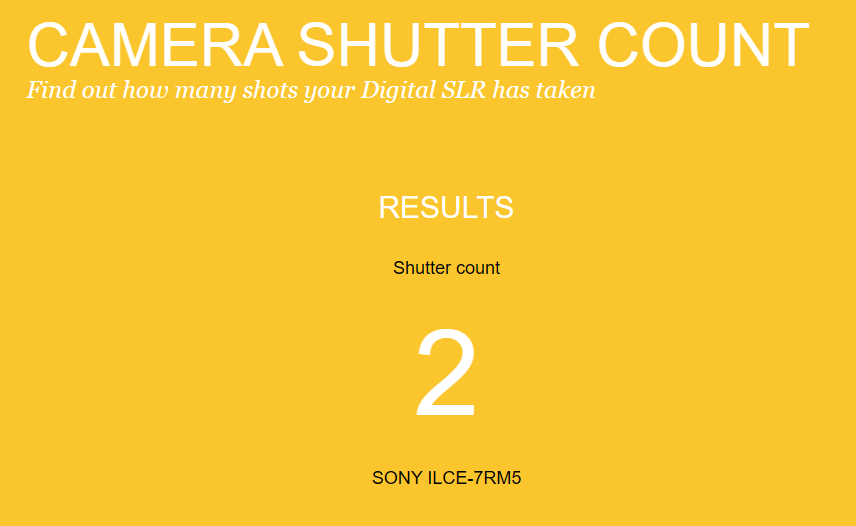
For those who want to verify the shutter count of their new camera, you can use camerashuttercount.com. As far as I know, there is no known way to manipulate this data.
I took my first photo, uploaded the RAW file, and checked the camera’s shutter count.
Only one image had been taken before it left the factory—exactly as expected!
Regional Experience – Europe
I can only speak from my experience in Europe, but it is very likely that similar principles apply in other continents. If Panamoz or similar dealers operate in your country, the price advantage and process should be comparable.
✅ Final Verdict: Highly recommended!
|


