fredmiranda.com
Login


  Previous versions of tsdevine's message #15529267 « Official: Voigtlander 35mm f/2 APO-Lanthar announced! »


tsdevine
Online
Upload & Sell: On
Re: Official: Voigtlander 35mm f/2 APO-Lanthar announced!


That came from Kolari via Lloyd Chambers, but I agree that Vivek's test doesn't support that. Maybe it starts up near 420nm...but it doesn't do a hard cut there. In published content, Kolari puts Sony around 409nm, which puts it lower than any other major manufacturer. Fuji is up at 422nm.

https://kolarivision.com/uv-filter-effectiveness-article/

And still, if we go by Vivek's test, the stack filtering fits within the Kenko curve, or is so close to it in portions you can't differentiate. The only wavelengths where the Kenko seems to block more is between 380-400nm. And we're talking a few percentage points.

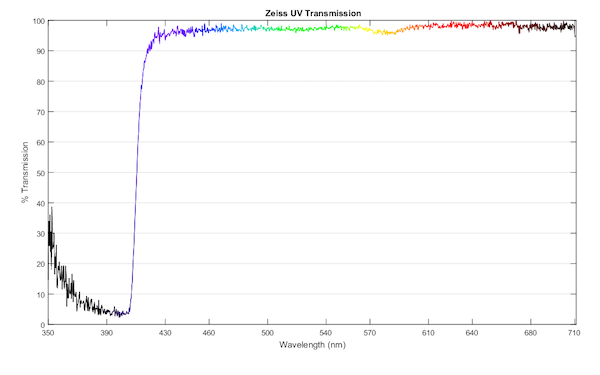
The published (transmission curves for the Zeiss and Kenko appear to be pretty close. Maybe the Kenko filters slightly more. If you go by Lensrentals and Viveks test, they look fairly close.

Zeiss (via Lensrentals test)


Kenko L41 (via Vivek's test)


And if you look at my comparison of sky shots with the Zeiss and Kenko (vs bare), they are relatively close.

https://www.fredmiranda.com/forum/topic/1683319/3#15528811

I do think the T&Y is probably overkill given Vivek's test. It will affect exposure and knock more visible spectrum from the end result.

Given Vivek's test, I stand by that the Zeiss and Kenko filters do not appear to be drastically different, or should filter much more than Sony intended via the sensor stack. It does seem as though there is some leakage as you get near the edges and corners, and these 2 filters help mitigate that. The other wavelength you mention are already attenuated much more by the filter stack (via Vivek's) test. I don't think the few percentage points makes a huge difference IMHO.

-Tim


Petegh wrote:
tsdevine wrote:

This is blasphemy, but I look at it this way. The argument would be that this filter should make no difference, as the Sony stack has a hard cutoff at 420nm. Given that it seems to have impact, at least in lenses where there is something obviously going on...doesn't mean it wouldn't have some impact on shots from lenses where it would normally be even harder to notice. The only harm being done is there is another piece of glass in the optical path, arguably from a color perspective, the results you are seeing with the filter is what Sony intended. Given that the stack should be filtering at 420nm.......how can it be argued that a filter that cuts at 410nm is somehow impacting color in a negative way (it should be doing nothing to color really.)

So yeah, I get the whole another piece of glass in the optical path, and you should avoid it. But if you feel the results are better, then so be it, use it. I mean we have people using PCX filters to make some short flange distance legacy lenses perform better. The results are what matter, at least to me. If you find it really doesn't make a tangible difference on a lens, then no need to use it.

-Tim

DWOfPaul wrote:
I find this color cast issue very interesting. Back over a year ago when I was considering getting the 50mm APO I noticed color cast, especially towards the corners in some of the photos people where posting here. I actually mentioned seeing a color cast and multiple people told me it's not something they have noticed using the lens. I did end up purchasing the lens and have enjoyed using it.

Anyway, seeing this color cast conversation I decide to purchase the Zeiss UV filter in both 49mm (for the 50mm APO) and 77mm for other lenses to experiment with. I have only done basic outdoor testing with it so far but, it looks like it definitely helps.

While it definitely helps the 50mm APO, I also noticed it helped my Sony 24-105mm f4. On both lenses the color just look more natural to my eye and have less of a magenta cast, especially in the clouds with the filter on. I also noticed a small shift in the red histogram when using the Zeiss UV filter.

For a while I have been in the camp of Sony colors not being as nice as Nikon colors. I have spent many hours in LR playing with color settings trying to Sony colors to where I like them. I wonder if this magenta casting has something to do with it. Going to have to also test what happens when I put the Zeiss UV filter on a Nikon lens mounted to my Sony camera. I also want to try and understand if the Zeiss UV filter maybe tinting the colors in a way I maybe find more pleasing out of camera, or is purely just fixing spectrum pollution. Since if it's causing a tint maybe I can replicate that tint in post for lenses I have which I can't put a Zeiss UV filter on.


'the Sony stack has a hard cutoff at 420nm': where are you sourcing that from Tim? realViveks A7rII transmission graph on the previous page doesn't show that.
'how can it be argued that a filter that cuts at 410nm is somehow impacting color': because the UV filter doesn't have a hard cut at 410: the gradient of the curve is not vertical on the Zeiss UV filter shown on this page https://www.zeiss.com/content/dam/consumer-products/downloads/photography/brochures/en/brochure-zeiss-filter-en.pdf ,and it doesn't round off till about 420nm at 98% transmission - so it'll be taking some of the visible blues out of the image; the transmission curve also isn't flat, reaching only 100% between 575-650nm which will also change the overall tint of the image.
The Kenko transmission graph show on this listing https://www.ebay.com/itm/Kenko-49mm-Zeta-L41-UV-ZR-Coated-Slim-Frame-Camera-Lens-Filters-from-Japan-/313278078882 takes even more of the visible blues out without degrading the reds like the Zeiss, so should look warmer still...


Mar 12, 2021 at 07:34 AM
tsdevine
Online
Upload & Sell: On
Re: Official: Voigtlander 35mm f/2 APO-Lanthar announced!


That came from Kolari via Lloyd Chambers, but I agree that Vivek's test doesn't support that. Maybe it starts up near 420nm...but it doesn't do a hard cut there. In published content, Kolari puts Sony around 409nm, which puts it lower than any other major manufacturer. Fuji is up at 422nm.

https://kolarivision.com/uv-filter-effectiveness-article/

And still, if we go by Vivek's test, the stack filtering fits within the Kenko curve, or is so close to it in portions you can't differentiate. The only wavelengths where the Kenko seems to block more is between 380-400nm. And we're talking a few percentage points.

The published (transmission curves for the Zeiss and Kenko appear to be pretty close. Maybe the Kenko filters slightly more. If you go by Lensrentals and Viveks test, they look fairly close.

Zeiss (via Lensrentals test)


Kenko L41 (via Vivek's test)


And if you look at my comparison of sky shots with the Zeiss and Kenko (vs bare), they are relatively close.

https://www.fredmiranda.com/forum/topic/1683319/3#15528811

I do think the T&Y is probably overkill given Vivek's test. It will affect exposure and knock more visible spectrum from the end result.

Given Vivek's test, I stand by that the Zeiss and Kenko filters do not appear to be drastically different, or should filter much more than Sony intended via the sensor stack. It does seem as though there is some leakage as you get near the edges and corners, and these 2 filters help mitigate that.

-Tim


Petegh wrote:
tsdevine wrote:

This is blasphemy, but I look at it this way. The argument would be that this filter should make no difference, as the Sony stack has a hard cutoff at 420nm. Given that it seems to have impact, at least in lenses where there is something obviously going on...doesn't mean it wouldn't have some impact on shots from lenses where it would normally be even harder to notice. The only harm being done is there is another piece of glass in the optical path, arguably from a color perspective, the results you are seeing with the filter is what Sony intended. Given that the stack should be filtering at 420nm.......how can it be argued that a filter that cuts at 410nm is somehow impacting color in a negative way (it should be doing nothing to color really.)

So yeah, I get the whole another piece of glass in the optical path, and you should avoid it. But if you feel the results are better, then so be it, use it. I mean we have people using PCX filters to make some short flange distance legacy lenses perform better. The results are what matter, at least to me. If you find it really doesn't make a tangible difference on a lens, then no need to use it.

-Tim

DWOfPaul wrote:
I find this color cast issue very interesting. Back over a year ago when I was considering getting the 50mm APO I noticed color cast, especially towards the corners in some of the photos people where posting here. I actually mentioned seeing a color cast and multiple people told me it's not something they have noticed using the lens. I did end up purchasing the lens and have enjoyed using it.

Anyway, seeing this color cast conversation I decide to purchase the Zeiss UV filter in both 49mm (for the 50mm APO) and 77mm for other lenses to experiment with. I have only done basic outdoor testing with it so far but, it looks like it definitely helps.

While it definitely helps the 50mm APO, I also noticed it helped my Sony 24-105mm f4. On both lenses the color just look more natural to my eye and have less of a magenta cast, especially in the clouds with the filter on. I also noticed a small shift in the red histogram when using the Zeiss UV filter.

For a while I have been in the camp of Sony colors not being as nice as Nikon colors. I have spent many hours in LR playing with color settings trying to Sony colors to where I like them. I wonder if this magenta casting has something to do with it. Going to have to also test what happens when I put the Zeiss UV filter on a Nikon lens mounted to my Sony camera. I also want to try and understand if the Zeiss UV filter maybe tinting the colors in a way I maybe find more pleasing out of camera, or is purely just fixing spectrum pollution. Since if it's causing a tint maybe I can replicate that tint in post for lenses I have which I can't put a Zeiss UV filter on.


'the Sony stack has a hard cutoff at 420nm': where are you sourcing that from Tim? realViveks A7rII transmission graph on the previous page doesn't show that.
'how can it be argued that a filter that cuts at 410nm is somehow impacting color': because the UV filter doesn't have a hard cut at 410: the gradient of the curve is not vertical on the Zeiss UV filter shown on this page https://www.zeiss.com/content/dam/consumer-products/downloads/photography/brochures/en/brochure-zeiss-filter-en.pdf ,and it doesn't round off till about 420nm at 98% transmission - so it'll be taking some of the visible blues out of the image; the transmission curve also isn't flat, reaching only 100% between 575-650nm which will also change the overall tint of the image.
The Kenko transmission graph show on this listing https://www.ebay.com/itm/Kenko-49mm-Zeta-L41-UV-ZR-Coated-Slim-Frame-Camera-Lens-Filters-from-Japan-/313278078882 takes even more of the visible blues out without degrading the reds like the Zeiss, so should look warmer still...


Mar 12, 2021 at 07:25 AM


  Previous versions of tsdevine's message #15529267 « Official: Voigtlander 35mm f/2 APO-Lanthar announced! »