RustyBug wrote: mb126 wrote:
Looking forward to seeing Bill Claff's data as well. But WOW if this is true.
Similar improvement to the 5D4 sensor would legitimately put it in the same category as the A7r4.
From a diff thread:
Ziffl3 wrote:
On more of the technical side.
From the 5DIV.... that sensor generation had the AD converter moved from the off silicon/sensor up onto the sensor. This reduced noise and provides better DR.
This is what sony/nikon have.
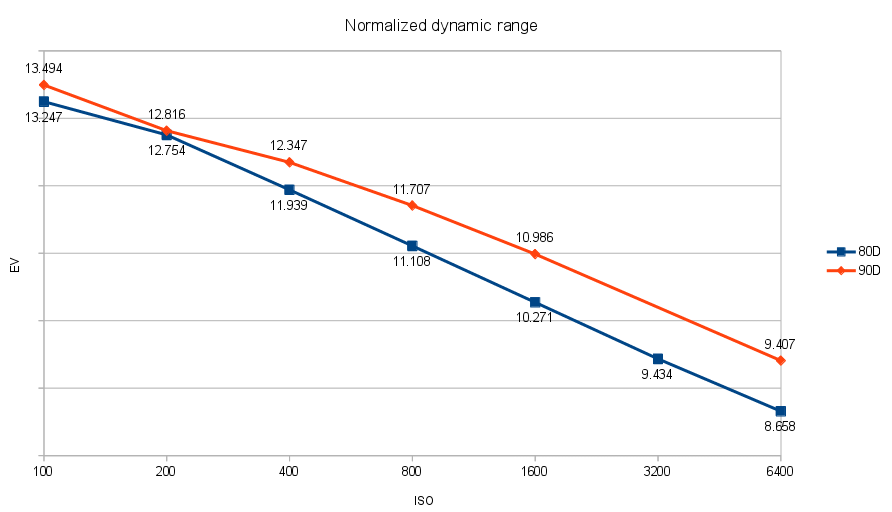
If this is correct, and has been implemented in the 90D ... it looks like it could be showing benefit in the north end. Picking up roughly a full stop, while raising pixels by 33% ain't too shabby.
Imo, you just need to get the ISO in the ballpark to start. You can't seem to play with Canon files the same way as ISO-less approach of gross underexposure and a ton of lift. Get 'em in the ballpark (i.e. less than 2-3 EV lift needed) with ISO, and they tend to do better, than dragging them up from a lower ISO and cranking the lift (4-6 EV).
As such, seeing the DR up a notch in the higher ISO's is encouraging.
This could play well with Auto-ISO approach scenarios.
Given that the 80D has about 1 EV advantage over the 7D2 at base, and is even in the higher ISO's. This would put the 90D approximately 1.25 - 1.00 EV improved over the 7D2 across the entire ISO range. Matching FPS @ 10 (or 11) with the 7D2, the main thing that remains to be seen compared to this being a hybrid of the 7D2 & 80D is going to be AF performance, imo (build & dual card slot, notwithstanding).
Many people say that in practice the 7D2 is significantly better for High ISO (above 800 or so) than the 80D, whatever the measurements say ...
---------------------------------------------
cpe1991 wrote: cgarcia wrote: dclark wrote: cgarcia wrote:
I just have converted a a dpreview sample picture to test the DR. The results are slightly better compared to the 80D:
90D ISO 100:
DR at 32MP: 12.468 DR at 8MP: 13.480 (+1.012)
read noise: 2.80125
80D ISO 100:
DR at 24MP: 12.435 EV
DR at 8MP: 13.2343 (+0.7993)
read noise: 2.86601
The improvement is tiny, close to the measure error. But Canon has managed to keep the same performance despite the smaller pixels (not too difficult, that was the trick the 5DS used to stand out in the old times). After taking into account the normalization, the new sensor is around 0.25 EV better.
The link to the sample image seems to be broken.
It seems that FM doesn't always properly redirect when a link is embedded...
Well, there are GREAT news... I tested the ISO 6400 by curiosity and, after detecting a big improvement, I have done a full comparison with the 80D, except for ISO 3200 which is missing in dpreview's samples. Since the sensor is far from being ISO-less, and one needs to crank up the ISO to improve the shadows, the new DR at high ISO is very valuable.
The 90 has much better performance at high ISO. To the point that from ISO 1600 it seems nearly an stop ahead of the 80D. That is, the ISO 6400 should look as clean as ISO 3200 on the 80D (ok, in the shadows... in the midtones, physics laws can't make miracles). These are the read noise values:
90D vs 80D:
ISO 100: 2.77497 vs 2.84197
ISO 200: 4.43868 vs 3.99936
ISO 400: 5.55092 vs 6.35349
ISO 800: 8.65067 vs 11.304
ISO 1600: 14.2535 vs 20.1949
ISO 3200: ? vs 36.077
ISO 6400: 42.5752 vs 61.7794
The ISO 100 values differ a bit from yesterday because I have used both green channels instead of a single one. Well, we are not sure if the ISO sensitivity is equal in both cameras, but this is looking very good.
I have retested ISO 200 and 400 since there were two available images on each and the results (read noise 4.40524 and 5.4736) confirm that the DR "dip" at ISO 200 is real. I don't say it has two base ISO settings (another one optimized for high ISO) but this is interesting. I think that other Canon cameras already had this behaviour. The 90D also applies scaling to the red and blue channels (likely white balance correction applied to the raw) as the 5D4 did.
These are the 90D images used (ISO 100 - ISO 6400, except for ISO 3200):
A nearly one stop increase in DR under conditions where photon noise is the limiting factor with efficient modern sensors is truly remarkable. That means the sensor has the same DR as a 5DIV with its 2.56x larger sensor, and well above any Sony or Nikon APS-C. Have I got something wrong?
I have my doubts as well, it doesn't make sense to see such a big jump while the pixels are significantly larger, and that after lagging for years they are now suddenly ahead of the competition despite no sign of completely new technology. Very likely the biggest gain is from the way DR is measured here, or maybe there is some trickery going on between sensor and RAW files; I will wait for more standardized measurements before drawing a conclusion. Also looking at images from e.g. the Nikon D500 my 80D is WAY below that in High ISO performance, while theoretically it is just over 1/2 stop behind from what I remember. Maybe the noise character is a factor that isn't well represented in the measurements?
Sep 02, 2019 at 10:54 AM
Previous versions of technic's message #14965775 « EOS 90D dynamic range »