Also keep in mind that when comparing crop factors the changes in depth of field are not linear, which means the change from say 1.20 to 1.30 is noticeably bigger than the change from say 1.50 to 1.60. We of course know that when we think about teleconverter. A 1.4X teleconverter increases depth of field by one stop, whereas a 2X teleconverter increases depth of field by 2 stops. In exactly the same way a 1.41 crop factor increases depth of field one stop, whereas a 2.0 crop factor increases depth of 2 stops. So, in terms of depth of field changes the. .41 difference between 1 and 1.4 creates the same increase in depth of field as the .59 difference between 1.41 and 2.0. And the .29 difference between a .71 and a 1.0 crop factor is the same size as the two above difference as it decreases depth of field one stop. So in these examples .29, .41, and .59 all are the same size in terms of how they affect depth of field. They all are one stop different from the next succeeding crop factor.
One of the reasons that I used what I'll call a "movable normal" in my chart is that it should rectify this concern.
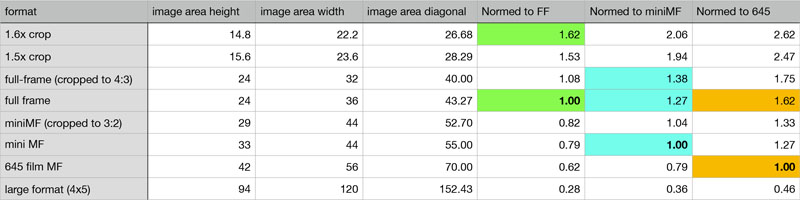
For example, note that the three right columns treat different formats as being the baseline — 1.00 crop is full frame, miniMF, or 645 film MF depending on which column you select. A given crop factor value there represents a relationship to this baseline in a way that should be consistent.
For example, we can say that the relationship between 645 MF and full frame is virtually the same as the relationship between full frame and 1.6x crop. See the "normed to normed FF" and "normed to 645" columns and compare, noting that the crop factor relationships are of the same magnitude.
Here is an updated version of the chart with some relationships highlighted in color.
"Normed to FF" sets full frame to crop factor of 1.00
"Normed to miniMF" sets miniMF to crop factor of 1.00
"Normed to 645" sets 645 film FM to crop factor of 1.00
Note also that I have added two additional cases in order to deal with the various possible ways of handling the aspect ratio differences between miniMF and full-frame. I have added a row representing full frame cropped to 24mm x 32mm (4:3 aspect ratio on full frame) and miniMF cropped to 29mm x 44mm (miniMF cropped to 3:2).
Some interesting take-aways:
1. 645 MF film is to full frame (and 35mm film) as full frame is to 1.6x APS-C crop.
2. 645MF film is to miniMF as miniMF is to uncropped full frame.
3. miniMF lies about halfway between full frame and 645 MF film.
4. Compared to miniMF, full frame has a 1.27 or 1.38 crop factor depending on whether or not you crop full frame to 4:3 aspect ratio.
Dan
May 12, 2018 at 03:37 PM
Previous versions of gdanmitchell's message #14465861 « Hasselblad C 250 f/5.6 Superachromat on Fuji GFX »