Re: Hasselblad C 250 f/5.6 Superachromat on Fuji GFX
(Note: I realized that my post is going a bit off-subject, so I have shortened it from the original.)
Sauseschritt wrote:
Its not exactly an evaluation of the corner sharpness as such since the image circle of 44x33mm sensors is 55mm, while the original 56x56mm sensor has an image circle of 79.2mm.
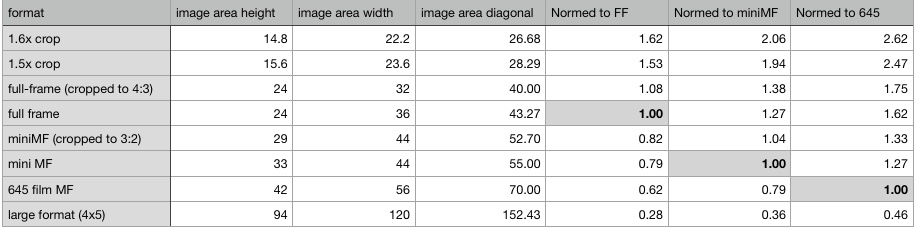
I'll share this little chart that I created last night as an add-on to this comment.
There's a lot of interesting and useful information in it for some people. For example, it includes the image diagonal sizes for several formats ranging from 1.6x crop up to 4 x 5 large format. As you point out, this explains why corner performance on miniMF when using lenses designed for film MF formats is likely to be pretty good — just as corner performance on APS-C may be quite good when using lenses designed for full frame coverage.
There are a lot of other interesting things to learn from this chart, I think. For one thing, the three right columns normalize the crop factor to three different starting points — the traditional full frame, miniMF, and 645 film MF.
Re: Hasselblad C 250 f/5.6 Superachromat on Fuji GFX
(Note: I realized that my post is going a bit off-subject, so I have shortened it from the original.)
Sauseschritt wrote:
Its not exactly an evaluation of the corner sharpness as such since the image circle of 44x33mm sensors is 55mm, while the original 56x56mm sensor has an image circle of 79.2mm.
I'll share this little chart that I created last night as an add-on to this comment.
There's a lot of interesting and useful information in it for some people. For example, it includes the image diagonal sizes for several formats ranging from 1.6x crop up to 4 x 5 large format. As you point out, this explains why corner performance on miniMF when using lenses designed for film MF formats is likely to be pretty good — just as corner performance on APS-C may be quite good when using lenses designed for full frame coverage.
There are a lot of other interesting things to learn from this chart, I think. For one thing, it normalizes the crop factor to three different starting points — the traditional full frame, miniMF, and 645 film MF.
Re: Hasselblad C 250 f/5.6 Superachromat on Fuji GFX
(Note: I realized that my post is going a bit off-subject, so I have shortened it from the original.)
Sauseschritt wrote:
Its not exactly an evaluation of the corner sharpness as such since the image circle of 44x33mm sensors is 55mm, while the original 56x56mm sensor has an image circle of 79.2mm.
I'll share this little chart that I created last night as an add-on to this comment.
There's a lot of interesting and useful information in it for some people. For example, it includes the image diagonal sizes for several formats ranging from 1.6x crop up to 4 x 5 large format. As you point out, this explains why corner performance on miniMF when using lenses designed for film MF formats is likely to be pretty good — just as corner performance on APS-C may be quite good when using lenses designed for full frame coverage.
There are a lot of other interesting things to learn from this chart, I think.
Re: Hasselblad C 250 f/5.6 Superachromat on Fuji GFX
Sauseschritt wrote:
Its not exactly an evaluation of the corner sharpness as such since the image circle of 44x33mm sensors is 55mm, while the original 56x56mm sensor has an image circle of 79.2mm.
I'll share this little chart that I created last night as an add-on to this comment.
(corrected chart with added rows to reflect effects of applying 3:2 cropping to miniMF and 4:3 cropping to full frame.)
There's a lot of interesting and useful information in it for some people. For example, it includes the image diagonal sizes for several formats ranging from 1.6x crop up to 4 x 5 large format. As you point out, this explains why corner performance on miniMF when using lenses designed for film MF formats is likely to be pretty good — just as corner performance on APS-C may be quite good when using lenses designed for full frame coverage.
I put it together for another reason. This is a bit tricky to explain in writing, but here goes. We are all familiar with the concept of "crop factor" as a way of understanding relative "size" differences among format. In virtually all cases the familiar crop-factor numbers are offered as a way of comparing full-frame format to smaller formats. This approach incorporates a bias (or perhaps a "basis?") in an assumption that full-frame is the norm. That is very useful for photographers familiar with traditional 35mm film formats who are, for example, trying to figure out what focal lengths will provide the same angle-of-view coverage when using one of the smaller cropped sensor formats.
But what if you are trying to understand "crop factor" size differences where full-frame is not one of the cases being compared? For example:
- You are contemplating the value of a system incorporating an APS-C sensor camera and a miniMF camera, and you want to understand the relationship.
- You are familiar with medium format film 645 camera systems and you want to compare to miniMF digital systems.
- You want to understand the relative size of the differences between various pairs of options — for example, what is the magnitude of the difference between MF 645 film and 35mm film versus the magnitude of the difference between, say, miniMF and full frame?
The concept in the chart is to regard and one of three target formats as having a 1.00 (or baseline) crop factor — in this case the columns assign that to full-frame, miniMI, or 645 film. From there you can now better understand the relative size of other formats by comparison to your given starting point.
For example, we are familiar with the concept that Canon APS-C cameras have an approximate 1.6x crop factor and that Nikon and Fujifilm APS-C cameras have an approximate 1.5x crop factor by comparison to full frame. By looking at the right column of the chart, where we use MF 645 film as the baseline, we see that its relationship to 35mm film and full-frame is approximately the same size.
There are a lot of other interesting things to learn from this chart, I think.
Re: Hasselblad C 250 f/5.6 Superachromat on Fuji GFX
Sauseschritt wrote:
Its not exactly an evaluation of the corner sharpness as such since the image circle of 44x33mm sensors is 55mm, while the original 56x56mm sensor has an image circle of 79.2mm.
I'll share this little chart that I created last night as an add-on to this comment.
[I just noticed errors in this chart. I'm fixing them now and will upload a correct version soon.]
There's a lot of interesting and useful information in it for some people. For example, it includes the image diagonal sizes for several formats ranging from 1.6x crop up to 4 x 5 large format. As you point out, this explains why corner performance on miniMF when using lenses designed for film MF formats is likely to be pretty good — just as corner performance on APS-C may be quite good when using lenses designed for full frame coverage.
I put it together for another reason. This is a bit tricky to explain in writing, but here goes. We are all familiar with the concept of "crop factor" as a way of understanding relative "size" differences among format. In virtually all cases the familiar crop-factor numbers are offered as a way of comparing full-frame format to smaller formats. This approach incorporates a bias (or perhaps a "basis?") in an assumption that full-frame is the norm. That is very useful for photographers familiar with traditional 35mm film formats who are, for example, trying to figure out what focal lengths will provide the same angle-of-view coverage when using one of the smaller cropped sensor formats.
But what if you are trying to understand "crop factor" size differences where full-frame is not one of the cases being compared? For example:
- You are contemplating the value of a system incorporating an APS-C sensor camera and a miniMF camera, and you want to understand the relationship.
- You are familiar with medium format film 645 camera systems and you want to compare to miniMF digital systems.
- You want to understand the relative size of the differences between various pairs of options — for example, what is the magnitude of the difference between MF 645 film and 35mm film versus the magnitude of the difference between, say, miniMF and full frame?
The concept in the chart is to regard and one of three target formats as having a 1.00 (or baseline) crop factor — in this case the columns assign that to full-frame, miniMI, or 645 film. From there you can now better understand the relative size of other formats by comparison to your given starting point.
For example, we are familiar with the concept that Canon APS-C cameras have an approximate 1.6x crop factor and that Nikon and Fujifilm APS-C cameras have an approximate 1.5x crop factor by comparison to full frame. By looking at the right column of the chart, where we use MF 645 film as the baseline, we see that its relationship to 35mm film and full-frame is approximately the same size.
There are a lot of other interesting things to learn from this chart, I think.
Re: Hasselblad C 250 f/5.6 Superachromat on Fuji GFX
Sauseschritt wrote:
Its not exactly an evaluation of the corner sharpness as such since the image circle of 44x33mm sensors is 55mm, while the original 56x56mm sensor has an image circle of 79.2mm.
I'll share this little chart that I created last night as an add-on to this comment.
There's a lot of interesting and useful information in it for some people. For example, it includes the image diagonal sizes for several formats ranging from 1.6x crop up to 4 x 5 large format. As you point out, this explains why corner performance on miniMF when using lenses designed for film MF formats is likely to be pretty good — just as corner performance on APS-C may be quite good when using lenses designed for full frame coverage.
I put it together for another reason. This is a bit tricky to explain in writing, but here goes. We are all familiar with the concept of "crop factor" as a way of understanding relative "size" differences among format. In virtually all cases the familiar crop-factor numbers are offered as a way of comparing full-frame format to smaller formats. This approach incorporates a bias (or perhaps a "basis?") in an assumption that full-frame is the norm. That is very useful for photographers familiar with traditional 35mm film formats who are, for example, trying to figure out what focal lengths will provide the same angle-of-view coverage when using one of the smaller cropped sensor formats.
But what if you are trying to understand "crop factor" size differences where full-frame is not one of the cases being compared? For example:
- You are contemplating the value of a system incorporating an APS-C sensor camera and a miniMF camera, and you want to understand the relationship.
- You are familiar with medium format film 645 camera systems and you want to compare to miniMF digital systems.
- You want to understand the relative size of the differences between various pairs of options — for example, what is the magnitude of the difference between MF 645 film and 35mm film versus the magnitude of the difference between, say, miniMF and full frame?
The concept in the chart is to regard and one of three target formats as having a 1.00 (or baseline) crop factor — in this case the columns assign that to full-frame, miniMI, or 645 film. From there you can now better understand the relative size of other formats by comparison to your given starting point.
For example, we are familiar with the concept that Canon APS-C cameras have an approximate 1.6x crop factor and that Nikon and Fujifilm APS-C cameras have an approximate 1.5x crop factor by comparison to full frame. By looking at the right column of the chart, where we use MF 645 film as the baseline, we see that its relationship to 35mm film and full-frame is approximately the same size.
There are a lot of other interesting things to learn from this chart, I think.
Dan
May 11, 2018 at 09:43 AM
Previous versions of gdanmitchell's message #14464714 « Hasselblad C 250 f/5.6 Superachromat on Fuji GFX »