samlee.hk
Offline
Upload & Sell: Off
|
 Re: First Sighting: A7rii Thin filter in action Re: First Sighting: A7rii Thin filter in action | |
uhoh7 wrote:
OK let\'s get serious 
most of you know I\'m obsessed with the whole issue since Dec 2013. While this thread is really about modding the A7rii, the A7s is now a big favorite with many astro shooters, and they teach each other all about these sensor stacks. I think it will inform us.
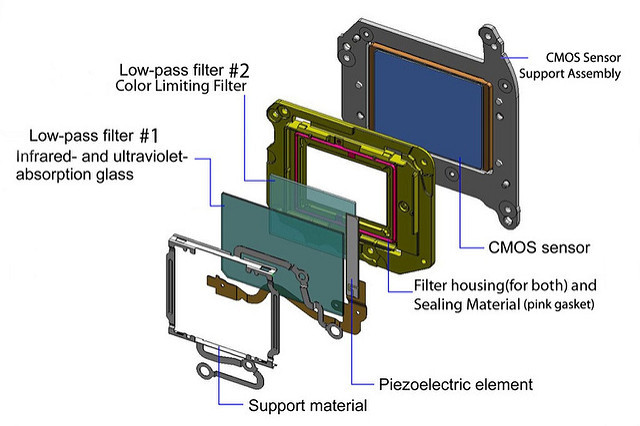
Basic Sensor Cover Design by unoh7,
Above is apparently (and ANYONE chime in to correct ANYTHING) the basic sensor stack design in all the major players. Sony Canikon etc. Note we have LPF1 and LPF2. They say we should use these names.
Here is the complete sensor assembly on the A7s:
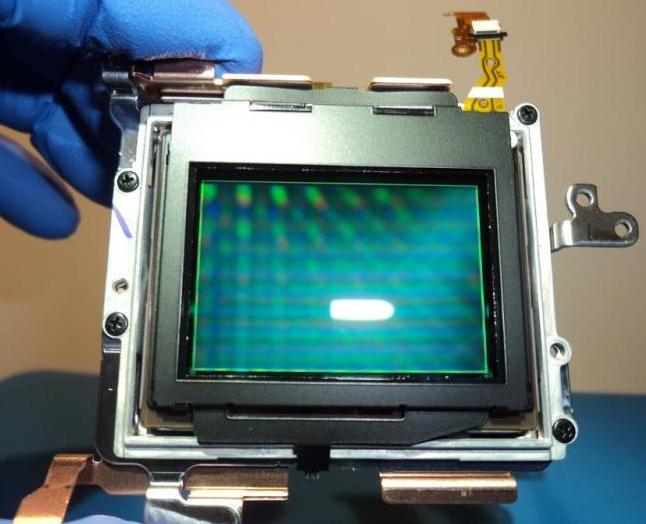
A7s Sensor assembly by unoh7, on Flickr
Now LPF-1/Piezo (Piezo I think refers to electrostatic cleaner)

LPF1 front by unoh7, on Flickr
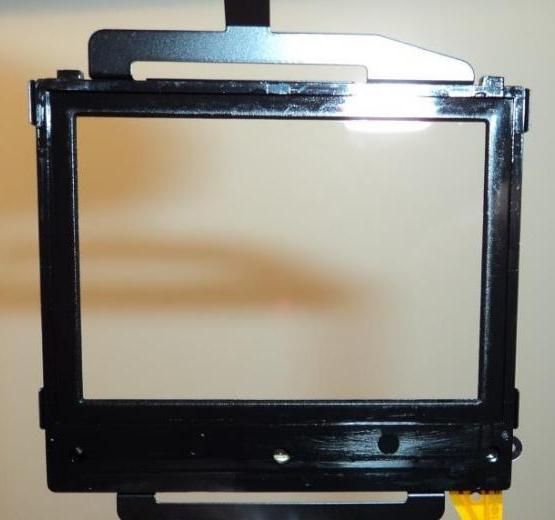
LPF1 back by unoh7, on Flickr
Now LPF2:
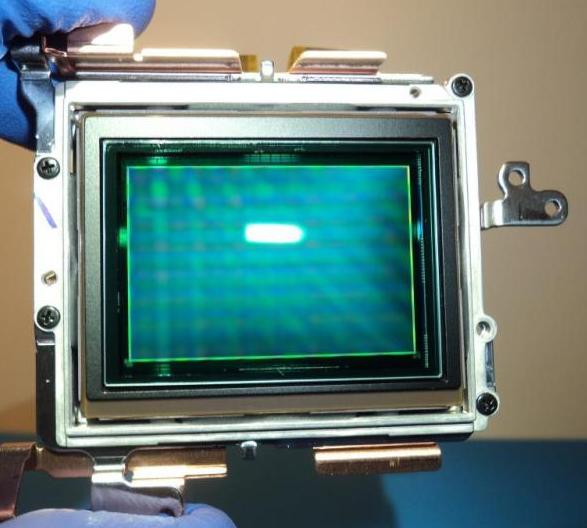
LPF2 by unoh7, on Flickr
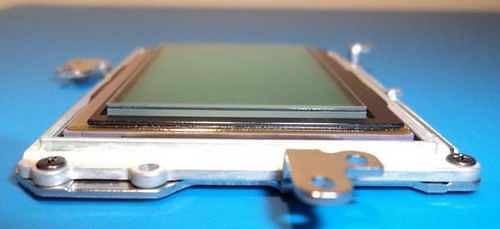
LPF-2 side by unoh7, on Flickr
Many thanks to Mike Malik for making and sharing these images.
Now above we DO NOT see what most in astro refer to as \"COVER GLASS\", which is in fact a thin layer directly on the sensor, (shown below) which I don\'t think anybody removes, but the same term is also used to refer to LPF1+LPF2.
In Astro (kolari does astro mods often) the basic options are seen as:
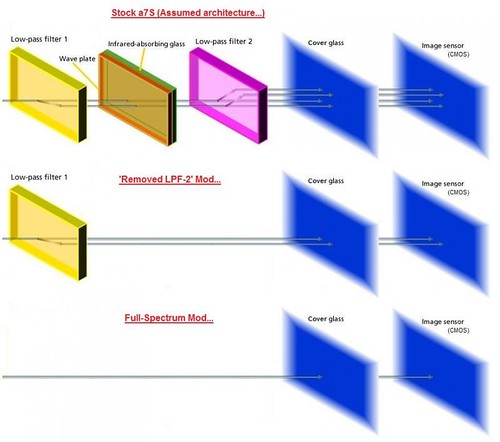
Mod Options for Astro by unoh7, on Flickr
OK First real serious question, Sam or anyone: How different is the A7r2 in the basic setup of LPF1 or 2?
Now when I would try to ask the Astro guys int the forums about stuff to get an idea about what would really work best for UWA RF glass, they basically rolled their eyes and ignored me so I found a tech they often used and I used \"cover glass\" in the generic way- including LFP1&2 (not knowing the dif)
\"Are you absolutely sure that Kolari are removing the coverglass and not the thick filter stack? I\'ve never seen a sensor with a thick window. I know for a fact the A7s has a 1.6 mm thick filter stack that includes the colour correcting filter (that we remove for astronomy). Removing this makes the camera about 4x more sensitive to h-alpha, which is of interest to astronomers.
We also reposition the sensor and properly re-align it to within +/- 0.02 mm. This is very important if you are going to be using fast lenses. I\'ve seen more than one camera where this is not done properly, once the alignment is lost it requires specialised tools to get it back (we have those, but prefer not to need them!).
The sensor must be moved forwards to compensate the optical path. It sits on 3 points, each with a different adjustment to ensure the sensor is perfectly aligned as each camera is slightly different. Often we see that these shims are just all removed - which corrects for the back focus but loses the alignment, this will work with slower lenses but for fast lenses you really need this to be done properly.
Another solution is to fit clear glass or quartz but this just introduces glass back into the path and also is a source of halos and reflections.\"
He also sent a few image samples of the effects of the options on WB, which I will post later if we want them. Very nice guy,
Here is his site
Armed with all this dangerous knowledge I then asked all about it to Ilija at Kolari, who has been such an asset for many of us.
\"Ok let me clarify. In all of our mods, both filters are removed. Full spectrum is when that stack is replaced with a clear window that does not block any wavelengths, in that case it just helps keep focus and protect the sensor.
Removing just one of the filters will give you basically an H-alpha conversion in camera. Both stacks block IR aggresively, but only one of them blocks the H-alpha wavelength. So removing one shifts your red sensitivity up, making it perfect for astro. It isn\'t going to be even close to an accurate white balance, but for some of the less picky shooters if you set a custom white balance with that setup you will get a passable result. In this mod, you are reducing the thickness of glass over the sensor by about half, so it does help RF performance. What these guys fail to do, or at least I\'m assuming, is move the sensor forward. They mostly shoot with telescopes or AF lenses were that doesn\'t show up as a problem. When we do this removal we move the sensor forward to provide good MF performance as well.
In our thin fitler, we remove both filters, and replace it with an even thinner replacement that does the closest job of approximating the transmission curve of BOTH original filters (less well at the UV end but accurately in the red portion)
Another option that probably wasn\'t mentioned, is removing the LPF2 filter, and then restoring proper color balance with our hot mirror filter over the lenses for regular photography.
For H-alpha photography you can just use a thin filter camera for similar performance as a stock camera, but your camera will only pick up about 15% of available light in that band without the LPF2/H-alpha mod.\"
This communication, and what I learned about color issues with the astro mods convinced me Kolari was really ahead of these astro guys for our purposes. But I owe them for such great explanations of whats over the sensor. 
OK now we are talking about a whole new sensor and Sam has tried 2 mods: (I quote from our PM)
1. first modded at 2015 oct, mod to stc 0.7mm thin filter, silimar to Kolari v2 but with anti-smudge(water contact angle>110∘, antistatic and scratch resistant coatings,
used around 1 years there is no dust issues on thin filter, i can only use a7rii internal dust removal function to remove the dust. but still have some RF wide lenses can\'t use. The STC 0.7mm thin filter main problems is awb will have some red but easily tune at LR / C1 .
2. second modded at 2016 June, removed the sensor protection glass/ cover, which will reduce 0.7mm. removed the glass outcome is very very good. All the lenes become much more sharper and cleaner.
the sensor protection cover/glass is not easily to remove. This cannot be revented with the orginal sensor protection cover / glass , but the master say he can prodive third party glass to replaced, but i dont think we will revented it...
So, I am not clear on 2 exactly. Perhaps The mast actually removed the real \"cover glass\" which is shown above in the drawings, and which is attached directly to the sensor, and our Astro Modder said he could not believe anybody would take off
Another thing Sam mentioned to me was very interesting: \"it seems that there are newest STC thin filter @0.5mm or 0.85mm with 100% sony colour /AWB profile, there will be no awb / colour problems.\"
Sam\'s Link to STC glass
Sam, since this link takes us to an external filter, are you using any special filters on the lens itself? It is making me think of the \"hot mirror\" technique which Ilija describes. Or, is this link to show the glass you are using either 1) in LPF1 or LPF2 or the actual sensor cover?
Sam, I think you did say you were not so fond of the r2 color, and I\'m just wondering was that the case before the mod. I\'ve been talking with Ilija at Solari and he is pretty excited doing some more r2 mods. I will try to get him in here also to help us and perhaps we can chart a way forward which will give us the highest performance possible
I also can\'t thank Sam Lee enough for sharing his experience. He is at the tip of the spear
yes, for my 2nd mod, the taiwan master removed the real \"cover glass\", the glass is around 0.7mm. it hard to remove like astro modder said, but finally done, so now is only lowpass filter 1 (STC 0.7mm thin filter ) + sensor only.
Since i haven\'t use the STC 0.5mm or 0.85mm thin filter, i needed to say again, this two filter seems to provide almost the same colour profile and awb for sony sensor.
Many thank for uhoh7 Great effort in doing such summary...
|


