About 13.3 - 13.4 EV at ISO 100 (noise level about 3 DN).
This is about 0.1 EV less than 1DX2:
ISO 100 (793A6840.CR2): 13.38 EV (1dx2 was 13.55)
ISO 100 (793A6466.CR2): 13.29 EV
ISO 100 (793A6491.CR2): 13.29 EV
ISO 400 (793A7165.CR2): 12.88 EV (1dx2 was 12.83)
ISO 800 (793A7094.CR2): 12.32 EV (1dx2 was 12.58)
ISO 1600! (793A6463.CR2): 11.57 EV (1dx2 was 11.82)
ISO 3200 (793A7330.CR2): 10.65 EV (1dx2 was 11.28)
ISO 25600 (7A0A0098.CR2): 8.40 EV (1dx2 was 8.49, 1dx was 8.79)
About 1.60 EV above 5D mark III results, exactly just like 80D and 1DX2 which also are about 1.60 EV better than their predecessors.
The test image at ISO 1600 had no blown pixels, so the saturation level is assumed (but surely correct). All ISO levels seem to saturate at exactly DN 16383, the black level is 512 for ISO 100 (and likely ISO 200, but dpreview had not a single shot at ISO 200) and 2048 for the rest of the ISO levels.
The previous threads results (since the new Canon sensor era):
PS: I edit the initial post because the results were wrong: a saturation of 14380 (instead of 16383) was hardcoded in the tool, causing a general underestimation. I just have changed my impressions and comments in consequence... I apologise by the not-so-good initial news :-)
* * * * UPDATED * * * *
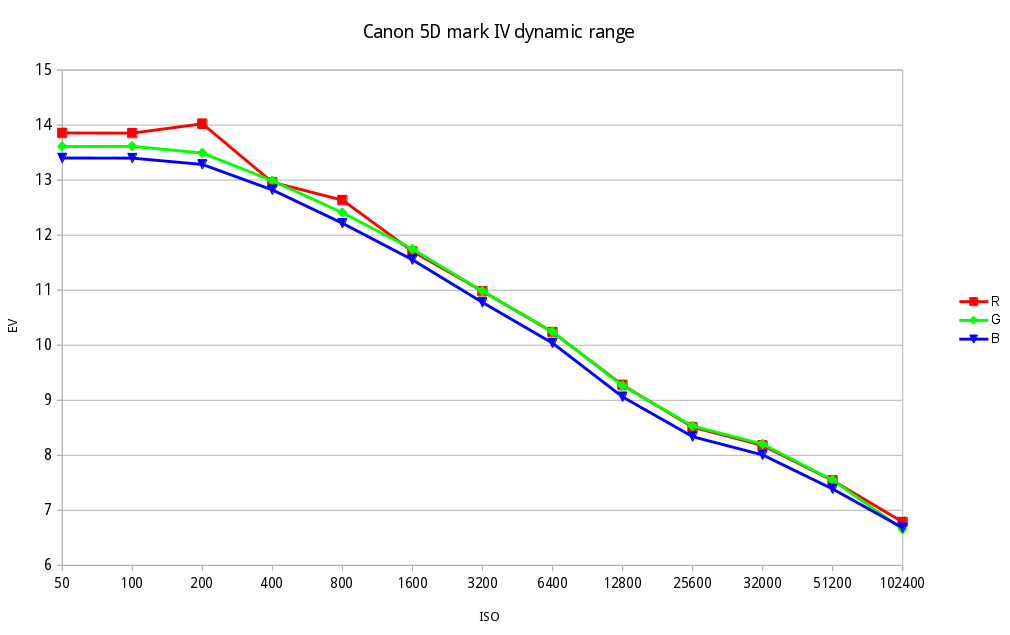
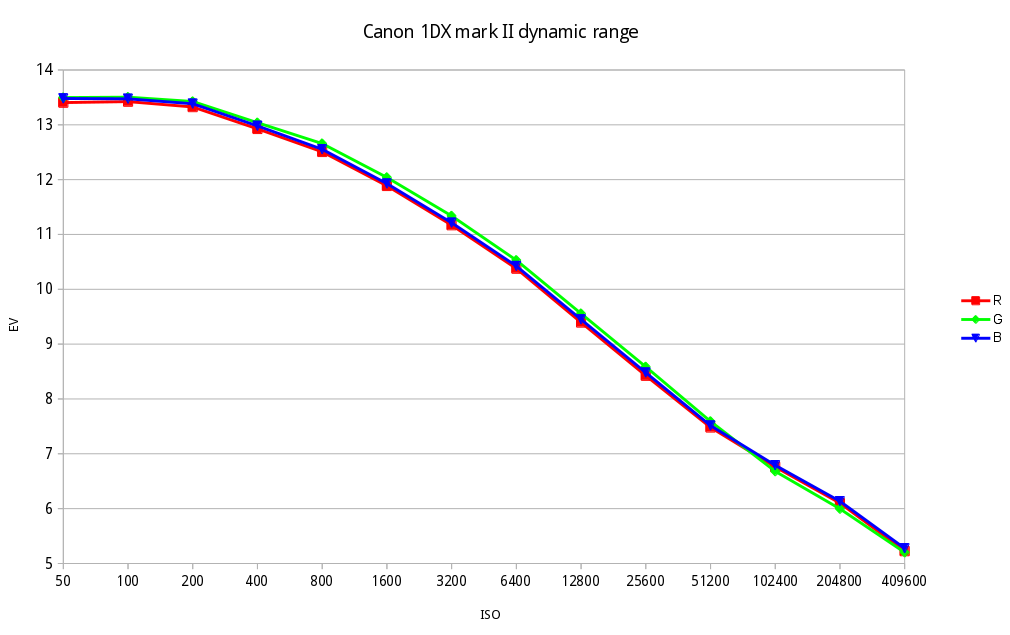
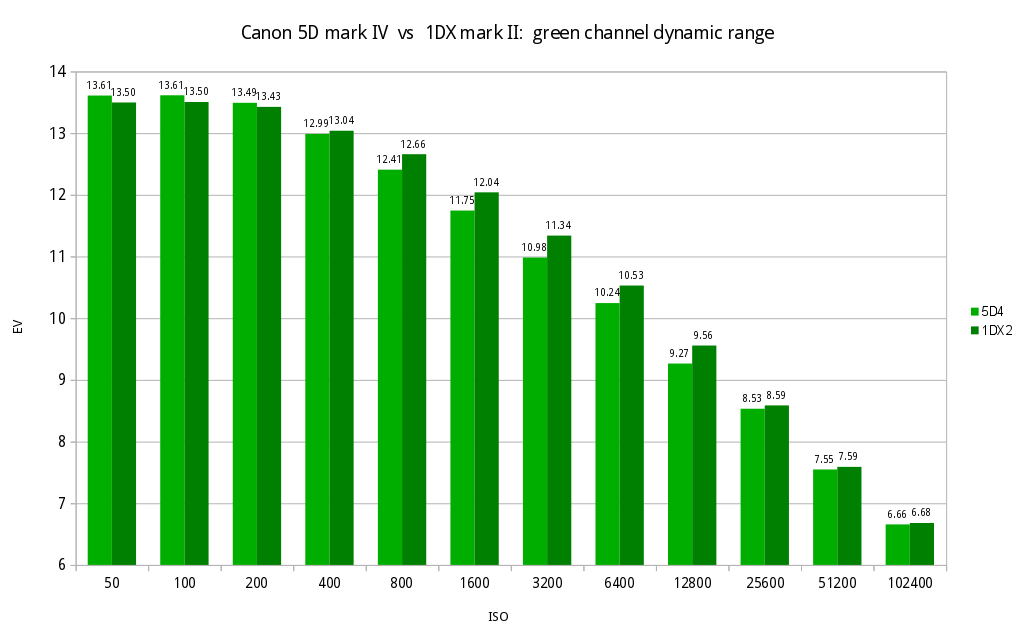
These are the final DR graphs, using the RAW samples from Imaging Resource. When there are several RAW for a given ISO level (e.g. 4 files for ISO 100) the file with the higher DR has been selected (but the differences are tiny).
Note how the 5D4 has different values for each color channel, specially at low ISO levels. This is a very rare feature:
The 1DX2 sensor is \"normal\" in this regard:
The comparison uses the two greens channels combined on each camera. Had we used the combination of the 4 channels (RGGB) the result would almost 100% match that of the combined greens alone:
The full data used for the graphs is here, for anybody interested on it:
About 13.3 - 13.4 EV at ISO 100 (noise level about 3 DN).
This is about 0.1 EV less than 1DX2:
ISO 100 (793A6840.CR2): 13.38 EV (1dx2 was 13.55)
ISO 100 (793A6466.CR2): 13.29 EV
ISO 100 (793A6491.CR2): 13.29 EV
ISO 400 (793A7165.CR2): 12.88 EV (1dx2 was 12.83)
ISO 800 (793A7094.CR2): 12.32 EV (1dx2 was 12.58)
ISO 1600! (793A6463.CR2): 11.57 EV (1dx2 was 11.82)
ISO 3200 (793A7330.CR2): 10.65 EV (1dx2 was 11.28)
ISO 25600 (7A0A0098.CR2): 8.40 EV (1dx2 was 8.49, 1dx was 8.79)
About 1.60 EV above 5D mark III results, exactly just like 80D and 1DX2 which also are about 1.60 EV better than their predecessors.
The test image at ISO 1600 had no blown pixels, so the saturation level is assumed (but surely correct). All ISO levels seem to saturate at exactly DN 16383, the black level is 512 for ISO 100 (and likely ISO 200, but dpreview had not a single shot at ISO 200) and 2048 for the rest of the ISO levels.
The previous threads results (since the new Canon sensor era):
PS: I edit the initial post because the results were wrong: a saturation of 14380 (instead of 16383) was hardcoded in the tool, causing a general underestimation. I just have changed my impressions and comments in consequence... I apologise by the not-so-good initial news :-)
* * * * UPDATED * * * *
These are the final DR graphs, using the RAW samples from Imaging Resource. When there are several RAW for a given ISO level (e.g. 4 files for ISO 100) the file with the higher DR has been selected (but the differences are tiny).
Note how the 5D4 has different values for each color channel, specially at low ISO levels. This is a very rare feature:
The 1DX2 sensor is \"normal\" in this regard:
The comparison uses the two greens channels combined on each camera. Had we used the combination of the 4 channels (RGGB) the result would almost 100% match that of the combined greens alone:
About 13.3 - 13.4 EV at ISO 100 (noise level about 3 DN).
This is about 0.1 EV less than 1DX2:
ISO 100 (793A6840.CR2): 13.38 EV (1dx2 was 13.55)
ISO 100 (793A6466.CR2): 13.29 EV
ISO 100 (793A6491.CR2): 13.29 EV
ISO 400 (793A7165.CR2): 12.88 EV (1dx2 was 12.83)
ISO 800 (793A7094.CR2): 12.32 EV (1dx2 was 12.58)
ISO 1600! (793A6463.CR2): 11.57 EV (1dx2 was 11.82)
ISO 3200 (793A7330.CR2): 10.65 EV (1dx2 was 11.28)
ISO 25600 (7A0A0098.CR2): 8.40 EV (1dx2 was 8.49, 1dx was 8.79)
About 1.60 EV above 5D mark III results, exactly just like 80D and 1DX2 which also are about 1.60 EV better than their predecessors.
The test image at ISO 1600 had no blown pixels, so the saturation level is assumed (but surely correct). All ISO levels seem to saturate at exactly DN 16383, the black level is 512 for ISO 100 (and likely ISO 200, but dpreview had not a single shot at ISO 200) and 2048 for the rest of the ISO levels.
The previous threads results (since the new Canon sensor era):
PS: I edit the initial post because the results were wrong: a saturation of 14380 (instead of 16383) was hardcoded in the tool, causing a general underestimation. I just have changed my impressions and comments in consequence... I apologise by the not-so-good initial news :-)
About 13.1 - 13.2 EV at ISO 100 (noise level about 3 DN).
This is about 0.33 EV less than 1DX2, and the difference is consistent at all tested ISO levels:
ISO 100 (793A6840.CR2): 13.19 EV (1dx2 was 13.55)
ISO 100 (793A6466.CR2): 13.10 EV
ISO 100 (793A6491.CR2): 13.10 EV
ISO 400 (793A7165.CR2): 12.67 EV (1dx2 was 12.83)
ISO 800 (793A7094.CR2): 12.11 EV (1dx2 was 12.58)
ISO 1600! (793A6463.CR2): 11.36 EV (1dx2 was 11.82)
ISO 3200 (793A7330.CR2): 10.44 EV (1dx2 was 11.28)
ISO 25600 (7A0A0098.CR2): 8.18 EV (1dx2 was 8.49, 1dx was 8.79)
But about 1.45 EV above 5D mark III results. Still, a slightly worse improvement (80D and 1DX2 were about 1.60 EV better than their predecessors). At ISO 100 the 80D has exactly the same dynamic range.
The test image at ISO 1600 had no blown pixels, so the saturation level is assumed (but surely correct). All ISO levels seem to saturate at exactly DN 16383, the black level is 512 for ISO 100 (and likely ISO 200, but dpreview had not a single shot at ISO 200) and 2048 for the rest of the ISO levels.
The previous threads results (since the new Canon sensor era):