StarNut
Offline
Upload & Sell: Off
|
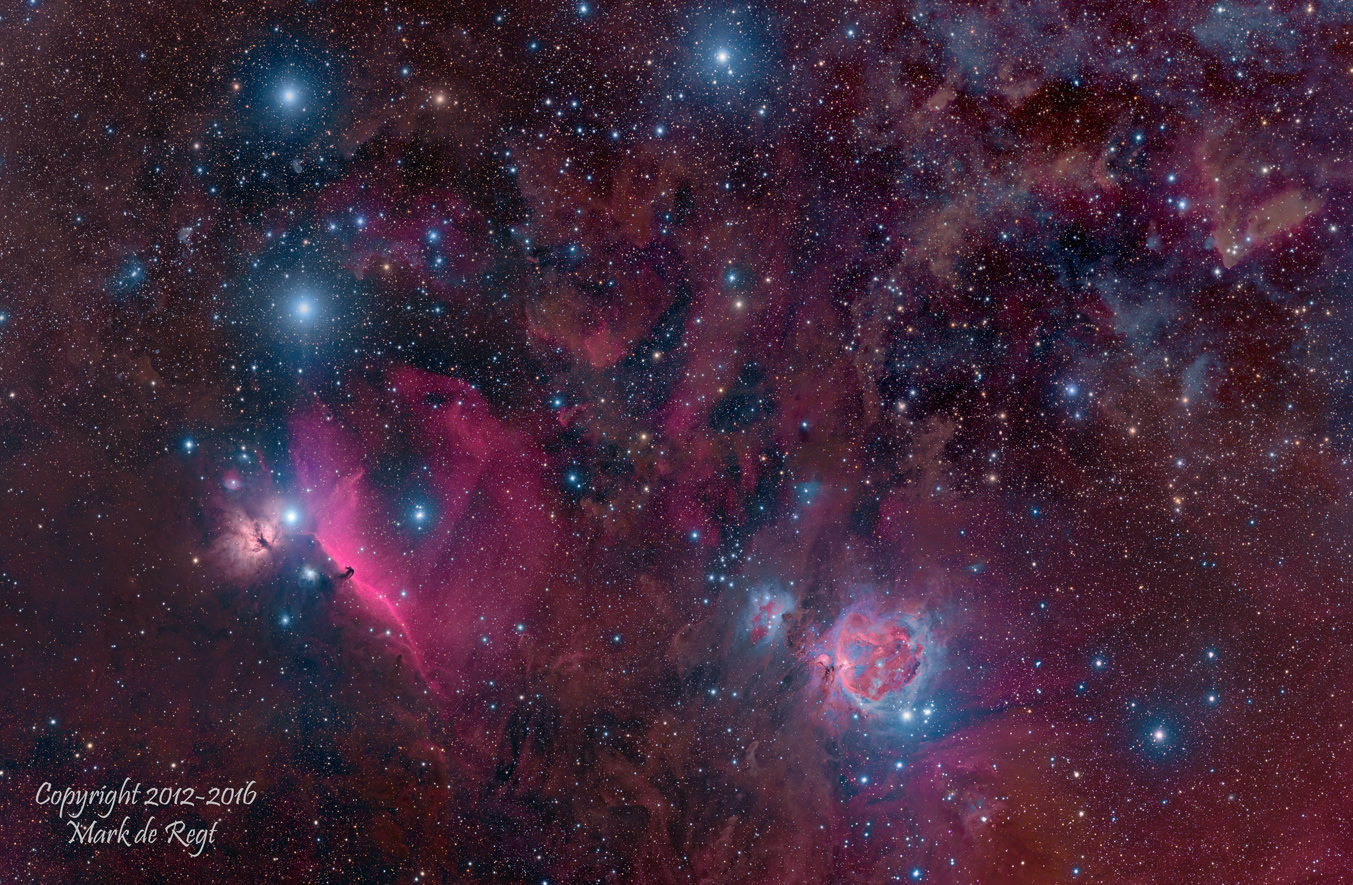
 Ten-Frame Mosaic of Central Orion Region Ten-Frame Mosaic of Central Orion Region | |
Hi,
Sometimes I get sucked into doing really crazy things. This started out, in late 2012, as a picture of something that looked interesting, the reflection nebula NGC1990. But when I processed my data, I realized that my field contained two of the three stars comprising Orion’s belt. So I had to get all three stars, which would include the Horsehead Nebula and the Flame Nebula. Well, then the Orion Nebula is right next door, I thought, so why not?
Over three years later, I learned “Why not?” It took me through most of winter 2012-2013 and winter 2013-2014 to gather the data, with generous framing of the two principal parts of the planned-image. Then it took me another year to learn Pixinsight well enough to re-commence processing images. Then it took me until November 2015 to gather the energy to tackle processing a nine-image mosaic. Then I found out there was a gap in my data, so I had to take one more frame, which I finally finished taking last week. PITA does not begin to describe it!
Anyway, I am pleased with the outcome, which I guess is a good thing!
IMO it looks better in the larger sizes (this image is 15% of full size, lateral measure), so you might want to click through to the higher-resolution versions eventually, if you have a good monitor. You can find a variety of higher-resolution versions here:
http://www.de-regt.com/Astronomy/Orion.htm
Central Orion Region: This is a decent-sized chunk of the Orion Molecular Cloud Complex, a large star-forming region in the constellation Orion. There\'s a lot going on here! (It looks better in the larger versions, because the tiny stars aren\'t so scrunched up and fuzzy-looking.)
The three very bright, blue stars in a column toward the left side of the field are the three stars that make up Orion\'s belt. Yes, the Horsehead Nebula (Barnard 33), a dark nebula, seen in silhouette against the bright emission nebula IC434 behind it, is right next to Alnitak. The Flame Nebula (NGC2024), an emission nebula of ionized hydrogen, energized by a bright new star obscured from us behind the dust of the nebula, is even closer to Alnitak than the Horsehead Nebula. The bright blue star above Alnitak is Alnilam, the middle star of Orion\'s belt; Mintaka, the third star in Orion\'s belt, is above Mintaka (close to the top of the image). The large, bright double-ball well to the right of the Horsehead Nebula is the Orion Nebula (M42). We see the Orion Nebula in our night sky as Orion\' belt--it is that bright. The Orion Nebula is one of the brightest nebulae seen from Earth, and is the closest region of massive star formation to Earth. The M42 nebula is estimated to be 24 light years across. It has a mass of about 2000 times the mass of the Sun.
The blue clouds are \"reflection nebulae,\" reflecting the light from bright, blue stars in their midst. There are a lot of reflection nebulae in this field (but not to be confused with the bright, blue stars in the field).
There are even some background galaxies showing through.
This area is about 1,500 light years from us; for scale, the horse\'s head is about five light years \"tall.\" The wispy shape of the ionized gases will change over time (thousands of years), as the stellar winds \"blow\" the nebulae.
The processing of almost all celestial objects requires \"stretching\" the histogram, to make all interesting things in the field visible (compared to the brightness of the brighter stars in a field, the dimmer objects would be invisible if the dimmer objects didn\'t have their brightness intensified relative to the brighter objects). So, for instance, in this field, the Horsehead Nebula is a very dim object, difficult to see (visually) even with a moderately large (say, 10 inch/254mm) telescope without dark skies and a good filter, while the Orion Nebula is easily visible with the naked eye. In this image, so that all are visible, they appear to have similar brightnesses, but they do not (without this sort of process, it would be impossible to show even the Orion Nebula as I have, since the brighter parts saturate the sensor in a very short time, while it takes very long exposures to get the dim, wispy stuff).
It contains approximately 150 hours of light-frame data.
Telescope: Takahashi FSQ106
Camera: Santa Barbara Instruments Group STL11000M
Mount: Software Bisque Paramount ME German Equatorial Mount.
Copyright 2012-2016 Mark de Regt
|


