This lens is one of the few I am interested among the MFT lenses.
It would be nice to know how the lens magnification changes with the distance.
For example, what is the lens magnification at 70 cm (the MFD of the 40-150 F2) and 140 cm (the MFD of the 300 F4)?
ruthenium wrote:
This lens is one of the few I am interested among the MFT lenses.
It would be nice to know how the lens magnification changes with the distance.
For example, what is the lens magnification at 70 cm (the MFD of the 40-150 F2) and 140 cm (the MFD of the 300 F4)?
Sorry, I did not make my question clear. I meant "what is the M.Zuiko Digital ED 90mm F3.5 Macro IS PRO lens magnification at 70 cm (the MFD of the 40-150 F2) and 140 cm (the MFD of the 300 F4)?
The specs indicate Maximum image magnification 1.00x and 2.00x(S-MACRO) at the Closest focusing distance 0.250m and 0.224m(S-MACRO), respectively. When the focusing distance is longer than 25cm, the 90mm Macro lens magnification should decrease. I wondered how much it drops from 1.00x and 2.00x(S-MACRO)?
To ask this differently: which of the two lenses one should use at 70 cm: the 90mm Macro or the 40-150mm F2 to get more of a macro subject in the frame? Also, which of the two lenses one should use at 140 cm: the 90mm Macro or the 300mm F4 to get more of a macro subject in the frame?
In real life, it can be difficult or impossible to get too close to some macro subjects (e.g., an insect). Then, shooting from a longer distance (for example, 0.7 to 1.4m) can be more convenient. Then, the practical question is which one of the available lenses has the best image magnification at such distances?
ruthenium wrote:
Sorry, I did not make my question clear. I meant "what is the M.Zuiko Digital ED 90mm F3.5 Macro IS PRO lens magnification at 70 cm (the MFD of the 40-150 F2) and 140 cm (the MFD of the 300 F4)?
The specs indicate Maximum image magnification 1.00x and 2.00x(S-MACRO) at the Closest focusing distance 0.250m and 0.224m(S-MACRO), respectively. When the focusing distance is longer than 25cm, the 90mm Macro lens magnification should decrease. I wondered how much it drops from 1.00x and 2.00x(S-MACRO)?
To ask this differently: which of the two lenses one should use at 70 cm: the 90mm Macro or the 40-150mm F2 to get more of a macro subject in the frame? Also, which of the two lenses one should use at 140 cm: the 90mm Macro or the 300mm F4 to get more of a macro subject in the frame?
In real life, it can be difficult or impossible to get too close to some macro subjects (e.g., an insect). Then, shooting from a longer distance (for example, 0.7 to 1.4m) can be more convenient. Then, the practical question is which one of the available lenses has the best image magnification at such distances?...Show more →
Sry this I cannot answer this it's beyond my knowledge
there is surely someone more knowledgeable in this area who can answer that
One of the advantages is that also 90 macro can be used with MC -14 - 20
When I shoot macro, I increased the f/stop as much as I can get away with.. You are only @ 5.6 with the 2.O TC and I would probably increase the f/stop to 5.6 (2 stops) to get more DOF.
When I shoot macro, I increased the f/stop as much as I can get away with.. You are only @ 5.6 with the 2.O TC and I would probably increase the f/stop to 5.6 (2 stops) to get more DOF.
Then the mosquito might be in focus.
I shoot the 9mm F/3.5 @ F11.
Tom
Tom
I didn't see the mosquito until I was home and had uploaded the pictures to the computer
but you are absolutely right about the aperture
Sometimes I want a little blur on the insect and I use the lens wide open
Ronny
Olympus E-M1X + OLYMPUS M.60mm F2.8 Macro by Ronny Olsson, on Flickr
Los Angeles has ben cold so not many bugs but I'll break out my 90f/3.5 and pair it with my OM-1 mark 2 and see what I can photograph. I also need to experiment with my two OM System flashes and various reflectors. I have no bird trips planned do it is macro time.
Hey Ronny—
Great shot! Question for you- what kind of lighting did you use, if any?
I recently started using the 60mm and was surprised how much my shutter speed was slowing down when I got really close to things. Ive really only used it on cloudy days so far, but an wondering if I need to use a flash or flashlight of some sort?
flash is good then shutter speed is less important as the flash does most of the work.. if I get too bad shutter speeds I raise the iso a bit
close macro images, you don't need very fast times if you are a little steady on your hand
Ronny
One with flash ( Godox V860 II ) many recommend the godox v350o
Olympus are fast and good 900R and FL-700WR
OM Digital Solutions OM-1 + OLYMPUS M.60mm F2.8 Macro by Ronny Olsson, on Flickr
I am just beginning. I did shoot underwater macro with a D-300/105 and dual underwater strobes on long arms and was near professional with my work. I shot is focus priority, not release priority with a +5 or +10 wet diopter. I shot at f11 to f22 and started closer than MFD slowly backing out until the camera had a focus lock.
This is my first attempt with my OM-1 m2 and the 90mm f/3.5. I am set at F11 and 1/250 or 1/200 second.
It seemed that the camera had difficulty focusing. There are 3 settings on the lens Macro, .25-0.5 meter and o.25-infinity meter. .25 meter is 9.84" MFD so I was moving in and out of range.
First shot was natural light. The camera/lens is a joy to use as it is very light
Second shot, the OLympus FL-900R will @ 1/10 sec but the combo is heavy.
My next try is the tiny FL-LM3 flash (that comes with the camera) as the trigger mounted on the camera and the FL-900 off to one side as I shot underwater.
So far unimpressed.
Tom
Natural Light
OM-1MarkIIOM 90mm F3.5 lens90mmf/11.01/250s25600 ISO0.0 EV
OLy FL-900 mounted on top of camera, TTL
OM-1MarkIIOM 90mm F3.5 lens90mmf/11.01/250s25600 ISO0.0 EV
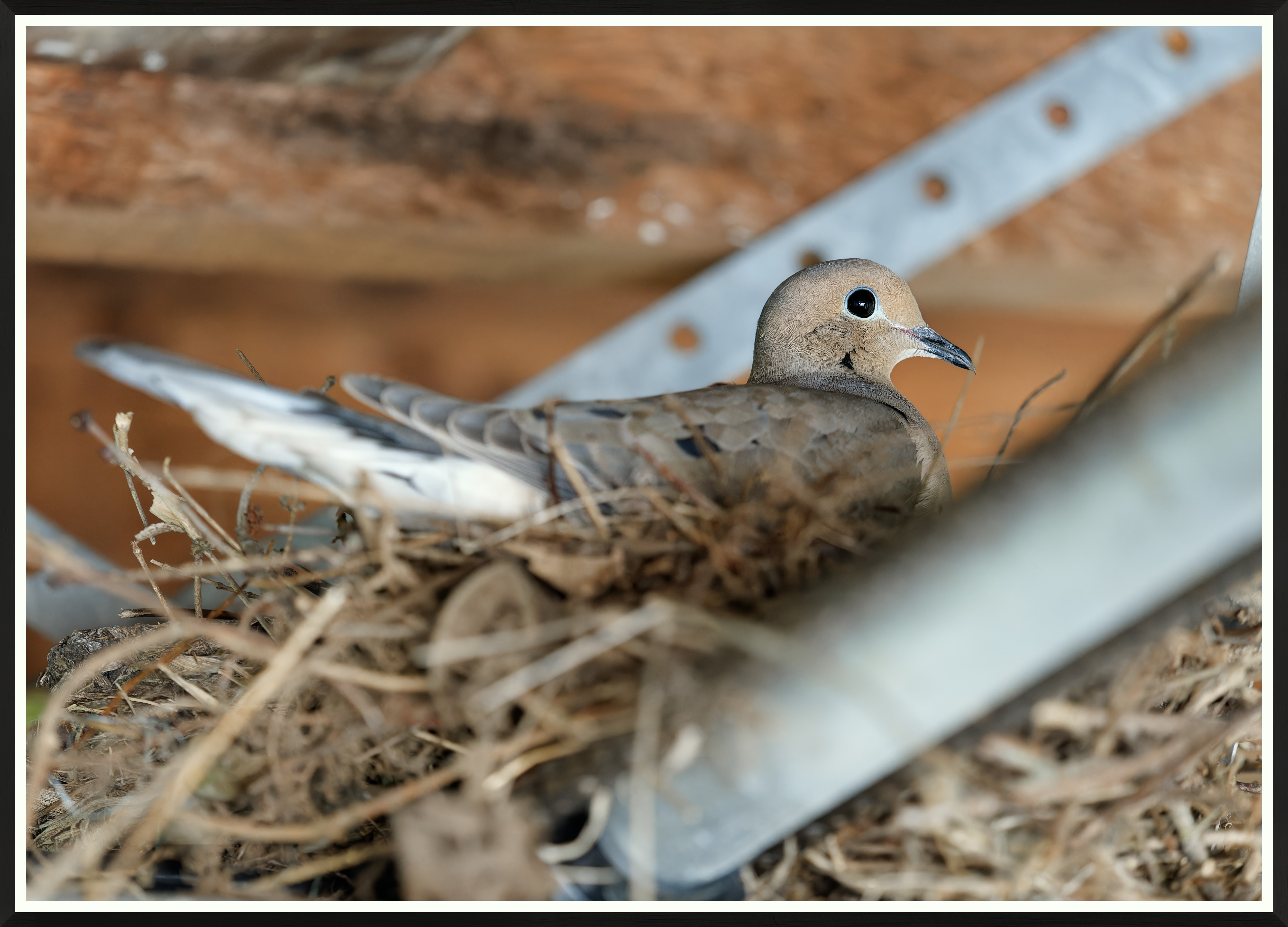
During the pandemic, a pair of robins made a nest in our garage. Now I see doves nesting there, although they didn't re-use the existing nest left by the robins, but built a new one next to it.
I took this photo this morning, on my way to work.
OM-1MarkIIOM 40-150mm F2.8 lens150mmf/2.81/160s3200 ISO0.0 EV
flash is good then shutter speed is less important as the flash does most of the work.. if I get too bad shutter speeds I raise the iso a bit
close macro images, you don't need very fast times if you are a little steady on your hand
Ronny - your work with small objects is really incredible. Could you tell me why you have decided to photograph some of your images with Sony cameras and other with Olympus. I have owned Sony's for many years and just dipped my toe in the water with Olympus.
jmmaher wrote:
Ronny - your work with small objects is really incredible. Could you tell me why you have decided to photograph some of your images with Sony cameras and other with Olympus. I have owned Sony's for many years and just dipped my toe in the water with Olympus.
Jim
Hi Jim and thanks
I got the Olympus system last year and then mostly for macro, I like the functions that are on Olympus .. pro capture, focus bracketing and/or focus stacking in camera, easier to get better depth of field, know that some of these functions are now available on newer Sony body,, however at a completely different price level, I would like not to be without fx, but just for macro photography the Olympus feels better and more fun
there are both advantages and disadvantages to the system .. worse iso maybe and worse bokeh in some cases, more crop sensitive, only 20MP etc.
but I really like the system and the 300 f4 is a really nice lens
Ronny
stacked image
OM Digital Solutions OM-1 + OLYMPUS M.300mm F4.0 by Ronny Olsson, on Flickr