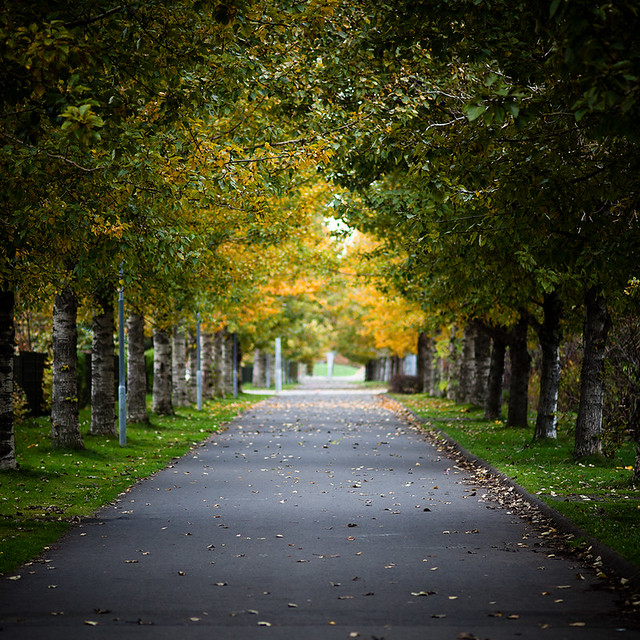
This is a cross posting from the Leica thread, but I thought it might be interesting here as well - shots taken with the Zeiss 18/4 Distagon. I violated my own rule of not ever getting a lens slower than f/2.8 when buying it but so far I'm very happy. At f/4 it looks like it is the equal of the 21 Distagon, which is saying a lot.
Luka, great shots, which beget a question: I have read that a very wide lens of an older design on a digital sensor can generate colour shift, and that this was the case on Zeiss lenses wider than the 25. Is that the case, otherwise a 18mm on my NEX would be a very welcome addition at an effective 27mm plus almost unlimited DOF...
Regarding color shift, yes, it's pretty strong on FF but there are a couple of choices there. One is coding it as a Leica lens and get the built in corrections (which removes 90% of the red/cyan shift). The images above were incorrectly coded so the shift is clearly visible. The other is to use CornerFix, a program that removes all traces of color shift and works directly on DNG files. On crop, from what I understand the color drift is not a real problem. The ZM 18 is very popular on M8 which has the same crop factor as the NEX (1.5x). So it should be a good choice.
Well, the M8 has a 1.33x crop, and still needs to corrections for the ZM18, but it is a bit nicer since the Leica 18 corrections are fine for the crop sensor, AFAIK.
The color shift is mainly due to the UV/IR filter, which on the M8 is infront of the lens. So if you remove the filter, it's gone. On the M9, the filter sits on the sensor which is a bit worse (depending on how close the rear element is to the sensor). But of course more convenient in most cases.
Makten wrote:
The color shift is mainly due to the UV/IR filter, which on the M8 is infront of the lens. So if you remove the filter, it's gone. On the M9, the filter sits on the sensor which is a bit worse (depending on how close the rear element is to the sensor). But of course more convenient in most cases.
Not quite Makten. An IR filter accentuates the red drift but the drift is because of the ray angle. Simply put, with film it isn't important at which angle the light hits the medium. With a digital sensor it does - a too steep angle and you get the color drift. Now the M9 sensor has been designed with this in mind with increasing angle of the photo sites toward the edges. What they could not do with that they have addressed with software (lens profiles). There are however lenses where the rear element is very close to the sensor and the exit pupil of the lens is very small so the ray angle becomes really extreme. The two worst lenses in that respect are the Zeiss 18/4 Distagon and Zeiss 21/4.5 Biogon.
denoir,
you shots are inspiring and I really enjoy them, but the few on this page look fairly cropped. for instance, 21mm gives about a 90 degree field of view but your shots don't really convey that. can you confirm?
Thanks Jim. Actually none of the shots that I've posted on this page have been significantly cropped (some have been slightly rotated to adjust the horizon). #3 in the first series on this page is the only one that has been significantly modified - it has actually been stretched vertically (without constraining proportions) as the original shot looked kind of squashed.
denoir wrote:
Not quite Makten. An IR filter accentuates the red drift but the drift is because of the ray angle. Simply put, with film it isn't important at which angle the light hits the medium. With a digital sensor it does - a too steep angle and you get the color drift. Now the M9 sensor has been designed with this in mind with increasing angle of the photo sites toward the edges. What they could not do with that they have addressed with software (lens profiles).
As far as I know, the pixels on the M9 are normal, and only the micro-lenses are shifted progressively towards the middle as you near the edge and corners.
There are two kinds of IR filters, and the ones used in Leica's lens filters for the M8 are the interference type, as is the (too-thin) filter on the sensor. Several thin coatings are deposited with thicknesses around the wavelength of the undesirable wavelength of light, i.e. IR here. This cuts the IR very effectively, but towards the corners, as the light impinges at a greater angle, the distance between the layers of coatings are no longer the right size, and some IR is let through, hence the in-body corrections on the M8.
On the M9, they used an IR-absorbing filter on the sensor instead. This type is generally less effective, unless you can get it thick enough, but having a thick piece of glass in front of the sensor causes secondary (and tertiary...) reflections, leading to ghosts and lacking sharpness. Leica found a way for the M9 to keep the filter thin, but still make it effective. I expect another notch of improvement in the M10.
carstenw wrote:
As far as I know, the pixels on the M9 are normal, and only the micro-lenses are shifted progressively towards the middle as you near the edge and corners.
It's possible, even probable that it's the micro lenses and not the pixels. I used the encompassing expression "photo sites" because of that. This is what Lloyd Chambers writes:
The M9’s sensor was specifically designed to accommodate the increased ray angles by orienting the photosites somewhat more towards the expected ray angle, but this is only mitigation, not full compensation, and of course the ray angles vary with each and every optical design (lens).
Too much Leica-tech talk! ;-) And I also need to up my post-count after all these years of lurking :-)
Zeiss 100 Makro-Planar is my most favourite lens of all time, and I have had quite a few lenses. No matter what the circumstance, it delivers. I have had the ZE21 in my bag for the same amount of time, but it gets probably 20% usage in comparison to the ZE100.