I greatly appreciate your systematic, well-controlled approach to technical issues in macro photography. In my personal opinion, your many controlled scientific experiments using relevant test objects are especially informative. They provide a solid comparative basis from which each of us can draw our own conclusions and/or perform similar experiments for our own purposes. IMO, simply posting an opinion, perhaps supported by a single photo, is much less informative and harder to interpret.
Changing a single variable at a time and providing as much quantitative information as is practically available are also very helpful and very important and interpretable. Of course, at the front lines a photograph is influenced by a combination of many technical variables and aesthetic considerations but without an understanding of key variables in a controlled scientific manner, it is very difficult to make sustained, predictable progress.
I'm a (retired) scientist and freely confess to being biased in these matters and hope that others also appreciate the value of your tests.
Thank you very much for ongoing research and educational regarding the many details of understanding macro photography.
Thanks for the comments DQE and The1- much appreciated.
DQE -Think we have the same mindset although when I was at work we often did multifactorial experimentation which is great for working out the relationships of different factors affecting a parameter. The one downside of this experiment is I could not figure out a way of easily measuring the diffusion level.
I have put this simplistic view of lighting in responses before, but I am still coming back to the same conclusion...there are only 4 aspects of light that I can identify:
1. Direction (including angle and area of source(s) )
2. Intensity
3. Duration (up to the length of the SS, of course)
4. Color (range of wavelengths available)
I do think that for avoiding highlights, and for evenly distributing the light, the bigger the source the better, and depending upon steh effect you are looking for, more than one angle.
I assume the Intenstiy and duration can vary indirectly for the same lighting effect, alhtough I do accept that too long a duration may in fact allow for some motion blur, although I struggle a little with this idea, since we are generally talking about about lnegths of time that woudl be lighting fast shutter speeds, so I am not fully convinced. If duration is a big deal for motion blur, then we all ought to have super powerful flashes to avoid long durations.
I do think the spectrum of wavelengths matters greatly. I would be interested to see a study of what the difference in availbale wavelngths on a day when the sunlight brings out the best in all the colors vs. a dull or too bright day.
Anyway, just my musings. Curious about other opinions, but not interested in a big fight over flash duration/motion blur.
LordV wrote:
... I have tried a much narrower diffuser which is fine for shots around 3:1 or higher but it didn't perform anywhere as near as well as my larger one at lower mags.
My flash to subject distance may be shorter than yours -the further your flash is from the subject the larger your diffuser will need to be...
LordV wrote:
In many of the shots I take I rely on light scattering from the background - I actually like the effects it can give
I don't see you shooting critters on bright yellow flowers much
MichAg92 wrote:
...alhtough I do accept that too long a duration may in fact allow for some motion blur, although I struggle a little with this idea, since we are generally talking about about lnegths of time that woudl be lighting fast shutter speeds, so I am not fully convinced. If duration is a big deal for motion blur, then we all ought to have super powerful flashes to avoid long durations.
The shutter speed will only be lighting fast if you can use the flash at it's lowest power setting Amy -but the odds of being able to do that and get a proper exposure are low. Now add in the stop loss from the diffuser, and realize that for every stop the flash has to turn on twice as long. A two stop loss is a four fold increase in flash duration...
Check out the video on this page. It's not about macro, but it is about freezing motion with a flash. To get the shot Chase Jarvis kept the flash duration of his strobes to 1/8000 of a second. Although that's well within the range of a standard camera flash you have to get that flash close to what you're shooting, and make sure that you're not blocking too much of the light from your flash, to get those kinds of speeds. In macro the shorter you can keep that flash duration the better -Chase was trying to freeze a splash of water from a distance and not trying to freeze a scene in which movement of no more than a pixel can rob you of detail...
Sanlameer wrote:
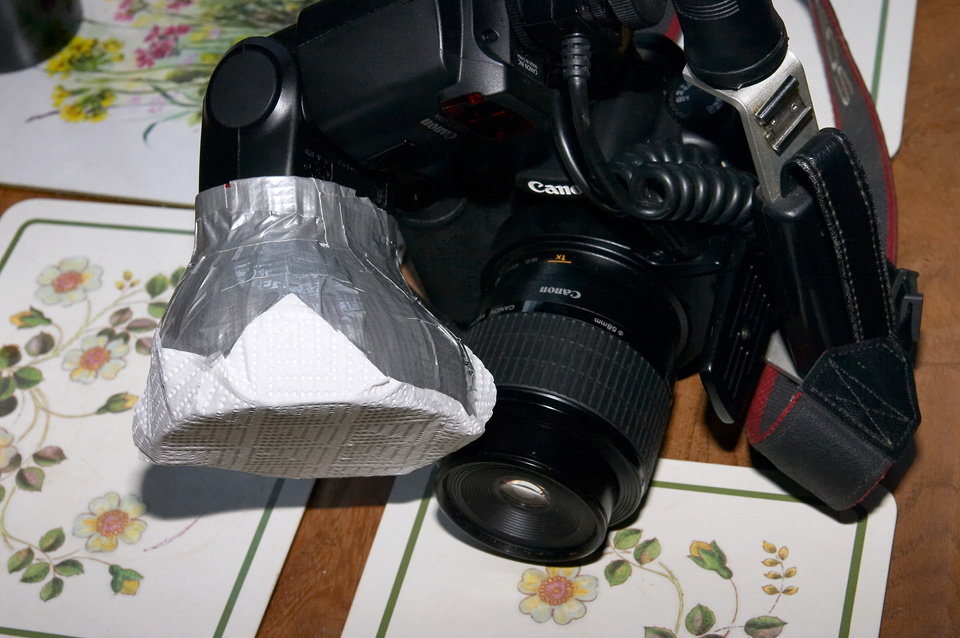
How does your setup work? Picture please.
Ben
Sorry Ben - only just spotted your question - pic of my coke can diffuser below. What I'm testing here are different materials over the front of it.
MichAg92 wrote:
I have put this simplistic view of lighting in responses before, but I am still coming back to the same conclusion...there are only 4 aspects of light that I can identify:
1. Direction (including angle and area of source(s) )
2. Intensity
3. Duration (up to the length of the SS, of course)
4. Color (range of wavelengths available)
I do think that for avoiding highlights, and for evenly distributing the light, the bigger the source the better, and depending upon steh effect you are looking for, more than one angle.
I assume the Intenstiy and duration can vary indirectly for the same lighting effect, alhtough I do accept that too long a duration may in fact allow for some motion blur, although I struggle a little with this idea, since we are generally talking about about lnegths of time that woudl be lighting fast shutter speeds, so I am not fully convinced. If duration is a big deal for motion blur, then we all ought to have super powerful flashes to avoid long durations.
I do think the spectrum of wavelengths matters greatly. I would be interested to see a study of what the difference in availbale wavelngths on a day when the sunlight brings out the best in all the colors vs. a dull or too bright day.
Anyway, just my musings. Curious about other opinions, but not interested in a big fight over flash duration/motion blur.
Tend to agree with you Amy re the size of the diffuser - you only have to look at the cloudy sky scenario to see that.
Thinking about it I think the size of the light source to subject size can be a bit mis-leading in macro where you'd naturally think the light source is pretty big compared to the subject but I suspect the strongly reflective and curved surfaces of many subjects come into play here as they act as convex reflectors.
The colour of the light is another area altogether. I tend to colour temp adjust my pics with flash to what I thought I saw in the viewfinder. In most cases the flash shots are much warmer especially with a mainly green background and I tend to drop the colour temp a bit. But when I'm shooting against white/grey or black backgrounds the colour temp with flash seems to be correct and I don't need to adjust. I'm guessing this has something to do with the way AWB works on the camera.
Love the weevil shot Brian -could turn it to the left and it would still work
One of the problems I've had with the MT-24EX is that the flash heads are sometimes too low for the angle that I'm shooting from -lots of yellow light getting bounced back up into the subject. Looks like you've kept your flash at a high angle relative to the subject and the sensor in those shots -something that I'm working on with the twin flash. The hard part is getting a higher angle, being able to shoot at 2x and higher mag, and not cast a shadow over the critter. I find myself shooting in bright sunlight way too much...
I was doing a search on my user name at Flickr (someone is stealing images again -sigh) and stumbled upon the post that Brian made on Flickr with this comparison test. I'm posting here the same text that I posted to that image:
"I was doing a search on my user name (MJ alerted me to an image thief) and I came across this post.
Excellent comparison Brian! I do see a relationship between the flash duration and the blown highlights in the red channel in your test shots -I see it even worse with the MT-24EX. If you look at those histograms there are more pixels to the far right, and a much higher spike, as the stop loss from the diffuser increases -and as the stop loss goes up so does the flash duration. Something I tried to point out at Fred's but it was glossed over.
I haven't done any comparison shots like yours -probably will this winter. But from all the experimenting that I've done with different diffusion plastics this year I'm convinced there is a direct relationship between flash duration and blowing the red channel -a relationship that's painful with the MT-24EX. The angles that I'm shooting from, and the angle of the flash relative to the subject and the sensor, also plays a part in blowing the red channel when shooting against bright colored objects like flowers. I'm currently at -1 FEC full time with the MT-24EX and on my next outing I'll be at -1 1/3 FEC..."