Sean7236 wrote:
Can someone clarify exactly how the aperture is set prior to reversing the lens? From what I can pick up, you set the aperture with the lens mounted normally, then push the DOF preview buttion, then remove the lens and mount in the reverse - is that it?
If so, do you turn off the camera when changing the lens around or must it be left on?
Also what are the optimal aperture ranges for macro?
That is certainly how to do it with a canon camera body- not sure if it works with other bodies (you do have to keep the DOF button depressed whist removing the lens). The lens will reset next time it's mounted normally.
re- apertures depends on whether you are shooting natural light or flash but in natural light say F6.3 to F11 and with Flash say F11-F16 when shooting around 1:1.
Brian v.
Just my two cents, but there are reasons to use macro specific lens.
I have used reversed lens and suggest some flavor of the ASAHI PENTAX SUPER TAKUMAR. The 35mm and 50mm focal lengths are widely available on ebay or other sources at prices you can afford. The down side is that many subjects will scurry away when they see a Rube Goldberg contraption of a DSLR, lens, reverse mounted lens, and plastic bowls attached to a flash system headed for them.
I have also used low end and high end CU filter. The Canon 500d and Nikon 6T are both fine choices. The lower end models work well enough, especially since most of the time only a small part of the image needs critical focus so poor edge IQ is not a big problem. They have advantages of not losing a stop and you can easily and quickly remove them to take advantage of normal photography shots that may present themselves. There is sometimes an IQ hit with a CU filter compared to a dedicated macro lens.
One thing I have not seen mentioned is extension tubes. Depending on where you get your adapters and lens to reverse stacked ETs can be as cost effective as as this method. There are standard techniques to figure out what kind of f-stop hit you take with ETs; something I have not seen for reversing lens. For me the biggest advantage of using ETs is the working distance. I often stack three ETs behind my 400/5.6 or my 500/f4. In both cases I can get a working distance of just over 5 feet. As with CUs there is sometimes an IQ hit; but I will repeat the working distance is 5 feet or more.
The Swift Blue Darters were captured using my 400/5.6 and 86mm of ETs.
These were some of my earlier shots and probably would have been better shot at f11, or maybe even higher. In both cases I was well over 5 feet away, and the dragon fly shot was hand held. Natural light in both cases.
Speaking of light one thing I have found to be a nice cheap toy to play with is those sun screens you put behind the windshield of your car to block the sun. I have several, but my two favorites are one that is colored light gray on one side and black on the other and one that is light bronze on one side and dark brown on the other. I use them as reflectors, to block the wind, and to provide a simple background for shots.
This image was captured with no sun screen behind the subjects
And I would be remiss if I did not provide at least one image shot with my Sigma 150mm macro, which I consider the lens that most consistently produces good images for me. If you can afford one I highly recommend one.
I did not know the leading edge of a Swift Blue Darters wing was in the shape of a triangle or that the covering could be ripped till I looked at the original image.
None of these images came from my main macro gallery located here
I agree, the best equiptment is not going to gaurentee good shots, and cheaper equiptment and innovative setups will delive with the right know how.
I think understanding lighting is the most important, and i think the most versatile will be am external flash, which you can use for other things.
I was selling my 28-80mm canon lens so i shot some example pics. One of canons most basic lenses, used 68mm kenkos, and off camera flash diffused. Can get nice 1-2x magnification shots
Yeah, I think I'm agreeing here when i say that shooting with a reverse rig is probably the worst way to go unless you're also on a bellows at the same time. The distortion, field curvature, and vignetting from almost every lens I've reversed is just terrible - unacceptable IMO - and I have pretty low standards. The best results so far have been with a EL-Nikkor 63mm f/2.8 manual enlarger lens. But even that needed a bellows to get beyond the curved DOF field and edge distortion when reversed.
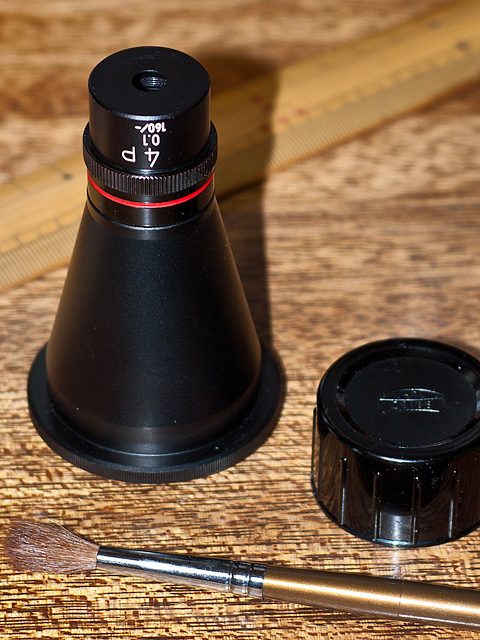
Next up from that IMO is shooting with microscope objectives. This also gives you the hyper-curved DOF fields but often no distortion. It's pretty cheap too. A rig like below can be put together for like $60 all total - including the objective if you do a little hunting:
Cone adaptor for RMS Thread to M42 Thread conversion + M42 to camera mount adaptor (not shown) + Microscope Objective.
Next up the quality ladder from that it seems to be a toss-up between a good "AC" close-up filter at about No.4 or No.5 on your existing macro or non-macro lens and hunting down a good deal on a used macro lens on e-bay. Both come in at around $50 and either can produce images like the best shown in this thread so far.
And at the top of the heap is probably a dedicated high quality Macro Lens and/or a bellows with "a good lens" attached to it. These solutions are costly however and that's not really in the spirit of this particular thread - I think.
Again, I think I'm agreeing with most of you here when I say that lighting for macro is extremely important. At least as important as the lens and if the lens is satisfactory or "good" then lighting is certainly the most critical factor thereafter.
I am still on the fence about the reversed lens method. I like a single lens reversed directly on the camera body. I get no vignetting, and a rather flat DOF with my 18-55 reversed on my D5000. I do use a 10x close up on the reversed lens, between the body and the lens. I don't know if that flattens the field or not. Conversely, I do not recommend reversing a second lens onto another lens. The vignetting is severe at best. I get the same magnification at 18mm on my kit zoom as I do with my 70-300 zoom and the 18-55 reversed onto it. I do not own a dedicated macro, so I cannot comment on that just yet, but I hope to get the new 85mm from Nikon for Christmas.
On the other hand, I do agree whole-heartedly that lighting is crucial. Since I'm so cheap, I don't have an external flash yet, but have been able to make due in most situations. That being said, there is an SB-400 and an off camera cord in my near future. Here are two of my latest with the reversed 18-55 and 10x filter.




 I like the moths wing. I'll have to try that when I get my flash setup.