lbuscher wrote:
Hi Chris, I got your PM and I think you will do the right thing here. First of all I am thinking they are both young birds and most likely first nesting as the RSH likes to nest in a hardwood tree (Oak, maple) and most of the time hight does not matter as they like the first heavy crotch but yours have picked a pine. Little different but thats life. OK remember this, its a lot easier to drive a nesting raptor off eggs/egg than it is off of the young so if you get to close you really can't see into the nest and most of the time she will let you know if your to close. While incubating I would stay away for at least 3 weeks and keep the nest to yourself at this time. Others may see it bit not hold the interest you do. Should you see any one going close and causeing a disturbance tell them they are breaking the law and if they continue you will call the authorites Nesting raptors of all kinds are protected by law. I would suggest while your waiting out the incubation to find a good spot at a fair distance that allows you some view into the nest and pay attention to the sun when you look for a spot. You should try to keep at least 250 feet if you can and even more if you have the glass to support it. It is very important when the eggs hatch that you not drive either parent off the nest if it is hot as a youngster can cook in a very short time. Remember heat and cold they have no feathers and relay on the parents for that protection so it goes a bit more than just protecting the eggs. Consider yourself really lucky in your find and if you take care of them they will be back for many years for your enjoyment.
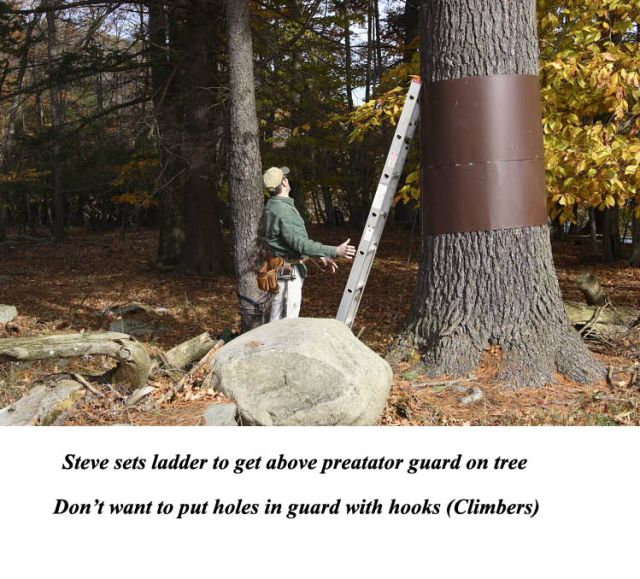
One other thing, the land, is it private? If so ask the owner if you can place a predator guard around the base of the tree and trim off any saplings that could allow a coon to get up into the nest. BTW be sure your spot you pick will have an opening for the young to leave the nest for first flights and you to see it. Don't worry about if one lands on the ground just keep an eye on it so no predator can get to it and the parents will feed it on the ground or it will most likely be able to fly up to a branch for protection.
Lou...Show more →
Thanks, Lou. Let me tell you a little bit more about this location and some observation of the female on the nest yesterday. This location is an office park inside the perimeter of the City of Atlanta, and the office park surrounds a large swampy area with some small lakes, so it is crawling with birds. There is another pair of adult RSHs that have lived in the southern part of this area for years and I see them all the time too.
This area is busy with people working and visiting the office buildings during the week and quite popular with local birders on weekends. In fact, one of my friends told me about the nest, which got me at least in the right area to find it, but she has not publicly disclosed the location.
Let me describe the area immediately around the nest for you. The nest is in a line of pine trees immediately next to a road within the office park -- I mean literally 10 feet from the road! There is a parking lot about 50 feet away in one direction, and an office building also about 50 feet away. There is no sidewalk so I doubt many people are walking immediately around the nest, but there are lots of people walking 50-100+ feet away pretty much all the time, and cars are driving by within 20-30 feet as well.
When I saw the female get onto the nest on Sunday I walked around to see where I could get the best angle to take pictures. The terrain is very flat and there is absolutely no way I will see into the nest unless I put a ladder up on another nearby tree and climb! So I camped out about 50-60 feet from the tree (literally standing on the curb of the street) and sat there quietly for about an hour. I could just barely see the top of her head and her eye with her sitting on the nest. She did not react at all to my presence. She looked around a little bit when some crows flew overhead, and a couple of cars driving by also got her attention, but she was completely silent and moved only her head the entire time I was there.
I will definitely be careful to watch their reactions whenever I go back to check them out.
Can you tell me what a predator guard is and how involved it is? I know some people who work in the office park so installing one may be possible, the problem is that if it is visible it will mark the tree where the nest is.
Thanks again for our thoughtful and comprehensive comments, Lou.
Well Chris I have to admit I lost some sleep last night just thinking about this pair of RSH. My God the one posted can’t be much more than 10 months or so as it does not even have the rusty red breast or shoulder yet. It still looks immature and I have to wonder if they will make out OK being so young, like two teenagers making a mistake in the backseat of a 50 Merc.
Ok as for this pair I guess I would have to say they are pretty much on their own from the nest location they picked so all you can do is see what happens. BTW avoid getting above the nest on a ladder or where they can see you, this is the one thing any raptor can’t stand and will take flight. As for the guard I guess you can forget it unless you feel it is really necessary and I am showing a photo of one on a large white pine with an eagle nest about a hundred feet up. If you try to do it now you will disturb the young Mom. I can only wish them luck. They have a good keeper.
Lou
Chris this is awesome.. your very own trained RSH.... How cool is this I have yet to train one of these. I can't wait to see you with one of the babies, do you think mom will let you hold one Keep us posted on their progress.
lbuscher wrote:
Well Chris I have to admit I lost some sleep last night just thinking about this pair of RSH. My God the one posted can’t be much more than 10 months or so as it does not even have the rusty red breast or shoulder yet. It still looks immature and I have to wonder if they will make out OK being so young, like two teenagers making a mistake in the backseat of a 50 Merc.
Ok as for this pair I guess I would have to say they are pretty much on their own from the nest location they picked so all you can do is see what happens. BTW avoid getting above the nest on a ladder or where they can see you, this is the one thing any raptor can’t stand and will take flight. As for the guard I guess you can forget it unless you feel it is really necessary and I am showing a photo of one on a large white pine with an eagle nest about a hundred feet up. If you try to do it now you will disturb the young Mom. I can only wish them luck. They have a good keeper.
Lou ...Show more →
Lou, thanks again for your comments. I didn't mean to suggest I was going to actually take a ladder out there and scale a nearby tree, so I defintitely won't do that.
I also won't try to put a predator guard on the tree -- the nest is definitely low enough to the ground that I think it would disturb the hawks to install one. At least they appear to be guarding the nest and taking turns doing that.
I share your concern about whether this will be a successful nesting because of the age and inexperience of the female, but then again this female is very likely the offspring of the established adult RSH pair that lives about a quarter of a mile to the south in the same wetland area, so the fact that she is growing up and even starting to nest is a success story in itself.
I will post updates on the situation as it unfolds, or if I have a specific question for you I may PM you again. Thank you again for all your advice.
72chevelle454 wrote:
Chris this is awesome.. your very own trained RSH.... How cool is this I have yet to train one of these. I can't wait to see you with one of the babies, do you think mom will let you hold one Keep us posted on their progress.
I think it is cool too, but I am trying to keep my expectations about holding one of the babies in check! I feel lucky just to know the location of the nest!
Chris Willis wrote:
I think it is cool too, but I am trying to keep my expectations about holding one of the babies in check! I feel lucky just to know the location of the nest!
Chris
Watch those talons with one eye and the beak with the other. I am sure if blood is spilled it won't be theirs I would think the only reason you would need to handel one is if there is a nest trouble and to know what to do take a look at the link on my home page for the DVRC and look up how to rescue a raptor. Right now I suggest you place and old blanket in your car and leave it in there and if you have room for a carboard box would be great. Never place one in a cage as it will hurt itself. Read that link.
( www.loubuscher.com ) on the home page. Pair of welders gloves won't hurt either
Lou
Lou.
Chris, Wow! Good for you. The information shared by you and Lou is just great. I watched a nesting pair of Cooper's Hawks and their 4 young ones for several months until they took off. It was a wonderful experience for me and I am sure the time you spend following and watching the RSH will be similar. Yes, keep us posted, please. Steve W
alameda wrote:
Chris, Wow! Good for you. The information shared by you and Lou is just great. I watched a nesting pair of Cooper's Hawks and their 4 young ones for several months until they took off. It was a wonderful experience for me and I am sure the time you spend following and watching the RSH will be similar. Yes, keep us posted, please. Steve W
Thanks, Steve. This is the first time I have ever had the opportunity to monitor an individual pair of birds over time like this and I am really thrilled by it, especially since they are so calm about having their pictures taken. I am going to try to check on them either today or tomorrow, so if I get any more pictures I will post an update.
Chris for some reason I lost your PM so her you go
Chris, Well in New York this would be the time for incubation. When this starts one of the birds (mostly the female) will do the most sitting and the male will bring her food. However this is not carved in stone as in all raptors the female is the larger of the two so she can be the boss and might just feel like a little jaunt about for some wing stretching but either way one of them will be on the eggs unless something is wrong.
After the incubation is complete one of the parents will still remain on them, as they really have no protection from heat or cold. Take a look at the first link and then the second one. You can see just what these little guys look like when they are just out of the egg and as they grow. The other shows I believe to be the female protecting the young (she had 2 that year) from a very strong sun and heat so really it takes several weeks before both parents can go back to hunting. I had a lot of mice getting in my house so I set traps every night and when lucky (not for the mouse) I would bring them some easy food.
Anytime they are upset you can tell from the cry as it is a very strong KE-AH KE-AH KE-AH you can tell for sure. Sounds like things are going good. They can go from one to 4 on the young but in most cases the #4 don’t make it due to the time lag in the hatch and it is the smallest of the group so be prepared for this.
Lou
Lou, thank you for your continued advice. I am going to go back and check on them Sunday morning, probably. I was relieved to find one of them on the nest yesterday afternoon, as I take that to be a good sign. If the incubation period for the eggs is about 33 days as my reading suggests, I am expecting the eggs to hatch in about mid- to late-April. I saw them mating on February 24, but not sure how soon after that the eggs would have been laid. Given the nest position I doubt I will be able to see the chicks until they are big enough to start climbing on the edge of the nest and the nearby branches. The good news is that the overhead canopy is very good, which will shield them from the sun quite effectively. I guess that is one advantage of using a pine tree instead of a hardwood.
nice shots. I have looked at these birds a couple of times, and I am not convinced that they are red-shouldered hawks. I have looked through all of my bird books and these birds do not look like the RS hawks in the guides. All adult RSH have distinct light and dark bars on the tail. Can you see those when you photograph the bird in different positions or when it is in flight?
wiens51 wrote:
nice shots. I have looked at these birds a couple of times, and I am not convinced that they are red-shouldered hawks. I have looked through all of my bird books and these birds do not look like the RS hawks in the guides. All adult RSH have distinct light and dark bars on the tail. Can you see those when you photograph the bird in different positions or when it is in flight?
Gerald
Gerald You know you have a good point there as the first time I looked at the photos I commented that I could not believe these were mating RSHs as the one looked about 10 months of age and lacked the rusty red breast and shoulder but to me it does look a lot like an immature RSH as I compared them also to my nesting pair I monitored for 4 years and the young do have this plumage look. Below are two of the fledged from this nest and they are about 16 to 18 weeks old here. They do appear much lighter but the older they get they do get darker with the plumage. You can see all the nesting photos for a comparison if you like at .http://www.loubuscher.com/Red%20Shoulder%20Nesting.htm.
A few things I noticed that threw me a curve was they nested in a pine, something the RSH does not do for the most part and the lack of the rusty red breast but things being what they are and I figure they must be young birds as I can not say for sure they are not RSH so Chris is seeing them and like people some look different depending on the plumage and right now it should be good. The one way I know for sure is if they are a RSHs their cry is unmistakable and I have recorded it but it is a wav file and I can’t post it on here but if you go to the Cornel U. and search it out they should have the sound of it on their site, or if you send me your email address I will be glad to send it to you or Chris. My info is on my home page.
Lou
Hello Chris
Just spent some time catching up on this post. I do remember you 1st post of the mating pair and remembering I was thinking how lucky your were to be there. It may seem a bit strange but for some reason this all seems 'meant to be' for you. I read where Lou says you will 'do the right thing' and I am convinced he is right about that, and I am sure you will share a lot of 'right' with others about your venture.
It appears to me you have been the adopted 'adult' of the immature pair to watch over them, enjoy this offering, it is quite a natural gift to be given and I am sure it will be quite a moving experience for you too.
Karl Witt wrote:
Hello Chris
Just spent some time catching up on this post. I do remember you 1st post of the mating pair and remembering I was thinking how lucky your were to be there. It may seem a bit strange but for some reason this all seems 'meant to be' for you. I read where Lou says you will 'do the right thing' and I am convinced he is right about that, and I am sure you will share a lot of 'right' with others about your venture.
It appears to me you have been the adopted 'adult' of the immature pair to watch over them, enjoy this offering, it is quite a natural gift to be given and I am sure it will be quite a moving experience for you too.
Thanks, Karl, I do spend a lot of time wondering how they are doing, and hopefully I will catch up with them tomorrow morning (although it will likely be raining here, so no pictures). I feel extremely lucky about this whole situation and I am really looking forward to seeing how it develops over the next couple of months.
wiens51 wrote:
nice shots. I have looked at these birds a couple of times, and I am not convinced that they are red-shouldered hawks. I have looked through all of my bird books and these birds do not look like the RS hawks in the guides. All adult RSH have distinct light and dark bars on the tail. Can you see those when you photograph the bird in different positions or when it is in flight?
Gerald
Gerald, the two shots in this thread are an immature female RSH. When I first started taking pictures of her, there was some confusion about what species she was (and we had a big discussion about it on this forum that went on for over a week), but the second time I ran into her (and when I have seen her since), she has been making a lot of noise and there is no doubt from her call that she is an RSH. To make the identification clearer, here is a picture of her with her mate -- no question about the RSH identification here:
I appreciate that she doesn't look like a RSH is supposed to, which is why a lot of us were confused at first, but since I have seen her four times in the last six weeks I can confirm that is what she is.
we do not have RS hawks in Kansas, but I know for sure that no two red-tailed hawks look the same. Not surprising that there can be variations in other hawk species.


 I have yet to train one of these.
  I can't wait to see you with one of the babies, do you think mom will let you hold one
 Keep us posted on their progress.