Paul Buff wrote:
None of this is going to tell you whether they will work with an inverter. You need to ask him "At what AC voltage does the power supply drop out and crash the uP?"
What it will tell me is what power inverter I will need at minimum to deal with the amperage spike.
Technically, yes. Practically you're not likely to get enough info from either the light or inverter mfg to really tell what will or won't work together. That's why we stay away from trying to define using Vagabond with brand xxxx lights. We know they work with our lights.
Paul, your stuff rocks! Love the vagabond unit. I've made my own unit to use with my white lightnings..but I like the vagabond II much more. Keep rockin it!
It appears these lights pull about 30amps for the first 15ms then quickly drops from there to a more reasonable draw 15amps then continues to drop to about 8amps. This all occurs within 175-200ms (2/10 of a second) of the charging cycle. After that the draw is roughly 8amps if I recall correctly from my original testing several months ago.
The waveforms you posted are pretty typical for any studio flash that uses capacitor voltage multiplier charging circuitry - which is just about all of them. I would comment that the peak current on your scope trace is about 28A peak and that this is approximately 20V RMS rather than "30A". AC currents are always expressed as RMS values rather than peak waveform value.
But this does accurately demonstrate the points in this thread and indicates a 120VAC power source that is to recycle one of these lights without ia voltage drop would have to deliver 2400 watts. (P=IE = 20A times 120V = 2400W)
FWIW, I just stumbled upon this thread and thought it might be worth mentioning that Alien Bees have a power source that uses a "pure sine wave inverter" for power conversion. It's designed for their lights, but one would expect it to work for most modern lights. At only $300 it might be worth looking at. Here's the link: http://www.alienbees.com/VIIsystem.html
Gene, that inverter in no way would work for these lights - not enough surge capacity.
I have heard back from Samlex, the way they read those charts they think it is drawing 300 amps. So, so far I have received three different interpretations of the same charts:
-27 amp draw
-30 amp draw
-300 amp draw
Somebody has it wrong, that is for sure.
Hopefully Samlex engineers talk to photogenic engineers and I end up with a decent solution.
Vagabond II recycles Zeus and similar power packs that draw approximately three times the current as the light in question. Recycle time at 2500 actual WS is nine seconds. In the process, the AC voltage necessarily drops to about 55VAC. So the question is not current draw of the light, it is immunity to low AC input.
Sorry to say if Samilex engineers read the very clear waveforms submitted by another poster as "300A" they need to do some homework. All the answers have been clearly posted here.
I understand what you are saying Paul, but I do not care test a $500 lights ability to live off 55 VAC, especially when my $500 is on the line.
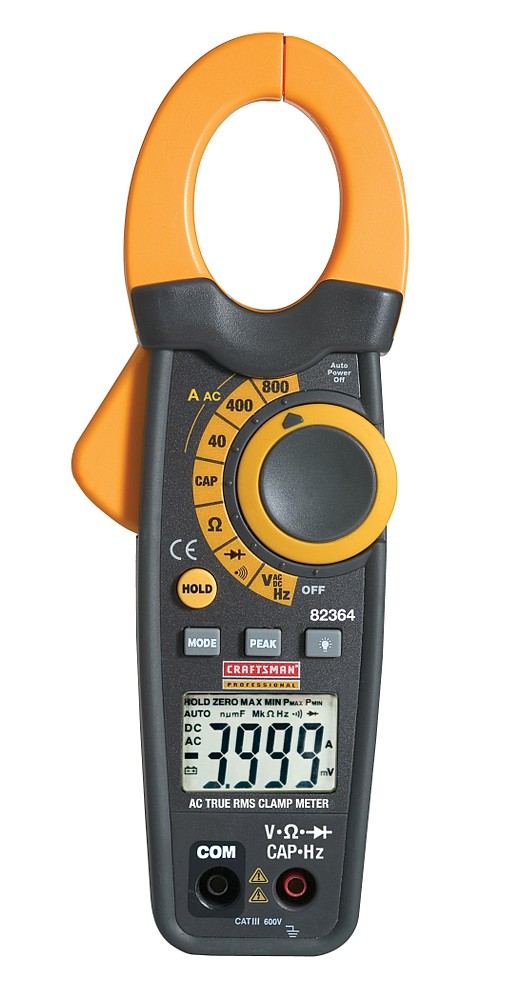
Somewhat frustrated with this whole situation I went out and bought a Craftsman 82364 "AC True RMS Clamp Meter" that captures peak amp load.
After several pops at full load with modeling light at full power the peak amp draw averaged 27.66 amps. On occasion it hit the odd 28.3 peak which could be explained by the +/- 2.8% accuracy of this meter.
OK - you did it right. I would suggest the meter probably is probably misreading a tad because of the transient nature of the waveform. They tend to do this. The real reading is probably a little lower, as supported by the other poster's oscilliscope capture of the waveform (he came out with 28A peak, which is about 20A RMS).
Surely the light can tolerate some voltage drop - even AC lines sometimes brownout to around 100VAC. This would suggest something closer to a 1500W - to 2000W inverter would do. But this is still a big inverter. It would require a huge battery to work right because the battery current would be around 150 to 200A. You may find a generator to be a better power source.
I decided to find out what happens when I have two or three lights connected to a single outlet - lets just say I have found the limit of my electrical circuit.
one lamp = 27.66 amps
two lamps = 47amps.
Three lamps = 47amps.
Though I have apparently reached the limit of my circuit there is no notable increase in charge time which leads me to believe these instantaneous peaks are just that, instantaneous.
If the peak I am reading is instantaneous and it does taper off within the first 25ms of the charge cycle to about 3/5th the peak level - as evidenced by the scope reading from Photogenic - then am I able to disregard this 25ms peak and gage my needs from the 3/5ths amount, about 16amps?
This seems reasonable considering the three lamps where sharing a peak draw of 47amps, or 16.2 amps per lamp, and showing no notable decrease in performance. Though, I do not have any REAL way to measuring the actual charge cycle to determine if there is a decrease in performance other than a stop watch.
Additionally, the lamps themselves have 15amp fuses, for what it is worth.
Tomorrow I am going to put all four lamps on a single circuit and see what I get, and I will time with a stop watch.
This morning I did time - as best I could using the charge indicator lamp - the recharge time of a single lamp and all four lamps on a circuit.
According to Photogenic the recharge time should be 1.5 seconds at full power which is about what I got with my trusty stop watch.
With all four lamps recycling the recharge time increased to nearly 3 seconds.
I am really beginning to think that a 2000 watt inverter is more than enough for a single lamp, and that a 3000 watt just may support two of them with an increase of recharge time.
I also wonder just how tolerate these light would be of "not so perfect" sine wave power supplies. If they can tolerate that then the costs just went WAY DOWN.
With a 2000 or 3000 watt "modified sine inverter" (Square wave) you run a high risk of frying the charging circuits on the lights. You really need a pure sine inverter.
Also, four lights on a single outlet will likely blow the circuit breaker in your house.
At this point I seriously believe these lights are drawing less than 15amps during the charge cycle, more like 10-12 amps. I also believe those absurdly high peaks I am catching are from within the first 25ms of the charge cycle and I question if that number is truly relevant when considering an inverter.
Wow thanks for the info... I just revisited this and realized that there was a whole bunch of new posts. So that basically means I need a 2000 watt minimum generator to run ONE of these lights That stinks. Guess its time to get a honda.


 That stinks. Guess its time to get a honda.