p.1 #1 · APS-C & MFT...Have I Misunderstood These For 15+ Years?
A lot of new APS-C lenses are being released this year and the marketing always states their "35mm equivalent."
I understand that putting a full-frame lens on an APS-C body gives a 1.5X crop factor (1.6X for Canon). So...
FF 70-200mm + APS-C camera = 105-300mm FOV.
However, for APS-C lenses on APS-C cameras, the FOV should be exactly what the lens barrel states, correct?
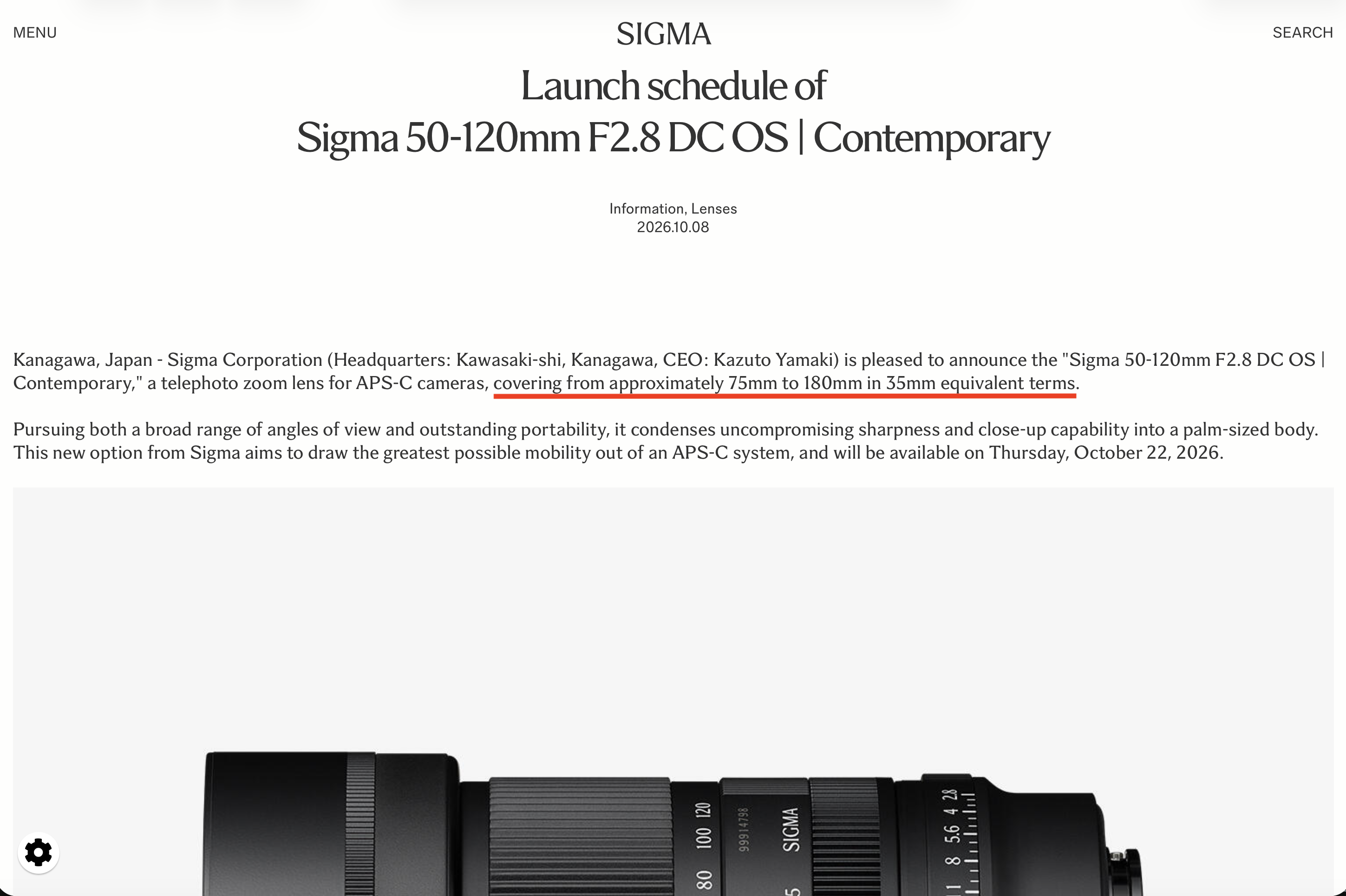
In the case of the new Sigma 50-120mm f/2.8 below, the FOV (on an APS-C body) should be the same that a full-frame 50-120mm would give on a full-frame camera, correct?
In other words...
(APS-C camera + APS-C 50-120mm) = (Full-Frame camera + FF 50-120mm)
Am I getting that right?
If so, then why does Sigma's marketing say the 50-120mm gives a "35mm equivalent" to 75-180mm?
p.1 #2 · APS-C & MFT...Have I Misunderstood These For 15+ Years?
I see the same type of "35mm equivalent" with MFT lenses.
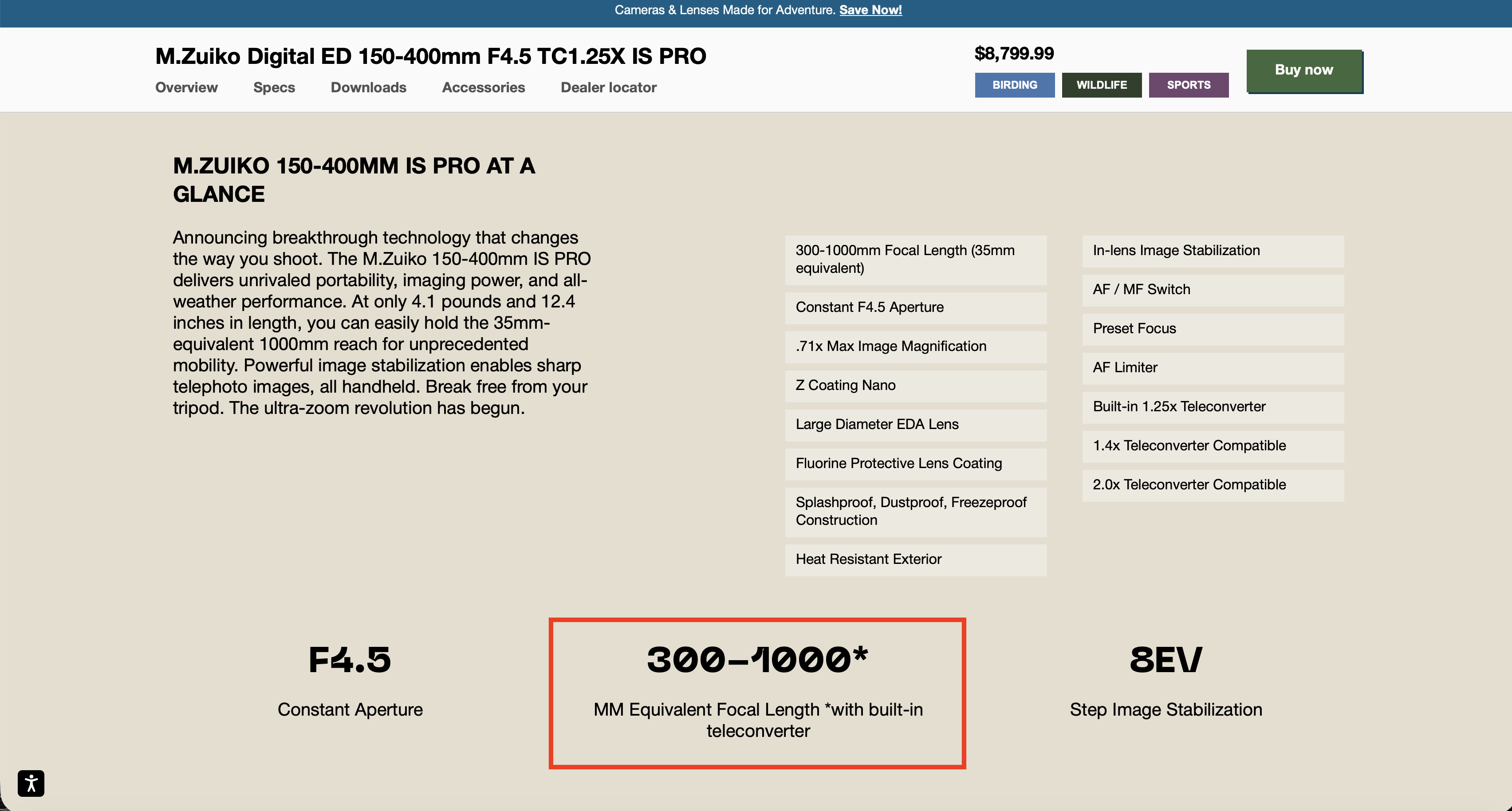
For example, take the OM SYSTEM M. Zuiko 150-400mm f/4.5 TC 1.25 IS PRO lens.
All the marketing talks about getting 300mm-1000mm of "equivalent" reach.
Is that because OM SYSTEM lenses are actually designed as full-frame lenses? So, when put them on MFT bodies, they actually give you that 2X crop factor?
p.1 #3 · APS-C & MFT...Have I Misunderstood These For 15+ Years?
You’ve misunderstood for 15 years. The focal length of a lens is a physical measurement and doesn’t change no matter what body it’s made for or on. What changes is the field of view based on sensor size. So the APS-C 50-120 is a 50-120 on all bodies. But on APS-C you have to account for the crop factor which is why Sigma uses it in marketing materials. In other words, all lenses-even APS-C lenses and mft lenses have equivalents that are different than the focal length when used on smaller than full frame cameras.
p.1 #4 · APS-C & MFT...Have I Misunderstood These For 15+ Years?
There are multiple components to understanding lenses. As already stated, you're confusing focal length with field of view. Field of view is the angle of coverage that the lens 'sees' the scene. It is independent of focal length. For example, a 65mm lens on a 4x5 camera has a much wider field of view (it's a very wide angle lens) than a 65mm lens designed for full frame sensor coverage, which is a slight telephoto. Then there's lens image circle. This is the light from the scene projected by the lens onto the the sensor area.
A full frame lens, say a 50mm, is designed to project an image circle that covers 24x36mm. If you put it on an APS-C camera, the size of the image content is the same as on a FF sensor, it's just that APS-C doesn't use the full coverage of the lens. It's effectively a crop of the full frame image circle. But if you drop that APS-C image onto the same image captured on FF, the image content size will be the same. It just looks 'bigger' in a standalone APS-C image because of the crop factor.
So as stated, the focal length doesn't change when you use a lens on different sensor sizes. If the lens's image circle can cover all the different sensor sizes, then its effective field of view changes depending on the sensor. The larger the sensor, the wider the field of view.
The Olympus 150-400 would have been designed with optimum performance to cover the m43 sensor area. It might have a larger image circle than m43. if it does and could be mounted on APS-C or FF, the image quality outside the m43 area would likely be relatively poor. If you follow medium format digital you'll notice that some are adapting various full frame lenses to those systems and there's talk about sensor coverage and peripheral image quality. Some FF lenses have relatively large image circles, larger than needed for FF, but it doesn't guarantee that image quality outside the FF area will be usable or acceptable. Quite often physical aspects of a given lens also affect sensor coverage. For example, the shrouds on the back of lenses inside the lens mount area will block coverage on larger sensors than the lens was marketed for. This is generally done to reduce or eliminate light spilling into the camera outside of the sensor area to reduce the chance of reflections that could degrade image quality. Removing these shrouds sometimes allows a lens to cover a larger sensor. IIRC there was a Tokina UWA zoom for APS-C that by removing the shroud was usable on FF for part of its range and possibly was fully usable on APS-H (1.3x crop that Canon used for their 1D non-S series before the 1DX).
p.1 #5 · APS-C & MFT...Have I Misunderstood These For 15+ Years?
Except for a few oddball cases (like some point and shoot cameras), the focal length of the lens is the focal length of the lens. If it says 50mm, it is 50mm whether on MFT, APS-C, FF, miniMF, LF film or whatever.
The "angle of view equivalence" of the 50mm lens on different formats is not the same. If you think of the 50mm lens on a full frame or 3mm film system as "normal," then on smaller sensor cameras the angle of view is smaller and the lens feels "longer." A 50mm lens on a Fujifilm APS-C camera provides the same angle of view that you would get form a 75mm lens on FF.
The opposite holds true as you go to larger formats. There the 50mm lens would have a larger angle of view and seem like a wide angle.
It is unfortunate that a few manufacturers are a bit lazy with the terminology. In your second example above, the manufacturer does it more or less the right way by saying that the lens is equivalent to 1000mm on full frame. In the first case, the manufacturer uses language that is less accurate, suggesting that the lens actually has the different focal length.
p.1 #6 · APS-C & MFT...Have I Misunderstood These For 15+ Years?
Don't blame yourself. The way people/manufacturers talk about it is confusing. I still have a hard time wrapping my mind around different equivalencies and how those produce same/different bokeh, etc.