robert614 wrote:
As far as the image stabilization goes. I think the 600mm’s super lightweight may be working against it somewhat
Usually, with a lens this long, the actual mass of the lens helps reduce small jerky movements of the hands and body working in tandem with the IS. I think the lightweight is allowing more of the natural body movements to be transmitted to the lens/body combo
That, and Sony not so great IS, is showing more with the longer focal length
Have you actually had any issues with IS on any modern gear of any sort?
I've shot Canon, Nikon, and Sony mirrorless with all the best bodies and glass, and I can handhold any of these lenses (300 f2.8, 600 6.3, even 600 f4s, 800 f5.6, 800 6.3, etc.) down to 1/5 easily.
I've never had image stabilization be a limiting factor when shooting.
I don't shoot video often, but I've also never had issues handholding there either on any of the brands.
I've always thought the "longer/heavier lenses help IS" was an old wives' tale. Never seen any truth behind it.
nmerc_photos wrote:
Have you actually had any issues with IS on any modern gear of any sort?
I've shot Canon, Nikon, and Sony mirrorless with all the best bodies and glass, and I can handhold any of these lenses (300 f2.8, 600 6.3, even 600 f4s, 800 f5.6, 800 6.3, etc.) down to 1/5 easily.
I've never had image stabilization be a limiting factor when shooting.
I don't shoot video often, but I've also never had issues handholding there either on any of the brands.
I've always thought the "longer/heavier lenses help IS" was an old wives' tale. Never seen any truth behind it.
I don’t shoot video either. I was just hypothesizing on why Jan was getting such shaky results in his video
I don’t know if it’s a wives tale or not. But I have seen more video focused creators on YouTube say that the extra weight of the video cages they use for their camera rig can help steady out their footage a little because of the extra mass acts as a stabilizing force. I think there’s some truth to that.
In terms of telephoto distances. Every degree of movement translates to quite a bit of movement in the viewfinder. If you’re holding the camera up to your eye with your hands acting as three points of contact. Extra weight probably doesn’t matter much. But if your holding the lens by handle low to the ground using the rear screen to frame the shot. In that situation, a really light weight 600mm might be a little shakier than a slightly heavier lens
duncangr wrote:
I don't know first hand how Sony or Nvidia do things but on the iPhone there is no downsampling step required - you simply pass a reference to the video frame buffer - once you have set up the source i.e. live feed camera or video file
Why would you think there's no downsampling? Just because you pass a pointer to the framebuffer? You can't infer implementation details from an SDK signature. I am pretty sure that the data is downsampled prior to slicing and tokenization behind the scenes. Obviously we don't have Sony engineers here to confirm, but having done plenty of embedded work in my career, including subject recognition on custom ASICs for surveilance cameras, I trust my intuition. I may be a few factors off, but not orders of magnitude off. The node+power give you the transistor budget estimate, and from there you can tell what's possible or not. With the current state-of-the-art processes, nothing substantial can be done with just ~2W of power on a live uncompressed 120 fps feed from a 24mp sensor, let alone 50 or 66mp. Simply pushing this much data through the chip is going to eat a lot of power. For example, the Nikon's EXPEED7 chip can't do RAW precapture supposedly due to internal bandwidth constraints, and that's with zero processing, just raw bandwidth.
My bet is that Sony's AI chip is operating on a sub-megapixel image. In fact, everything on the BIONZ is operating on sub-sampled stream: the AF, the EVF+LCD, evaluative metering, intelligent auto-WB, etc. It is very expensive to push the full stream to every subsystem on a chip in real time.
Not really a huge revelation. But more of an interesting tidbit
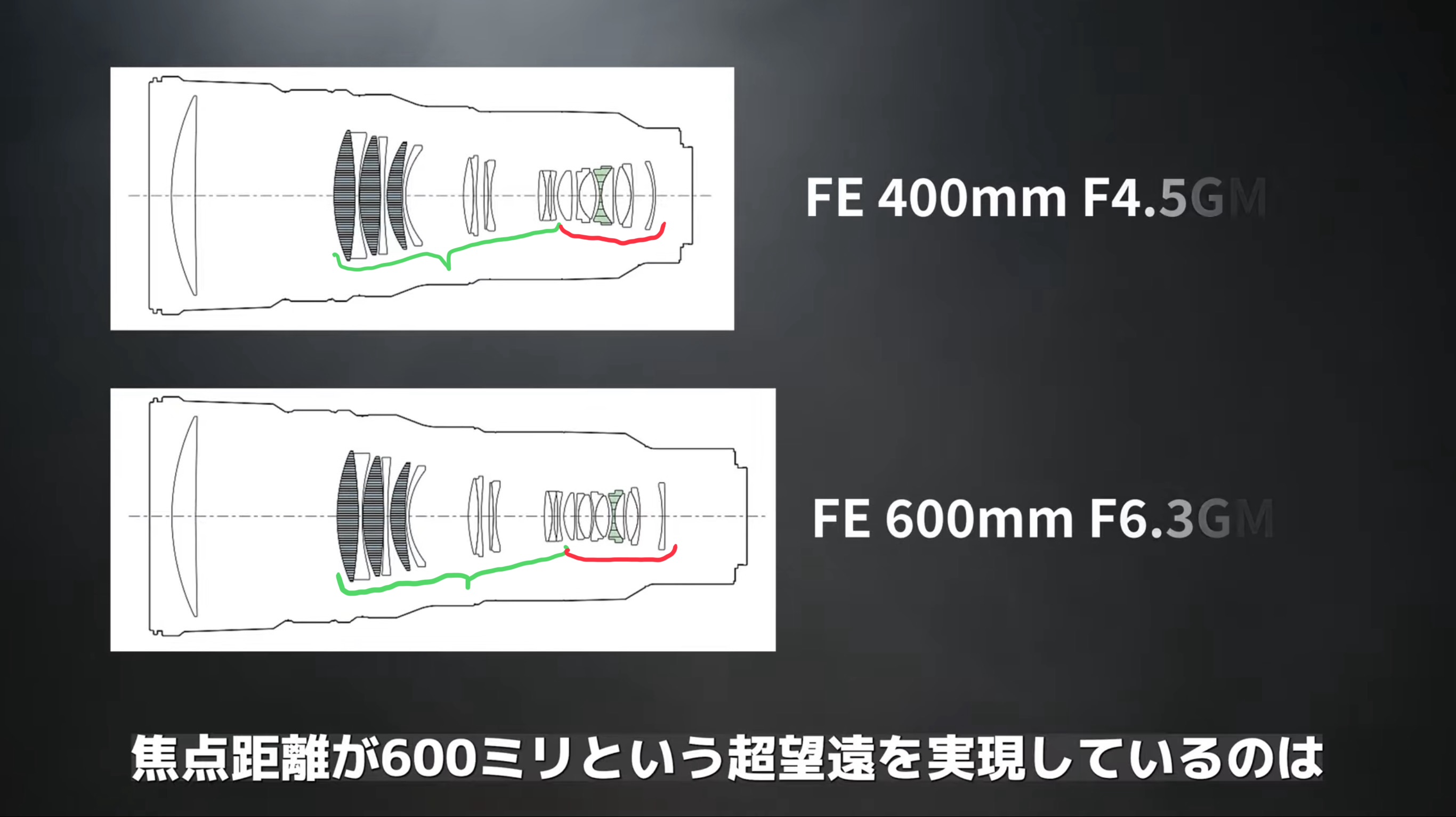
I was watching a Hands-on video from Japan on YouTube and they showed a side by side of the lens diagrams. So I took a screenshot.
When the two lenses were first announced, there was some speculation the 600mm was just a 400mm with a 1.4x TC permanently attached. Then when the lens diagrams were released, it was pointed out the 600mm has two extra elements compared to the 400mm.
Now I don’t know how accurate Sony’s diagrams are. But it appears the elements highlighted with green are identical. But all the elements highlighted with red seem to be unique to each lens. The rear element on each lens has a different curvature. The other pairs, while very similar. Have different thicknesses, diameters, curvatures. Unique to each lens
So while the designs are very similar, they are unique. What does all this mean? Absolutely nothing! 😄