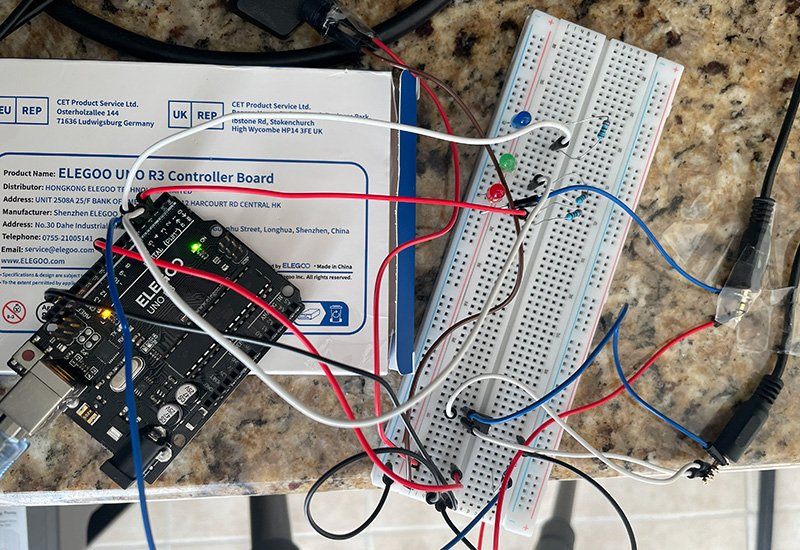
Arduino board connected to the Z6 III DC-2 remote shutter port via a DC2-to-2.5mm sub cable, electrically isolated through optocoupler.
Methodology
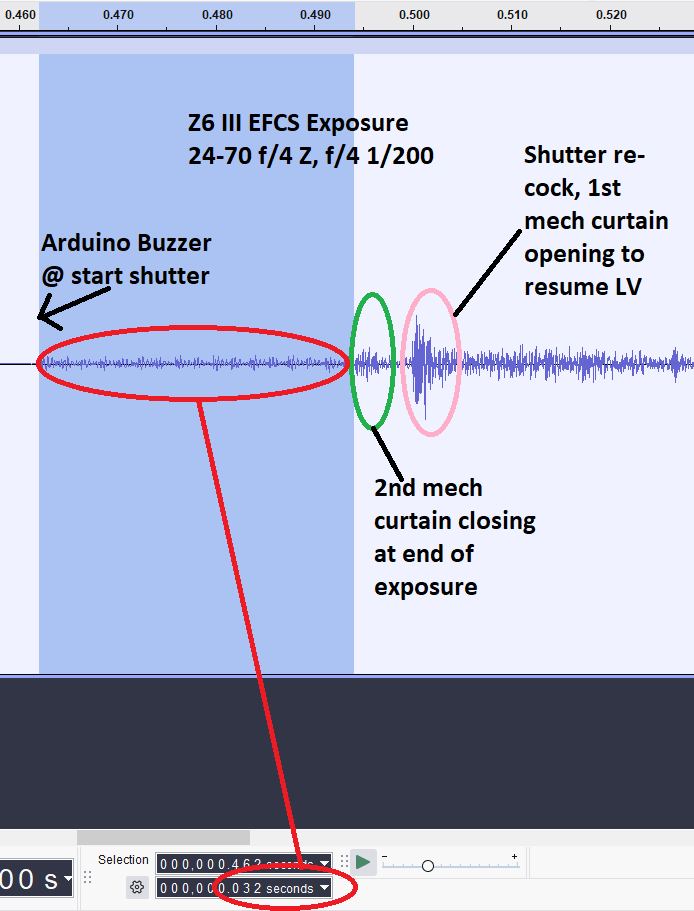
Audio: My Arduino code triggers the shutter programmatically, at the same time it turns on an Arduino-attached buzzer. An audio of the resulting exposure is captured with my iPhone. I pull the audio into a waveform editor and measure the time between the start of the buzzer and the start of the mechanical curtain sounds.
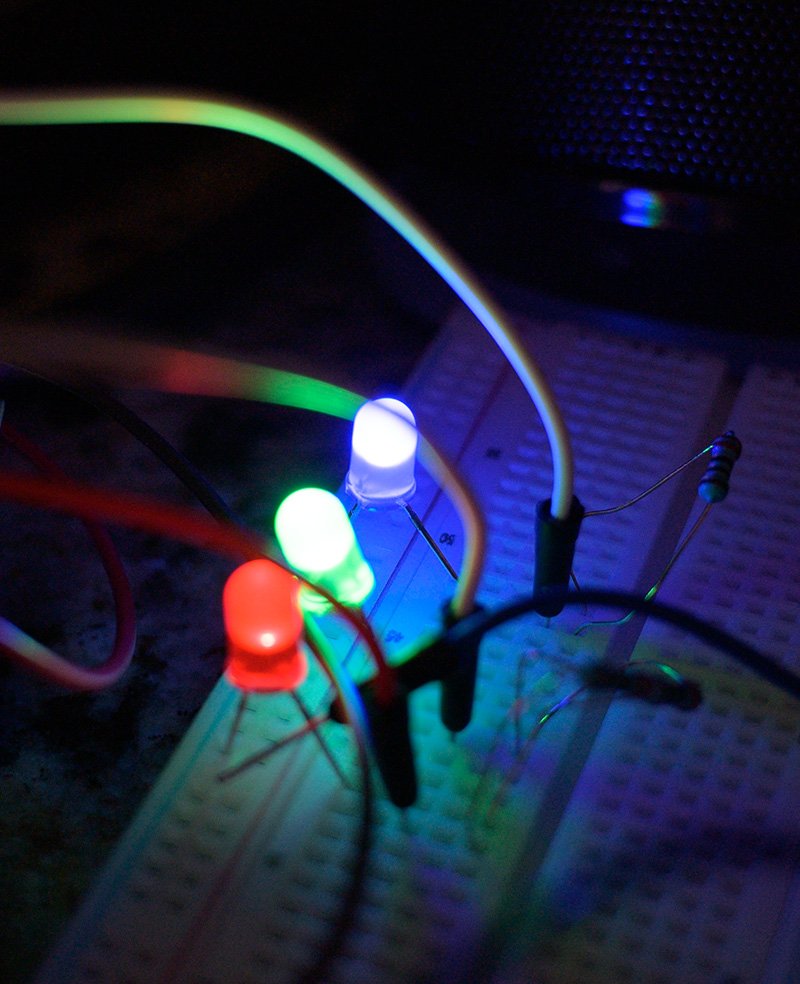
LED: There are three LEDs on the Arduino board. I turn on all three LEDs before triggering the shutter programmatically, then progressively turn them off:
I turn off the bottom (red) LED after 35ms (milliseconds)
I turn off the center (green) LED after 40ms
I turn off the top (blue) LED after 45ms
By counting the number of lit LEDs in the resulting captured image, the shutter lag including exposure time can be calculated.
Results
Fully-mechanical shutter: 65ms
EFCS: 35ms
Electronic shutter: 38ms
I also measured the minimum pulse duration (width) required to trigger the shutter. It's 160 us (microseconds).
Whats the lag introduced by the circuit? Is that measurable? Has to be something but my guess would be minimal?
Also would be very interesting if you did this with the Leica M11- sometimes I swear its 600ms
Shouldn't be any lag introduced by circuit - more likely to have a little introduced by the relative slow Arduino processor running my code.
I did this measurement to help a Panasonic S1R II user on Dpreview who is troubleshooting getting his Bolt Hunter device to reliably capture lightning strikes, which apparently isn't happening due to the long and variable shutter lag on that camera (up to 120ms). I measured the S1R and Z6 III as a comparison to the lag measurements he's seeing with the Bolt Hunter.
EB-1 wrote:
Wouldn't pre-capture be useful for such situations?
EBH
It would but it depends on the implementation. Nikon's current pre-capture implementations use the video pipeline of the sensor and so has too much rolling shutter for some shooting situations like action, lightning strikes, etc..
Then I would not use Nikon for that type of work. Especially for special projects you don't need to use a single system. Another option might be to grab frames from 8K video if that is good enough.
Probably the next Z8/Z9 will have more modern features/performance like that recent Sony and Canons have.
EB-1 wrote:
Then I would not use Nikon for that type of work. Especially for special projects you don't need to use a single system. Another option might be to grab frames from 8K video if that is good enough.
Probably the next Z8/Z9 will have more modern features/performance like that recent Sony and Canons have.
EBH
This isn't for my shooting - I was responding to someone on Dpreview trying to capture lightning strikes on their S1R II. I decided to measure Nikon's shutter lag to address his questions on what a typical lag is on other systems he's considering.
8K video grabs would suffer from the same video-based rolling shutter artifacts as Nikon's existing pre-capture implementation.
I agree the next cameras/EXPEED will surely support a proper pre-capture mode - the absence of that support in EXPEED 7 was a pretty big oversight on Nikon's part.
Any shutter lag will be after the lightning strike, so what they are trying to do, just start a recording sequence? In the old days we just set the cameras to shoot continuously with an exposure time that was reasonable at night with the background light.
EB-1 wrote:
Any shutter lag will be after the lightning strike, so what they are trying to do, just start a recording sequence? In the old days we just set the cameras to shoot continuously with an exposure time that was reasonable at night with the background light.
EBH
He's using a device named Bolt Hunter that supposedly can predict lightning strikes and trigger the attached-camera's shutter in anticipation. For it to work it has to be carefully calibrated to the camera's shutter lag, which is not working well on his S1R II because its shutter lag apparently has a lot of shot-to-shot variability, ranging from 70ms to 120ms.