I like the idea of having a hig res camera and ability to crop the image using DX mode, which would give almost 24MP FX results, working like a zoom. Like using 50mm lens would give me around 20MP 75mm lens photos.
I understand that it is not exactly the same, but wanted to ask Z7/Z8/Z9 users - do you often use that crop mode, is it helpful?
Could I use 45MP camera and really use crop mode like I would have different lens, is it essentially good practice?
I have Zf at this moment and was wondering if buying used Z7II would be good idea for a travel lens.
Keep Zf as my MF and casual local use camera and Z7II as a travel camera where I dont have lots of lens with me and dont want to swap glass on site.
phinix wrote:
I like the idea of having a hig res camera and ability to crop the image using DX mode, which would give almost 24MP FX results, working like a zoom. Like using 50mm lens would give me around 20MP 75mm lens photos.
DX crop mode DOES NOT give almost 24MP FX results.
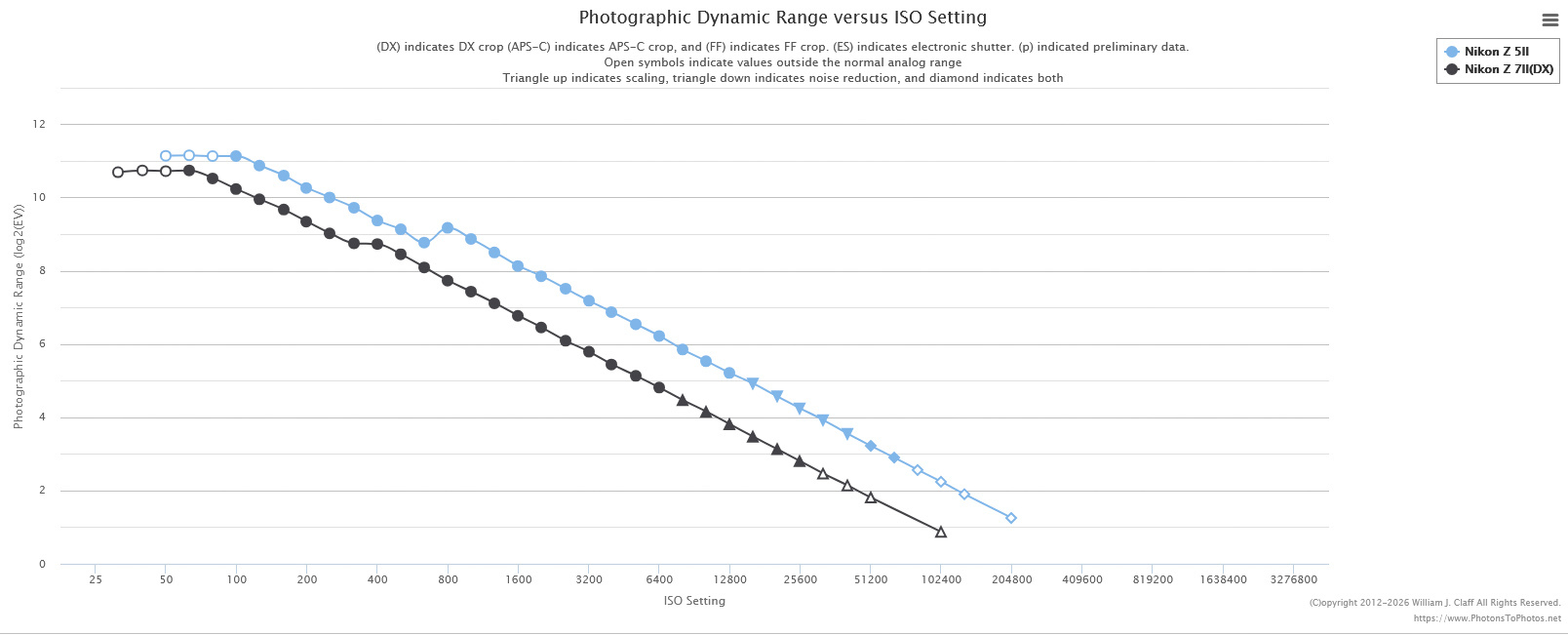
A Z7II DX mode file has a lower resolution (19.5 Mpix) and -most important- visibly more noise than, e.g., Z6/Z5II files.
Dynamic range too is worse.
If you can live with less Mpix, less DR and use AI noise reduction software at high ISOs (I recommend DxO Pure Raw 5 or 6), then the Z7II can be a good travel solution.
Cropping the central part of the sensor will work like a digital zoom. 19MP is still a lot of pixels and if you like the quality go for it. In a 1:1 comparison you will see the difference in reoslution and noise compared to the optical zoom.
The nice thinkg with mirrorless cameras is that you can assign a button to crop from, i.e. fx/dx and the viewfinder coverage is still 100%. AF object detection works a little better on enlarged objects, you need less memory, but you collect less quality - that said 19MP images were high resolution not long ago.
Technically, Ripolini above is correct - shifting to DX mode cuts your resolution to 19.5 max and reduces your DR. In practice the answer can be a bit more nuanced. Yes there is visibly (and measurably) more noise but how much that degrades your image depends on the light conditions, your shooting technique and how big you print your final image. And yeah if you pixel peep the difference can be visible - but that is looking at pixels, not images.
Many of us use DX as a lightweight travel alternative and if you go to the PtoP graph the difference between Z7II(DX) and the current DX sensor is negligible.
I'm saying the question is not which system (ZF or Z7II(DX)) will give you a 'better' image. I'm suggesting that depending on, again, technique, lighting conditions, final image size - and how you post-process - the difference in what the image ultimately looks like (and that's the point right?) isn't as dramatic as one might think.
On a high MP camera you might try taking the full frame shot and crop in post. That way you can also change the aspect ratio, etc. to best fit your desired image. I do this and it works well on my Z8. I use Lightroom for post processing with its AI-based noise reductio. It works very well.
There is only a single use case I’m comfortable turning DX on for my Z9 and that is birding when I am 100% sure I’d crop at least that much in post. It also helps the AF system to be in DX with smaller subjects.
Until Nikon introduces non-destructive DX or aspect ratios, I won’t use them for 99% of my shots because I want the freedom to crop in post instead.
It doesn't give almost 24MP FX results, it does give almost 21MP DX results. In short, it gives you a DX image almost indistinguishable from the IQ delivered by the current ~21MP DX lineup. That said, the IQ from current DX options is VERY good and as a practical matter I find few cases where I really see a practical difference between my modern DX results and my 24MP Z5ii (the difference is there when I pixel peep or push either DR or high ISO in the image, especially the ISO)
My primary use case for DX on the Z7 is to use DX lenses with IBIS, as an alternative to using them on my Zfc (which is my light carry/everyday camera). If not using a DX lens I would simply crop in post as Scott suggests, shooting DX with FX glass on a current 45MP FX body gives you nothing but less post-processing flexibility and somewhat more images per card.
But a 16-50/50-250 kit is a tiny carry kit, throw in the 24/1.7 or one or two of the small 3rd party f1.7/f1.8 primes and you have an inexpensive and excellent travel kit on either a Z7ii or a Z50ii.
I use it frequently as I find it helps visualize the shot I want. Sometimes I hit dx mode and the subject is still to small so I don't even bother shooting. in those cases it at least saves me wasted time in post. The alternative in many situations would be a second z8 and a 600 6.3. That is a bit much for my budget so I push the little red video button that I've programmed to dx mode and enjoy.
Ripolini wrote:
DX crop mode DOES NOT give almost 24MP FX results.
A Z7II DX mode file has a lower resolution (19.5 Mpix) and -most important- visibly more noise than, e.g., Z6/Z5II files.
Dynamic range too is worse.
If you can live with less Mpix, less DR and use AI noise reduction software at high ISOs (I recommend DxO Pure Raw 5 or 6), then the Z7II can be a good travel solution.
These DR charts are a bit misleading. Shooting in DX crop mode does not reduce DR any more than cropping the same image in post-processing does - the DR and noise do not change UNLESS you interpolate the cropped image back to full-frame size.
For web, social media, or even small to medium sized prints, you’d be hard pressed to notice a difference. If your photos just live on your hard drive and you just like knowing you have the highest quality pixels possible, then maybe don’t use DX mode.
Cliff L. wrote:
These DR charts are a bit misleading. Shooting in DX crop mode does not reduce DR any more than cropping the same image in post-processing does - the DR and noise do not change UNLESS you interpolate the cropped image back to full-frame size.
Or UNLESS you print the file to the same size (e.g., A2), right?