p.3 #1 · GFX100S worth it if ONLY planning to use adapted lenses?
gdanmitchell wrote:
To understand my response, read the OP’s reply. Then understand why even those “other things” that you go on about may seem irrelevant to his needs.
To understand my response, you have to think about how many times in how many threads you go on as if resolution is the ONLY reason for choosing a "better" camera. It's not, but you never seem to realize that.
Your only goal around here seems to be that no one should buy a "mini MF" camera, just because you are telling yourself that YOU don't need one. It's quite tiring.
p.3 #2 · GFX100S worth it if ONLY planning to use adapted lenses?
I read Dan's post at the end of the previous page and also thought that it was a reflection on his personal experience, that hasn't been too happy as it sounds.
I partly agree with his opening statement "there are some people for whom and some situations for which the larger sensors make sense, but they are both very small in number." I disagree with the "very small in number ...situations" but do agree about the small number of people. I believe that most people, perhaps more than 95% of those who buy high-end cameras, don't have a good understanding of how to take advantage of the extra dynamic range and the larger number of pixels that a GFX100 offers vs. the FF alternatives. In fact, their interests are elsewhere. The recent Sony A7RVI thread is revealing: the discussion seems to be mostly concerned with the sensor readout time and whether there should be a wing distortion in photos of flying birds. These types of photographers should find the GFX a ridiculous camera.
There seems to be little interest in dynamic range and image quality in general, the (naive) argument often being that the modern denoising makes ISO 12800 images look like taken at ISO 100. This just shows how shallow is the understanding and how low are the expectaions of some people.
Then there are a good number of photographers who are obsessed with ever smaller and lighter camera systems. These are easily fatigued by even an average FF camera, and should find the GFX an abomination.
I have a FF camera (Sony A1), two micro-four-thirds (OM-1 II and G9II), and more recently, since December 2025, the GFX100S II. A camera is an instrument, and I have reasonably successfully used all of my cameras. Having said that, the GFX100S II is now the camera I use all the time. The ergonomics of the body is near perfect to me (I won't mind a deeper grip however). The opportunity to save six custom sets is a dream come true, and I like the uncluttered body style with the relatively small number of buttons. I know this is different from what most FF photographers should like.
Ultimately, I feel that my GFX100S II is an outstanding camera, and the GF lenses make it a top choice of a system for anyone who cares about image quality above everything else. The enlarged 4 x 3 format vs. 3 x 2 is an added bonus of the system.
p.3 #3 · GFX100S worth it if ONLY planning to use adapted lenses?
I hear you.
You don’t like (nor do you address the validity of) the points I make. You just think I should shut up, apparently because your feelings are hurt. (Oddly, you have nothing critical to say to the poster before me who first brought up these issues.)
Apparently, anything less than pure praise for the miniMF format is heresy in your world, and miniMF is the best and most perfect choice for all photographers.
But I was not posting for you. These are facts that should be considered by people like our OP, who can then apply them and make their own decisions..
Makten wrote:
To understand my response, you have to think about how many times in how many threads you go on as if resolution is the ONLY reason for choosing a "better" camera. It's not, but you never seem to realize that.
Your only goal around here seems to be that no one should buy a "mini MF" camera, just because you are telling yourself that YOU don't need one. It's quite tiring.
p.3 #5 · GFX100S worth it if ONLY planning to use adapted lenses?
I appreciate the respectful reply and focus on the actual issue here. While we do not come down in exactly the same place, I feel like we could have the kind of respectful conversation about this that I have in person with my photography friends. Look me up if you are ever in the SF Bay Area.
ruthenium wrote:
I read Dan's post at the end of the previous page and also thought that it was a reflection on his personal experience, that hasn't been too happy as it sounds.
I partly agree with his opening statement "there are some people for whom and some situations for which the larger sensors make sense, but they are both very small in number." I disagree with the "very small in number ...situations" but do agree about the small number of people. I believe that most people, perhaps more than 95% of those who buy high-end cameras, don't have a good understanding of how to take advantage of the extra dynamic range and the larger number of pixels that a GFX100 offers vs. the FF alternatives. In fact, their interests are elsewhere. The recent Sony A7RVI thread is revealing: the discussion seems to be mostly concerned with the sensor readout time and whether there should be a wing distortion in photos of flying birds. These types of photographers should find the GFX a ridiculous camera.
There seems to be little interest in dynamic range and image quality in general, the (naive) argument often being that the modern denoising makes ISO 12800 images look like taken at ISO 100. This just shows how shallow is the understanding and how low are the expectaions of some people.
Then there are a good number of photographers who are obsessed with ever smaller and lighter camera systems. These are easily fatigued by even an average FF camera, and should find the GFX an abomination.
I have a FF camera (Sony A1), two micro-four-thirds (OM-1 II and G9II), and more recently, since December 2025, the GFX100S II. A camera is an instrument, and I have reasonably successfully used all of my cameras. Having said that, the GFX100S II is now the camera I use all the time. The ergonomics of the body is near perfect to me (I won't mind a deeper grip however). The opportunity to save six custom sets is a dream come true, and I like the uncluttered body style with the relatively small number of buttons. I know this is different from what most FF photographers should like.
Ultimately, I feel that my GFX100S II is an outstanding camera, and the GF lenses make it a top choice of a system for anyone who cares about image quality above everything else. The enlarged 4 x 3 format vs. 3 x 2 is an added bonus of the system....Show more →
p.3 #6 · GFX100S worth it if ONLY planning to use adapted lenses?
gdanmitchell wrote:
I appreciate the respectful reply and focus on the actual issue here. While we do not come down in exactly the same place, I feel like we could have the kind of respectful conversation about this that I have in person with my photography friends. Look me up if you are ever in the SF Bay Area.
Meeting in SF would be great, I shall keep this in mind - thank you! I and my wife are now in Japan, until July 15 - presently in Okinawa and suffering from a typhoon that is almost exactly above us at the moment.
p.3 #7 · GFX100S worth it if ONLY planning to use adapted lenses?
This discussion reminds me of the old Windows-vs-Mac debate—one that, at least in my view, we have fortunately moved past. Let everyone simply work with the tools they are happy with and find easiest to use! In photography today, we simply have a vast array of options—many of them truly excellent. By comparison, the photographers we often look up to today typically had to go to far greater lengths back in their time to produce their wonderful images.
Today, we have the choice of various sensor sizes, and even smartphones now capture surprisingly good images. Some artists—Paul Graham, for instance—deliberately work with a mix of high-end imagery and lower-quality shots taken with smartphones or simple, inexpensive cameras. I believe that anyone shooting with MFT, APS-C, full-frame, or GFX/Hasselblad systems has their own valid reasons for doing so. You can produce excellent work today with almost any modern camera, and we are certainly welcome to discuss the pros and cons of these systems here.
p.3 #8 · GFX100S worth it if ONLY planning to use adapted lenses?
We are in England until mid- June.
ruthenium wrote:
Meeting in SF would be great, I shall keep this in mind - thank you! I and my wife are now in Japan, until July 15 - presently in Okinawa and suffering from a typhoon that is almost exactly above us at the moment.
- - -
There are excellent photographers producing excellent photography with every brand and format. I would argue that this is a golden age of photographic technologies.
mabra wrote:
This discussion reminds me of the old Windows-vs-Mac debate—one that, at least in my view, we have fortunately moved past. Let everyone simply work with the tools they are happy with and find easiest to use! In photography today, we simply have a vast array of options—many of them truly excellent. By comparison, the photographers we often look up to today typically had to go to far greater lengths back in their time to produce their wonderful images.
Today, we have the choice of various sensor sizes, and even smartphones now capture surprisingly good images. Some artists—Paul Graham, for instance—deliberately work with a mix of high-end imagery and lower-quality shots taken with smartphones or simple, inexpensive cameras. I believe that anyone shooting with MFT, APS-C, full-frame, or GFX/Hasselblad systems has their own valid reasons for doing so. You can produce excellent work today with almost any modern camera, and we are certainly welcome to discuss the pros and cons of these systems here. ...Show more →
p.3 #9 · GFX100S worth it if ONLY planning to use adapted lenses?
gdanmitchell wrote:
To understand my response, read the OP’s reply. Then understand why even those “other things” that you go on about may seem irrelevant to his needs.
- - -
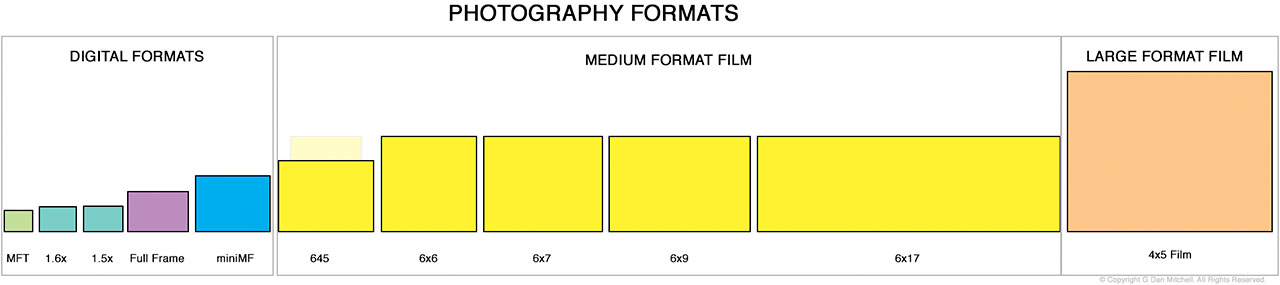
(Few want to think about the fact that the difference between FF and the GFX format is half as large as the difference between APS-C and FF…
As for what the call the format, virtually every manufacturer has engaged in confusing or misleading nomenclature. The first offender was Pentax, who named their cameras using the 33x44mm sensors the “645” system. Those numbers are utterly meaningless in this context and, in fact, misleading. Fujifilm has used all kinds of descriptions: “large format” (God help us!), “larger” (or “fuller”) than full frame, medium format, “GFX,” and probably others.
I refer to it as “miniMF” — I’m not alone — to acknowledge both that it is a “medium format” (if that includes anything larger than full frame) and a “mini” version of it, given its smaller size.
I definitely don't want "to think that the difference between FF and the GFX format is half as large as the difference between APS-C and FF" for the simple reason is that it is not true. I've pointed this out to you and you still say it. Especially rich in this post accusing manufacturers of misleading information. I guess we are in a post-math world these days, just make it up.
p.3 #11 · GFX100S worth it if ONLY planning to use adapted lenses?
SGinNorcal wrote:
I definitely don't want "to think that the difference between FF and the GFX format is half as large as the difference between APS-C and FF" for the simple reason is that it is not true. I've pointed this out to you and you still say it. Especially rich in this post accusing manufacturers of misleading information. I guess we are in a post-math world these days, just make it up.
Convert it to graphics or percentages all you want or even post it to your blog, its still wrong. To compare the size of a two dimensional objects, you use the calculated area. The term "difference" is subtraction in mathematics and using math, 1441-862=579 sq.mm (gfx to full frame) which is greater than 862-368=494 sq. mm (full frame to APSC). Spelled out, the difference between Gfx and FF is greater than the difference between FF and APSC. Feel free to DM me if you want to dispute the math and not further derail the thread. I only pointed it out because it was incorrect information as it was.
p.3 #13 · GFX100S worth it if ONLY planning to use adapted lenses?
With the 100S you can save (and name) six focal lengths in the Adapter settings. This will allow the IBIS work with your adapted lens. So for adapting lenses the 100S is great but you change systems for the native glass (which is excellent). The 100S will serve you for years so adapting lenses is fun and can bridge while you save for some GF lenses.
p.3 #14 · GFX100S worth it if ONLY planning to use adapted lenses?
Anyone who wants to see the actual data can visit the link I provided and compare for themselves.
The meaningful difference when it comes to sensor size comparisons the one expressed by crop factors.
SGinNorcal wrote:
Convert it to graphics or percentages all you want or even post it to your blog, its still wrong. To compare the size of a two dimensional objects, you use the calculated area. The term "difference" is subtraction in mathematics and using math, 1441-862=579 sq.mm (gfx to full frame) which is greater than 862-368=494 sq. mm (full frame to APSC). Spelled out, the difference between Gfx and FF is greater than the difference between FF and APSC. Feel free to DM me if you want to dispute the math and not further derail the thread. I only pointed it out because it was incorrect information as it was....Show more →
p.3 #15 · GFX100S worth it if ONLY planning to use adapted lenses?
Well ff is bigger than aps-c and gx is bigger than ff. What the actual differences will be depends on the actual sensors, processors etc. Names for sensor size are mere semantics .
Even my old aps-c! 16mpx Nikon at base iso was better than a Provia 100 slide taken on an M6 with a Summicron at detail, bigger is better but the differences are not in the same league as between 24x36mm, 6x7.5cms and 5x4in.
p.3 #16 · GFX100S worth it if ONLY planning to use adapted lenses?
gdanmitchell wrote:
Anyone who wants to see the actual data can visit the link I provided and compare for themselves.
The meaningful difference when it comes to sensor size comparisons the one expressed by crop factors.
In no way do your links to your own pages shows this statement to be true - "Few want to think about the fact that the difference between FF and the GFX format is half as large as the difference between APS-C and FF" - all I see is that you have been on some sort of strange campaign to diminish Gfx since it was launched. I really don't care if you don't want to use it, or even point out other good options. But I don't understand why you dispute physical geometry and mathematics and repeat something untrue hoping others believe it because you made a couple tables.
p.3 #17 · GFX100S worth it if ONLY planning to use adapted lenses?
One really begins to wonder what exactly is being argued about here—and to what end. Is there a definitive "right" and "wrong" in this context? Is there truly a need to convince others of the "correct" path, or to save them from doing the "wrong" thing? Isn't it all quite harmless if someone—like me, for instance—simply happens to be enjoying the experience of shooting with a camera featuring a (relatively) large sensor?
We all surely recognize that, nowadays, one can achieve excellent results with a wide variety of cameras. Wouldn't it be a relief, then, if this constant proselytizing would finally cease? Please, just let us keep shooting with GFX until we’ve had our fill. Yes, perhaps the day will come when I return to shooting primarily with FF or APS-C; but until then, I simply want to do what I personally deem best for myself. After all, I don't go around trying to convince others that shooting with APS-C is nonsense—that they would be better off switching to GFX. How absurd would that be? So, let's please put an end to this nonsense so that we can get back to exchanging ideas regarding the questions that are truly relevant and actually up for discussion here.
p.3 #18 · GFX100S worth it if ONLY planning to use adapted lenses?
mabra wrote:
So, let's please put an end to this nonsense so that we can get back to exchanging ideas regarding the questions that are truly relevant and actually up for discussion here.
Ok, I'm done and I'm sorry for aiding in the derail of a perfectly good thread.
I completely agree with your comments here. I currently enjoy APSC and Gfx for what they are good at. Maybe at some point, I'll circle back to 35mm. For me, the characteristic of Gfx I like the most is the sense of space and long transitions from the object in focus to completely out. Makten's photo is a great example.
p.3 #19 · GFX100S worth it if ONLY planning to use adapted lenses?
chez wrote:
Another thread off the tracks. What a shame…seemed like a good topic.
It was never on the tracks. 3 people tried to contribute to the actual question, and the rest devolved into posting their favorite native lenses and getting really uppity about the idea of buying a GFX to simply adapt glass. It's why the Fuji sub is one of the worst on this site.
It would be a net positive for the forum if those members would engage in a moment of self reflection as to how to better serve others with their time here.
p.3 #20 · GFX100S worth it if ONLY planning to use adapted lenses?
Given you make same statement again and again. I will beat the dead horse one more time here.
For anything with format ratio 4X3 such as 11,67,810. The area increase is 90%. That is almost double the sensor area. There is nothing magic about FF sensor size or 3X2 format. With larger sensor, you always have a lot more freedom to do thing you like.
The benefit is as simple as twice the signal light capture. This is not only for the case use all the resolution but also for anything downsampling used, less moire, less false color, sharper final image, less banding with very high DR scene, and better tonality, And you can crop…
Your argument make zero sense. A car with 400 horsepower is in another league to car with 200 ones and you might need to pay triple the price. FUji is a bargain for anyone want above advantages.
Don’t tell me your annual salary from 100k to 190k is less than 50k to 100k raise a few years back.
I just can’t stand experience or opinion based ignorance keep make center piece of the same topic over and over again.
gdanmitchell wrote:
Anyone who wants to see the actual data can visit the link I provided and compare for themselves.
The meaningful difference when it comes to sensor size comparisons the one expressed by crop factors.