nehemiahphoto wrote:
Why the resolution drops off from 28 to 50 with diminished contrast at 50mm.
My guess is because it's a zoom and it, like the Sony 25-50/2.8 and even the Canon 24-70/4L, started its life as a 28mm design and the engineers went from there. Every zoom has a sweet spot, and, with one possible exception I know of (the Minolta MD 24-50/4, which seems best at 50) and probably a very small number of other little weird exceptions, they aren't at their objective best at either end and tend to lose the most resolution at the long end. Even zooms like the 70-200GMII, which has a well-earned reputation for consistency across its range, is still at its objective best at 135 from a resolution and correction perspective, but it also has the most generous, lengthy sweet spot of any zoom I've used, so distortion and coma become the only noticeable tells between focal lengths when studying the raws. Most designs don't fare so well, and that's especially true for less expensive alternatives.
RoamingScott wrote:
I'd rather Thypoch make a few MF lenses that are bespoke for Z...contacts, aperture ring and focus rings that turn the "Nikon way", etc.
I had the Simera 28 for Sony for a few days and loved the way it rendered but lack of electronic contacts made me send it back. IBIS settings messed me up a few times and when adapting to my ZF, exclusion of MF confirmation is a pretty big loss.
Does Voigtlander have exclusive rights for contacts use or just too expensive for the other brands?
RoamingScott wrote:
I'd rather Thypoch make a few MF lenses that are bespoke for Z...contacts, aperture ring and focus rings that turn the "Nikon way", etc.
I bought the Sony 24-50/2.8 lens two years ago and it has been one of my favorite and most-used lenses. It is compact and lightweight, and the range is super useful. This new Thypoch lens looks ok, but the reviews I've seen suggest that the Sony lens is still better overall (as it should be for the higher price).
Going wider at this range very quickly complicates the optics. It would end up bigger and likely perform worse across the range. A 20-50 is a much bigger optics problem to solve than the 24-50.
phinix wrote:
Why the hell they cannot start from 20mm...
I'm actually interested in seeing what else they might release down the road. Solid first attempt from someone who pretty much exclusively made manual primes IMO. The more affordable zooms, the better!
Yep its a massive difference if you're shooting people as 30mm means you're starting to deal with unflattering distortion if you're not careful. 35mm is sort of the threshold where you can frame somewhat carelessly. 16-30 most of the focal range uwa focal range that is less than ideal for photos with people. I don't really like zooms but have the Tamron 35-150 as its an ideal wedding/event lens...its just massive. 24-50 covers a very useful focal range in a compact form factor, with the ability to go wider when needed.
jpelt78 wrote:
Going wider at this range very quickly complicates the optics. It would end up bigger and likely perform worse across the range. A 20-50 is a much bigger optics problem to solve than the 24-50.
Yes, that is the issue especially if you want to keep the wider f/2.8 aperture. Canon just released a smallish video centric 20-50 f/4 this week that looks like it will be nice and of course Sony has the fairly small 20-70 f/4 G, but those have the narrower max aperture. I think you sort of have a choice the wider focal length at the wide end or the wider aperture--at least if you want to keep it small.
May 15, 2026 at 05:45 AM
Steve Spencer Offline • • • • • • • Upload & Sell: Off
freaklikeme wrote:
My guess is because it's a zoom and it, like the Sony 25-50/2.8 and even the Canon 24-70/4L, started its life as a 28mm design and the engineers went from there. Every zoom has a sweet spot, and, with one possible exception I know of (the Minolta MD 24-50/4, which seems best at 50) and probably a very small number of other little weird exceptions, they aren't at their objective best at either end and tend to lose the most resolution at the long end. Even zooms like the 70-200GMII, which has a well-earned reputation for consistency across its range, is still at its objective best at 135 from a resolution and correction perspective, but it also has the most generous, lengthy sweet spot of any zoom I've used, so distortion and coma become the only noticeable tells between focal lengths when studying the raws. Most designs don't fare so well, and that's especially true for less expensive alternatives....Show more →
Totally agree Brad, but would just add this is especially true if you add the constraint to keep the lens small as Thypoch did here. If you want to keep a lens small, you want a zoom, you want a relatively fast aperture, there are going to be some optical constraints. I think Thypoch did a credible job here, but I also share nehemiah's assessment that to me the lack of contrast and weak flare resistance, which is typical in my view to Thypoch lenses and even their primes, is what would give me pause about getting this lens, but that is just me. I like Thypoch's control of color aberrations, and I like that the lenses generally have pretty good close up performance and nice aperture mechanism (both round bokeh balls and nice sunstars), but I don't like the only moderate contrast which gets heighten by veiling flare and that has kept me from getting any of their lenses and has dampened my interest in this lens as well.
A 24–50mm angle-of-view coverage span is almost the same as a 35-100mm, and not that far off a 28-75mm.
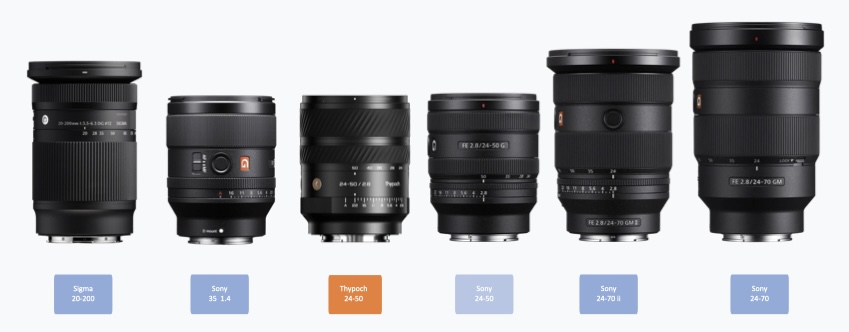
Also, not that long ago first-gen 24-70s like the Sigma, Nikon, and Sony GM were all around 900g. This thing is half that weight while also being internal zoom. It’s more of a compact standard zoom you actually want to carry around.
My favorite was Sigma 24-60mm f2.8 with my Canon 5D/40D due to its size and weight (550g) and zero distortion, not much bigger than the current 24-50mm options. However it needed f8 to get corners sharp and didn't have a long production time... Then the perfect 24-70mm 2.8 series came twice the size/weight as you said...Now there is a reduction in sizes again with some compromises, but I prefer more wider/tele reach with current high ISO sensor cameras rather then limiting the zoom range eg Tamron 25/28-200 / Sigma 20-200 /Panasonic 28-200mm are not much bigger... For 900g range, there is Sony 28-70mm f2...It is good that we have some many choices even in the same length 24-50mm and we are discussing this vs adapting lenses in earlier days.. Laowa is following the Thypoch, so more af options are on the way...
Outstanding wrote:
A 24–50mm angle-of-view coverage span is almost the same as a 35-100mm, and not that far off a 28-75mm.
Also, not that long ago first-gen 24-70s like the Sigma, Nikon, and Sony GM were all around 900g. This thing is half that weight while also being internal zoom. It’s more of a compact standard zoom you actually want to carry around.
24-50mm is only a 2.08x zoom range, but I see it as four important focal lengths in one lens: 24, 28, 35 and 50. If you look at that way, a 35-100mm is also essentially four: 35, 50, 85 and 100. And a 28-75 is also four: 28, 35, 50, 75.
By comparison, a 24-70mm is a 2.9x zoom range, is almost twice as big & heavy as 24-50mm, but only adds 70mm. A 24-70mm is more useful, but at considerable extra size & weight.
freaklikeme wrote:
My guess is because it's a zoom and it, like the Sony 25-50/2.8 and even the Canon 24-70/4L, started its life as a 28mm design and the engineers went from there. Every zoom has a sweet spot, and, with one possible exception I know of (the Minolta MD 24-50/4, which seems best at 50) and probably a very small number of other little weird exceptions, they aren't at their objective best at either end and tend to lose the most resolution at the long end. Even zooms like the 70-200GMII, which has a well-earned reputation for consistency across its range, is still at its objective best at 135 from a resolution and correction perspective, but it also has the most generous, lengthy sweet spot of any zoom I've used, so distortion and coma become the only noticeable tells between focal lengths when studying the raws. Most designs don't fare so well, and that's especially true for less expensive alternatives....Show more →
Thanks for the answer Brad.
I am pretty used to zooms having strong and weak points, but from an optical design perspective (something that is totally outside of my knowledge), I didn’t really think about it as a prime that is essentially stretched across a range.
In the old days the 70/80–200mm’s were typically soft at the longer end, and standard zooms were soft on the wide end. Things have changed in recent years as lenses seem to be optimized for certain focal lens in intelligently (UW now performing best at the widest FL).
With this new Thypoch, I was not surprised that some FL’s are weaker than others, but why the disparity is so large. The Sony 24 - 50 seems to do appreciably better overall with the exception at 24mm. And Dustin Abott’s testing puts the mid-zone and corners as being better on the Sony, but the center on the Thypoch. Across the rest of the range, especially towards 50mm, the Sony seems to trounce it.
Maybe it’s penalty or the smaller size and internal zoom?
@Steve Spencer I don’t think this lens is great at MFD, but I guess that depends on how you define it. Central sharpness is good and contrast (on the wide end) but the mid-zone and corners seem meh throughout at MFD. There seems to be quite a bit of FC at 50mm and contrast falls even centrally after 28 even is resolution is ok.
I had the Tamron 70-180g2–a lens I really enjoyed. I was initially excited by the MFD performance when reading reviews. But realistically, while the contrast was cracking, only the central third of the focal plane was in focus due to field curvature at 180 @2.8. It pretty severely hamstrung the usefulness I found to the point where I purchased a used Sony G 90/2.8 for close-up. Not even 1:1 macro stuff—just closer with decent performance. I think this Voyager MFD performance is noticeably worse than the Tamron. Again, it is reminiscent of their primes without the performance at MFD. But YMMV