So I wanted to share my experience with my M camera. Specifically focusing. I am hesitant to nerd out like this but I genuinely enjoy photography. The process. The results. Hell, I'll stand around talking about it for hours. My wife has learned more than she ever wanted!
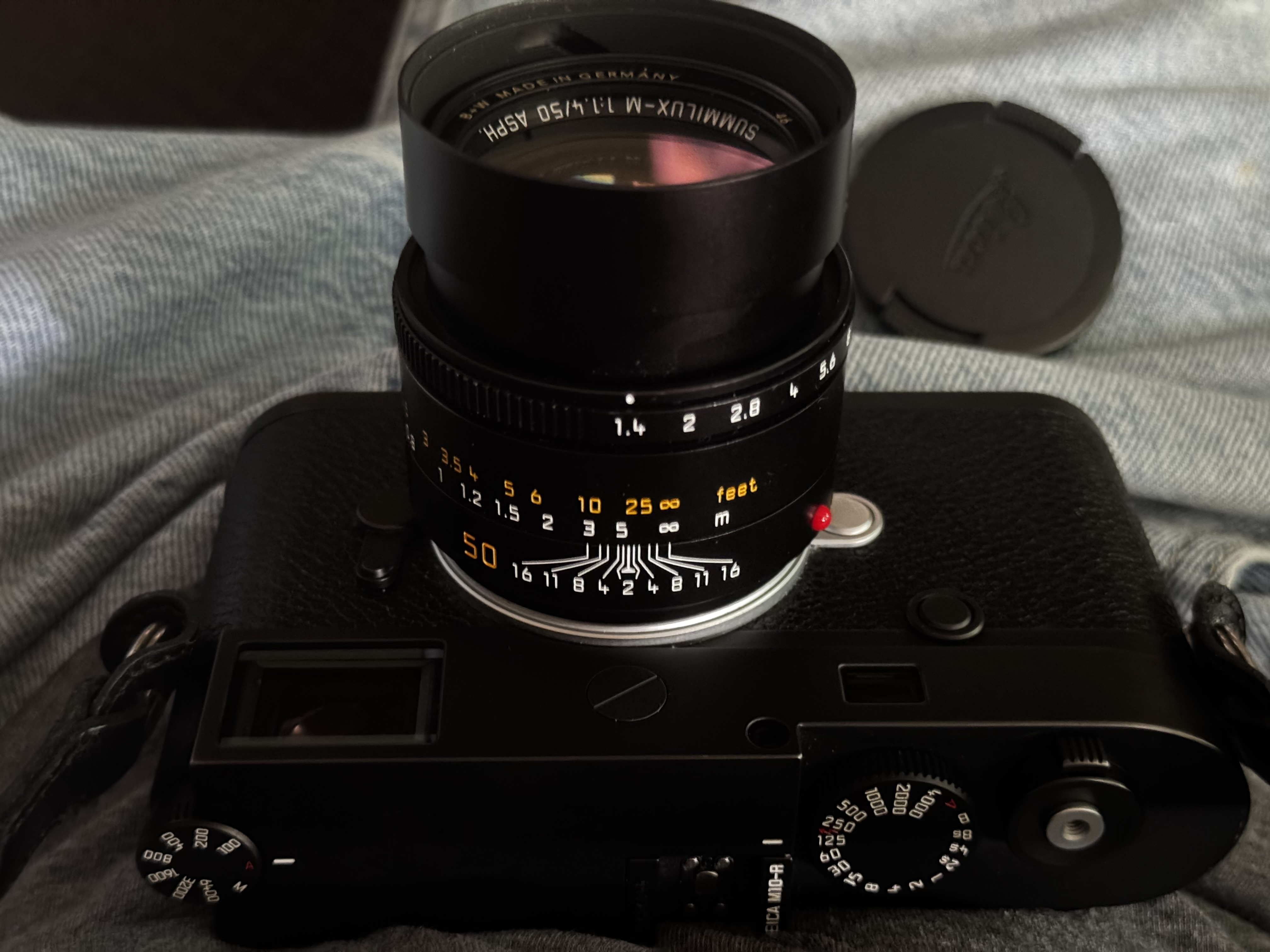
So back to the M, I’ve been surprised by how much I’m enjoying learning to use my Leica M10-R. The simplicity in this day and age is a welcome change.
I didn’t expect it to feel this natural, or to enjoy working through ideas in my head as I shoot. It also hasn’t been as difficult as I thought it would be before I bought an M.
I’ve been making a point to bring the M with me for family time. I only have a 50mm and the camera on a basic neck strap. That's it. No intention of adding more glass. Most of what I’m shooting is my kids out and about and everyday family life. I’m just present with a camera. It’s a completely different pace compared to using a Sony with a 70–200 2.8. Different tool, different mindset? I don't know.
I’ve also been surprised by how often I can catch the timing. Not every time, but often enough for things like a clean shot mid basketball throw or while they’re just messing around. Before somebody jumps down my throat, understand that I don’t mind missing things every once in a while. It's really not that big of a deal. Relax.
Coming from autofocus, I expected more friction, but it’s been more intuitive than I thought. With the 50 Summilux, I try to start at infinity and work in. It’s pretty wild how quickly you can bring something into focus using the tab while looking through the viewfinder. I certainly enjoy not to staring at a screen.
Anyway that has been my experience so far. It’s becoming a natural way for me to photograph my family. Your mileage will vary.
I would love to hear the experiences of some of the other photographers we have around here.
I remember being told years ago to start focus at minimum distance and then the subject will "snap" into focus as you move towards infinity. Try it, works for me. Glad you are having fun.
Kenneth Farver wrote:
I remember being told years ago to start focus at minimum distance and then the subject will "snap" into focus as you move towards infinity. Try it, works for me. Glad you are having fun.
I’ve always started at infinity. I had a couple of lenses with gear lash, early on, that would only focus accurately in that direction. It really doesn’t matter which direction you choose as long as you’re consistent. I find focus from infinity faster. But YMMV.
M’s reward practice. Getting fast and accurate with an M is a skill, not a gift. The more you do the better you get.
My first RF experiences were with one of my father’s cameras. But really my journey started with the XPan in the 90’s. To this day my favourite film camera ever. Modern M’s are my camera tech detox. I generally really like what’s happening in camera tech but sometimes it’s just fun to use all the skills I spent decades building. It’s kind of like driving a manual car. Sure the automatic is quicker and easier but it’s no where nearly as engaging. Mostly I use my Hasselblads of my SL3’s so I’m not as sharp of an RF as I used to be. At least now I have enough muscle memory that it comes back pretty fast when I take an M out for the day.
Congrats to your M gear! Hardest from my experience with rangefinder focusing are repetitive patterns. One example is with trees and small branches - easily you can get the focus wrong when overlaying similar looking branches with each other. Even after > 10 years of using rangefinder M cameras I haven't gotten used to the focus tab - one reason might be that I am using all kind of M and LTM lenses, and some of my older LTM lenses turn in the opposite focus direction compared to modern M lenses. By not looking directly on the lens metering scale I can't tell if I start from infinity or MFD to focus with the rangefinder - maybe also one reason why I prefer M lenses which just have a focus ring similar to manual focus SLR lenses. You will have it easier by just using one single prime lens and just getting used to this one.
Rangefinder focusing is still for me the fastest manual lens focusing method I am aware of. Much faster than EVF-based manual focusing using my Sony E-mount camera with focus peaking and magnification tools in comparison. When taking photos of moving subjects like kids or animals, zone focusing is the best method with smaller aperture like f/5.6 or f/8.0 being used. For portraits, I tend to use 50 or 75 mm focal lengths with often applied f/2.0 aperture and focusing on the eyes.
Yeah, I’ve found it can be challenging with tree branches and really busy backgrounds, especially when everything blends together in similar colors and there’s wind. That definitely makes it tougher at times. I can see myself building solid muscle memory with the focus tab on this 50 though, and getting very comfortable with it over time. i’m a big fan of going out is just one lens and learning to see the scene at that FL even before I raise the camera to my eyes.
retrofocus wrote:
Congrats to your M gear! Hardest from my experience with rangefinder focusing are repetitive patterns. One example is with trees and small branches - easily you can get the focus wrong when overlaying similar looking branches with each other. Even after > 10 years of using rangefinder M cameras I haven't gotten used to the focus tab - one reason might be that I am using all kind of M and LTM lenses, and some of my older LTM lenses turn in the opposite focus direction compared to modern M lenses. By not looking directly on the lens metering scale I can't tell if I start from infinity or MFD to focus with the rangefinder - maybe also one reason why I prefer M lenses which just have a focus ring similar to manual focus SLR lenses. You will have it easier by just using one single prime lens and just getting used to this one.
Rangefinder focusing is still for me the fastest manual lens focusing method I am aware of. Much faster than EVF-based manual focusing using my Sony E-mount camera with focus peaking and magnification tools in comparison. When taking photos of moving subjects like kids or animals, zone focusing is the best method with smaller aperture like f/5.6 or f/8.0 being used. For portraits, I tend to use 50 or 75 mm focal lengths with often applied f/2.0 aperture and focusing on the eyes. ...Show more →
Surfnsun wrote:
I can see myself building solid muscle memory with the focus tab on this 50 though, and getting very comfortable with it over time. i’m a big fan of going out is just one lens and learning to see the scene at that FL even before I raise the camera to my eyes.
I am doing this always with my M3 camera - it has the best rangefinder to be used with 50 mm lenses due to its unique 0.91x viewfinder magnification. I wish there was a digital M option with this kind of rangefinder magnification.
I hadn't thought about viewfinder magnification before. It’s interesting to learn that the M3’s .91x finder was so 50mm focused. Something about the framelines of the 28mm are part of why Leica moved to the ~.73? Is that correct?
retrofocus wrote:
I am doing this always with my M3 camera - it has the best rangefinder to be used with 50 mm lenses due to its unique 0.91x viewfinder magnification. I wish there was a digital M option with this kind of rangefinder magnification.
Surfnsun wrote:
I hadn't thought about viewfinder magnification before.
At various points in time, and for certain models, the M6 saw VF magnifications of 0.58, 0.72, and 0.85. As you surmise, these relate to the brightlines and associated lens FL that were being optimized. A very few rangefinder cameras had a 1.0x VF (e.g. Nikon S3) which provided the ideal "eyes open" shooting experience. You could also fit certain external VF like the Leitz SBOOI which offered the brightlines for 50mm and 1.0x magnification, but then you have to switch back to the camera VF for rangefinder focussing. Some cameras (e.g. certain Leica Barnacks) have inbuilt RF and VF optics but not integrated, so you have to switch eye position. Those RF magnifications can exceed 1.0x, e.g. 1.5x for Leica IIIb.
For me, the 50mm frame lines land just about exactly where I want them in the viewfinder. I feel like it lets in enough of what’s going around, but still gives me enough room to compose within the frame lines.It makes me think the 0.72 really is the sweet spot for my 50 lux imo.
rico wrote:
At various points in time, and for certain models, the M6 saw VF magnifications of 0.58, 0.72, and 0.85. As you surmise, these relate to the brightlines and associated lens FL that were being optimized. A very few rangefinder cameras had a 1.0x VF (e.g. Nikon S3) which provided the ideal "eyes open" shooting experience. You could also fit certain external VF like the Leitz SBOOI which offered the brightlines for 50mm and 1.0x magnification, but then you have to switch back to the camera VF for rangefinder focussing. Some cameras (e.g. certain Leica Barnacks) have inbuilt RF and VF optics but not integrated, so you have to switch eye position. Those RF magnifications can exceed 1.0x, e.g. 1.5x for Leica IIIb....Show more →
Surfnsun wrote:
I feel like it lets in enough of what’s going around, but still gives me enough room to compose within the frame lines.
For sure. Seeing outside the frame line was always a feature of rangefinders and premium viewfinder cameras. It was a feature lost by SLRs which had trouble even maintaining 100% coverage. Oddly, the capability returned for some DSLRs when attaching an APS-C lens because the optical VF could not be rescaled like MILC. So, a Nikon D4 with DX lens would actually show the DX image in a central box with the FX view dimmed (but still observable).
Surfnsun wrote:
So I wanted to share my experience with my M camera. Specifically focusing. I am hesitant to nerd out like this but I genuinely enjoy photography. The process. The results. Hell, I'll stand around talking about it for hours. My wife has learned more than she ever wanted!
So back to the M, I’ve been surprised by how much I’m enjoying learning to use my Leica M10-R. The simplicity in this day and age is a welcome change.
I didn’t expect it to feel this natural, or to enjoy working through ideas in my head as I shoot. It also hasn’t been as difficult as I thought it would be before I bought an M.
I’ve been making a point to bring the M with me for family time. I only have a 50mm and the camera on a basic neck strap. That's it. No intention of adding more glass. Most of what I’m shooting is my kids out and about and everyday family life. I’m just present with a camera. It’s a completely different pace compared to using a Sony with a 70–200 2.8. Different tool, different mindset? I don't know.
I’ve also been surprised by how often I can catch the timing. Not every time, but often enough for things like a clean shot mid basketball throw or while they’re just messing around. Before somebody jumps down my throat, understand that I don’t mind missing things every once in a while. It's really not that big of a deal. Relax.
Coming from autofocus, I expected more friction, but it’s been more intuitive than I thought. With the 50 Summilux, I try to start at infinity and work in. It’s pretty wild how quickly you can bring something into focus using the tab while looking through the viewfinder. I certainly enjoy not to staring at a screen.
Anyway that has been my experience so far. It’s becoming a natural way for me to photograph my family. Your mileage will vary.
I would love to hear the experiences of some of the other photographers we have around here. ...Show more →
Lovely way to start rangefinding! This is "starting at the top," in my opinion. I, too, started with that version of the Summilux ASPH, eight years ago, a post-retirement self-gift.
Yeah I figured it was time for my mid-life crisis camera.
RexGig0 wrote:
Lovely way to start rangefinding! This is "starting at the top," in my opinion. I, too, started with that version of the Summilux ASPH, eight years ago, a post-retirement self-gift.


 I, too, started with that version of the Summilux ASPH, eight years ago, a post-retirement self-gift.