I'm watching the video. Thing basically said the Z8 is still a better video camera than the RVI. LBJ2 wrote:
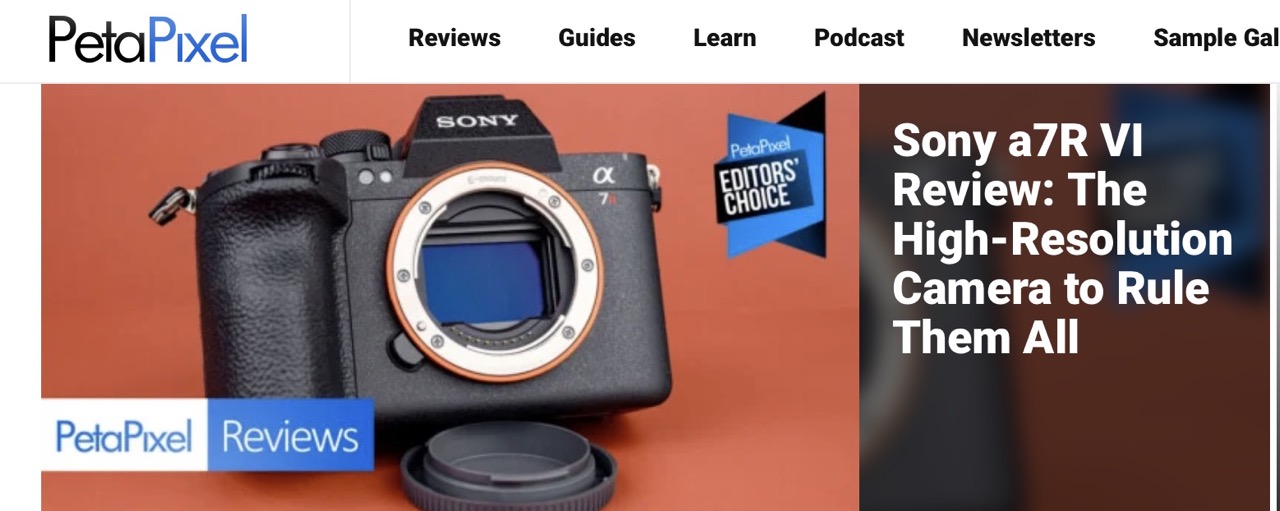
Is this the PetaPixel article you are referring to?
Sundial wrote:
On paper, the A7R VI sounds cool: new sensor with more megapixels, new processor, higher burst rate, and body refinements. But once you look past the marketing language, it becomes difficult to identify what has actually changed in a meaningful way for the photographers this camera is supposedly built for.
I feel many of the changes compared to a7R V come down to bringing the a7R line up-to-date with the later-released bodies.
robert614 wrote:
Still doesn’t support CFExpress Type A 4.0
While I love the size of type A cards. And the fact that you can fit two identical cards slots in such a small body. The speed difference (not to mention the price) between type A and Type B is get increasingly harder to ignore
Please Sony, if you want to continue type A route. Which I’m OK with. Please make future camera bodies 4.0 compatible
It is 4.0 compatible (4.0 cards are backwards compatible) the slot just doesn't support 4.0 speeds...
You know, it a way it also ot doestn’ matter what camer ayou use, as long as you have the vision and skills to achieve the results you aspire to.
Canon, Nikon, Sony, fujifilm, whatever… I say pick whatever works for you and mostly stick with it over the long term, rarely changing brands. There’s a lot to be said for simply becoming very familiar with the ins and outs of whatever system you use — much like a musician continuing to play a very old instrument that he/she knows very, very well.
These days, all of the major brands make excellent cameras, and any competent photographer can do excellent work with any them. Pick a brand, settle on it for a reasonably long term, and focus on making photographs.
Ross Martin wrote:
I’m torn on whether to acquire this. And it’s never about ‘need’ for me - I could have continued producing meaningful photographs without buying a new camera for the last decade or two. It’s about what I want. Like going to dinner: do I need the ribeye, when the burger will satisfy my protein requirements and save me significant cash? Nope, it’s about desire. Most people I know operate the same way.
Sony friends, please don’t hate me for the following: I sold off one of my two A7RV’s in anticipation for this rumored A7RVI, but then a funny thing happened - I acquired a Z8 in late January, and fell head-over-heels in love. As soon as I picked up the handsome Z8, the feel in hand harkened back to the days of my beloved D850 - the greatest DSLR ever made - and I became a smitten kitten. I’ve been shooting the Z8 for nearly 4 months now, and I lost all desire to put an A7RV in my hand - the ergos of the Z8 just work for me unlike any mirrorless I have used. So my last A7RV was sold off.
Now my logical mind sees the A7RVI specs and realizes that 50% more megapixels (compared to my Z8) will provide 25% more linear print width which matters to me, best in class DR combining low and high gain ISO steps in mechanical shutter mode, all while providing a sensor readout speed plenty fast enough for the occasional BIF and faster action work I sometimes do. But, my intuitive self has reconnected with Nikon strongly with the Z8 (I’m a longtime Nikon shooter). And for me the intuition, or ‘gut’ as some call it, is almost always right.
As I write this I’m contemplating doing an A7RVI preorder with my dealer at $100 discount and testing the hell out of it in the field in June (during the epic Roan Mountain wild rhododendron bloom), and if I end up selling it off I am comfortable marking the loss up as a rental fee.
[disclaimer: two wonderful IPA’s from North Carolina breweries were utilized in the making of this post 🤣] ...Show more →
JadedWriter wrote:
So based on PetaPixels review the Z8 is still a better hybrid camera than the A7RVI. My god...
The R series has never been a video camera. There are plenty of other cameras out there for that. The A7R line remains a photo first camera as it always has been. The new sensor is way, way better than the RV for video though.
I think the A7RVI is a fantastic camera for the price. The issue is many bought into the "A1II killer" hype by SAR and few others and found out it's not quite the case for fast actions, hence the disappointment. As some pointed out before the release, something has to give to sell this camera at a much lower price than the A1II, most likely the AF calculation and sensor scan speed. It turned out exactly that. It's NO A1II killer for fast action, which is the main reason people bought the A1II for.
Is the shutter speed really only 1/8000 in ES and MS mode? With a brand new stacked sensor.
I lost all interest in immediately purchasing it as a second body. I'll wait and see what the next body holds or for the A1II to come down in price. Hell, the A7V has become more interesting by default.
SPDTDL wrote:
That’s the whole point. I didn’t buy it (literally). It needed to be in the same league as the Canon R5II, so it’s a no buy from me.
It seems to be that the A7RVI is better than the R5ii for the intended use case of landscape / portrait / studio type photography. The 16 stop dynamic range, higher MP, and 14 bit raw bursts all come into play here.
If you want fast readout in electronic shutter mode (I do), then neither camera is for you. A9iii (0ms), A1ii (1/256s), Z8 (1/268s) are far and away faster than the R5ii (1/158s)
snapsy wrote:
According to DPReview, A7RVI's stacked sensor doesn't have a DRAM layer, replacing it instead with a "processing layer". That doesn't make much sense to me. Most image processing algorithms require access to in-place image data and can't be applied to data coming off-the-fly from the sensor, which means the processing can only be applied to simple processing algorithms like impulse noise reduction - more advanced algorithms will need to access to the stored image data in DRAM, which means this new stacked "processing layer" would have to access DRAM over the slower SLVS-EC interface, negating its sensor co-located stacked performance benefits. They likely kept DRAM off the sensor to improve yields / reduce cost, which begs the question why make it a stacked sensor in the first place, other than for marketing reasons....Show more →
I feel like I had a response for this in a draft, never hit send, got annoyed at work and left I'm at the point where if a person asked me that if they had a photo/video job and needed to get into a system that did both really well I'd just point them at Nikon. You can basically buy a refurb Z8 and refurb 24-70 2.8S for the same price as an A7RVI, unless they really really wanted to get an A1. If Sony wasn't the leading brand in production companies there's almost no reason to buy into the brand. Logan Nolag wrote:
The R series has never been a video camera. There are plenty of other cameras out there for that. The A7R line remains a photo first camera as it always has been. The new sensor is way, way better than the RV for video though.
Sundial wrote:
On paper, the A7R VI sounds cool: new sensor with more megapixels, new processor, higher burst rate, and body refinements. But once you look past the marketing language, it becomes difficult to identify what has actually changed in a meaningful way for the photographers this camera is supposedly built for.
The increase from 61MP to 67MP is only about a 10% increase in linear resolution, which translates to a relatively negligible real-world gain for landscape work.
High ISO performance also appears to remain broadly similar. It stills excel at low ISO, but once you move into ISO 1600+ territory, IQ starts to fall apart. There doesn’t seem to be a meaningful leap forward. I myself was hoping for improvements in read noise, shadow cleanliness, or downstream processing flexibility rather than simply more pixels.
Despited being a fully stacked sensor, the readout speed is still behind cameras like the Canon R5 II and Nikon Z8, both of which are years old already.
The only upgrade that actually feels meaningful is the higher-capacity battery.
The issue isn’t that the A7R VI is a bad camera. It’s that this release doesn’t push the envelope far enough to make Nikon, Canon, or even Sony’s own previous-generation offerings any less compelling.
This release feels like a sign that Sony understands the market has matured. Canon and Nikon users are no longer switching systems purely because of body specifications.
That may make business sense for Sony. But for photographers hoping to see the company aggressively innovate again the way it once did, the A7R VI feels surprisingly underwhelming.
JadedWriter wrote:
I feel like I had a response for this in a draft, never hit send, got annoyed at work and left I'm at the point where if a person asked me that if they had a photo/video job and needed to get into a system that did both really well I'd just point them at Nikon. You can basically buy a refurb Z8 and refurb 24-70 2.8S for the same price as an A7RVI, unless they really really wanted to get an A1. If Sony wasn't the leading brand in production companies there's almost no reason to buy into the brand.


 I'm at the point where if a person asked me that if they had a photo/video job and needed to get into a system that did both really well I'd just point them at Nikon. You can basically buy a refurb Z8 and refurb 24-70 2.8S for the same price as an A7RVI, unless they really really wanted to get an A1. If Sony wasn't the leading brand in production companies there's almost no reason to buy into the brand.