Any one have notes about parallax points for E-mount lenses?
I have just spent the morning testing my A7r3 with Sony 16-35pz lens and found that the NPP is 23mm behind the front of the lens (measured from the lens rim not the glass itself) or 83mm in front of the sensor plane. The reading on my 180mm rail was 68 and the rail appeared in my image from 16-18mm range.
The odd thing is that 68mm rail reading seemed to work best at ANY range from 16-35mm. I most specifically looked at 16, 24, 35Mm focal lengths. Everything I have read says this should not be so but it appears to be correct. Thoughts?
Next up my Tamron 50-400 lens at 50, 75, 100, 150
And Tamron 28-200 lens at 28, 50, 75, 100, 150
Anyone else have NPP’s they can share so we can create a bit of a database? One doesn’t seem to exist right now. If we get enough input I’ll put together a spreadsheet and host it on Google Drive to share freely…
I don't have any advanced thoughts... When zooming the lens one can see the entrance pupil move. So normally I would say The camera needs to be moved on the pano head/rail when zooming. However, there happens a lot of weird things with modern lens designs so the rule may not apply here. I would trust my observations.
At what shooting distance did you check for the NPP? Did you check if anything happened when changing the distance?
Jonas B wrote:
At what shooting distance did you check for the NPP? Did you check if anything happened when changing the distance?
I used two methods:
- The first was the “two uprights” set about five feet apart with the lens about five feet away from the closer upright.
- The second was a piece of tape on a window and a tree in the distance about 50 feet away. Camera about 3’ from the window first time and 10’ second time. No difference.
Jonas B wrote:
When zooming the lens one can see the entrance pupil move. So normally I would say The camera needs to be moved on the pano head/rail when zooming.
You can see the pupil move back and forth as you zoom in and out. A super rough guess is it looks like it moves about 5-10mm between 16 and 35. Maybe it’s just that at those wide focal lengths it makes little difference, but I’m not sure why.
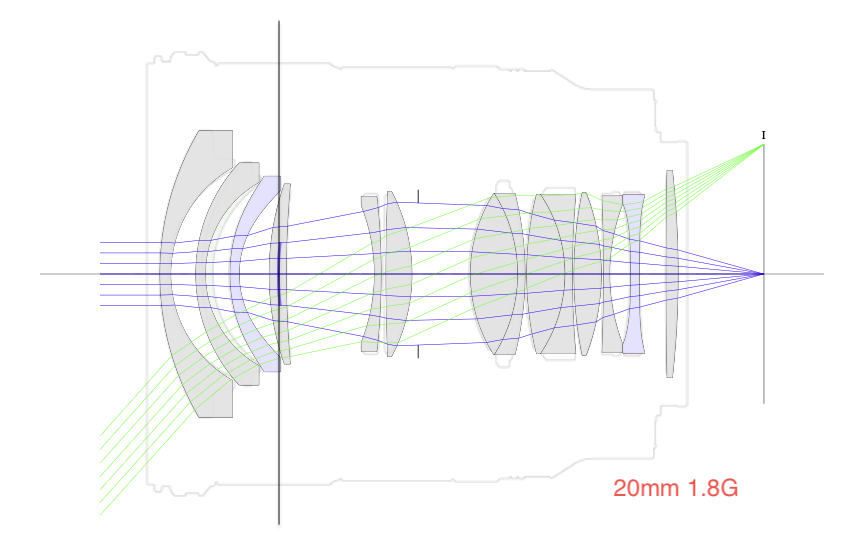
This site has a good repository of lenses with oodles of data including the no parallax point. Find your lens in the list and click to open. In the next window click the P Surface button to show the no parallax point/plane. I saved them and added a notation and axis line that I could put on my phone for reference.
James Burden wrote:
This site has a good repository of lenses with oodles of data including the no parallax point. Find your lens in the list and click to open. In the next window click the P Surface button to show the no parallax point/plane. I saved them and added a notation and axis line that I could put on my phone for reference.
If I'm interpreting this correctly, click on the button that says "Pupils" and "Z-axis". You are looking for the blue pupil line. In the chart, the row marked Positions, the fifth entry has a blue P above it and that is your entrance pupil measurement from the front of the lens.
In the top line, click on the "Zoom" button and it will bring up a slider so you can try other focal lengths of zoom lens.
That is a great site. Thank you. I occasionally try panos with the Sigma 14-24 at 24mm and curiously the entrance pupil only changes about 1 mm form 14 to 24mm. I have a mark on a focusing rail on masking tape so I know how far back to move the lens. (I know, a high tech solution) I determined it empirically and will now have to check how close I got. The site says 23 mm. I suppose focusing distance may make a difference for some lenses but anything close will probably aid the stitching.
TimCC wrote:
If I'm interpreting this correctly, click on the button that says "Pupils" and "Z-axis". You are looking for the blue pupil line. In the chart, the row marked Positions, the fifth entry has a blue P above it and that is your entrance pupil measurement from the front of the lens.
In the top line, click on the "Zoom" button and it will bring up a slider so you can try other focal lengths of zoom lens.
I think you are correct, thank you. Just a note the measurement appears to be from the front of the glass and not from the front of the lens (plastic or metal shell) which measures 3mm longer so if the chart shows 17mm the reading on your rail would be 3+17 or 20mm as measured off the front of the lens.
You should determine that NPP empirically using the near/far subject parallax method. I've gone overboard with looking at lens designs and element/group positions while zooming and they do not always correlate. It's quicker to go outside and take notes at various focal lengths. I sometimes have labels and marks on my MPR-CL II or other nodal slides for quick positioning in the field. Now after 28+ years panning and stitching it's second nature and easy to do.
Just a couple observations on things I found useful:
1. Keep a file that records the image plane to NPP distance for each of your lenses.
2. For your L-brackets / nodal rails keep track of any inherent offset. For my L-bracket / nodal rail, the markings are the I-P distance in landscape mode, for portrait mode I need to add 7mm.