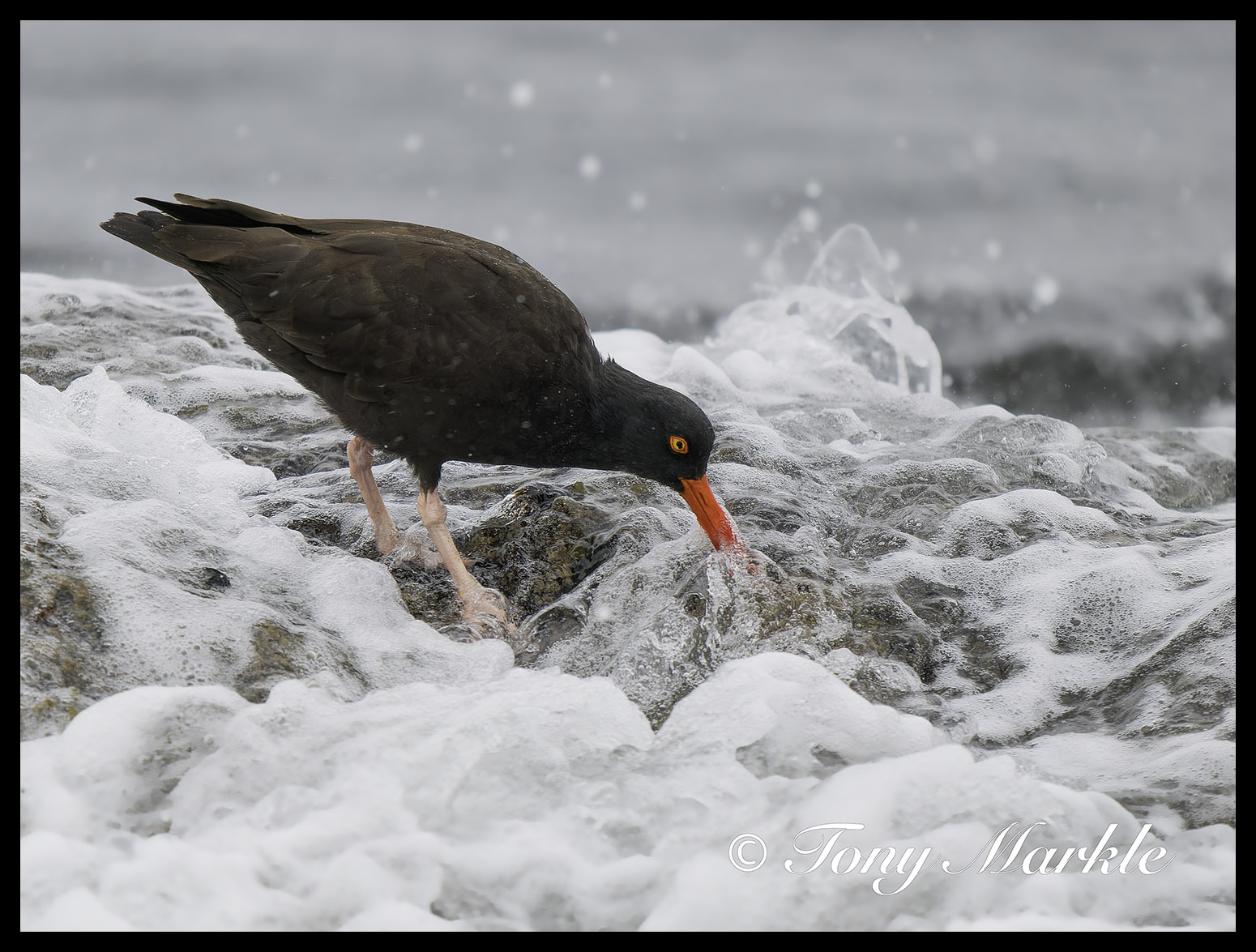
Female Black Oystercatchers can be identified by prominent, dark, irregular "eye flecks" or pigment spots in their yellow irises, often making the pupil appear larger, irregular, or connected to black spots. These flecks are a reliable, ~94% accurate field method to distinguish females (who have prominent flecks) from males (who have minimal or no spots).
Nice shot and interesting information and a very cool bird Tony, thanks for that. We don't have them here in our area but I have seen them in the coastal waters of Portugal, hard to get close to them as I recall.
We *never* saw Oystercatchers (nor osprey, eagles, willets, etc) growing up in NY coastal waters until about 15 years ago. Now they are common in the salt marshes. Love seeing and hearing them. (Oddly, SA Skimmer pairs were common working our cove, but I see fewer now.)
A true success story here, from the NY DEC:
Two races of American oystercatcher are recognized. The eastern race, Haematopus palliaatus
palliates, occurs along the Atlantic Coast and breeds in New York. American oystercatcher was
extirpated from New York in 1896. Breeding resumed in the Northeast in the 1930s and the population
has increased since then. Breeding resumed in New York in 1957 (Post 1961). New York’s second
Breeding Bird Atlas revealed a 51% increase in the last 20 years in the number of survey blocks where
this species breeds, which includes the coastal lowlands and southern Westchester County (McGowan
and Corwin 2008). Breeding occurs traditionally among sand dunes on barrier islands, but an
adaptation to nesting in salt marshes has been observed, likely as a result of disturbance in traditional
habitats