p.2 #1 · New Ziess RF 35mm F1.4 Lens - anyone considering it
Planetwide wrote:
The problem with this much distortion correction, is that the corners never really sharpen up...
Yeah, that's the intuitive conclusion that many people reach. But it doesn't really turn out that way in practice, and it is why I always tell people to look at the results before making assumptions.
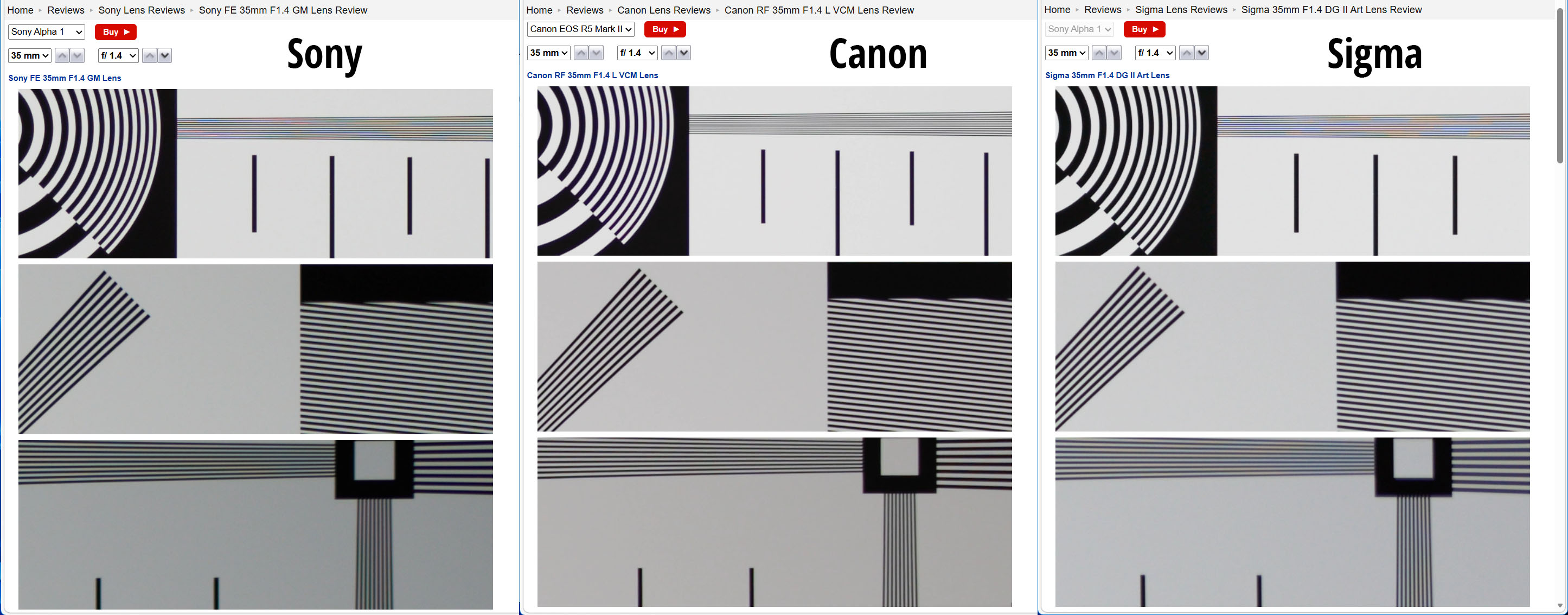
Take a look at these comparisons at TDP between the Canon RF 35mm f/1.4L VCM and the Sony 35mm f/1.4 GM--or pick any other comparable, like the EF 35mm f/1.4L II:
You will have to copy the text of the URL to see the second lens, as Fred's link handling is broken for URL parameters. Or, just pick any lens you want to compare:
I have used Canon Care extensively during the warranty time and I dont buy any expensive canon gear without the US warranty + canon care given my shooting style of wildlife in challenging situations often.Though that is unlikely to be the case with this lens.
p.2 #3 · New Ziess RF 35mm F1.4 Lens - anyone considering it
thedutt wrote:
I have used Canon Care extensively during the warranty time and I dont buy any expensive canon gear without the US warranty + canon care given my shooting style of wildlife in challenging situations often.Though that is unlikely to be the case with this lens.
thedutt, something to consider if you are considering this MF lens to use for some wildlife scenes or portraits. Think about the times when you are holding your camera in different positions to get different angles like on the ground, above your head, hanging out the side of a vehicle, camera sitting on a table, etc. I do this all the time and if you do, I say good luck to using MF in these situations. I get that MF can kind of slow things down and take you back to old times, but for run and gun travel or similar a lens that AF's is always going to prevent you from missing a spontaneous shot.
p.2 #4 · New Ziess RF 35mm F1.4 Lens - anyone considering it
thedutt wrote:
I have used Canon Care extensively during the warranty time and I dont buy any expensive canon gear without the US warranty + canon care given my shooting style of wildlife in challenging situations often.Though that is unlikely to be the case with this lens.
When I bought both the Otus 50 and 85 ML once I registered the lens with Zeiss I was given 3 years warranty.
That said all the Classic ZE/ZF, Milvus and Dslr Otus lenses I own not one has ever needed servicing.
p.2 #5 · New Ziess RF 35mm F1.4 Lens - anyone considering it
garyvot wrote:
Yeah, that's the intuitive conclusion that many people reach. But it doesn't really turn out that way in practice, and it is why I always tell people to look at the results before making assumptions.
Take a look at these comparisons at TDP between the Canon RF 35mm f/1.4L VCM and the Sony 35mm f/1.4 GM--or pick any other comparable, like the EF 35mm f/1.4L II:
You will have to copy the text of the URL to see the second lens, as Fred's link handling is broken for URL parameters. Or, just pick any lens you want to compare:
I think you will find that the 35 VCM is as competitive as any other lens in its category....Show more →
I own the RF35mm VCM, so I am speaking from experience. It is very sharp, but...
Digital stretching to correct the lens, is just that - stretching pixels. While I appreciate Canon using this correction to achieve zooms that would otherwise be larger or heavier, with the 24-105mm F2.8 being a great example of this. We all know that Canon can make an optically correct 35mm F1.4, as this is something that they have already done (EF).
But when I pay for the 35mm f1.4, I expect it to maybe correct distortion in 2-3% range. What Canon should have done, is make the lens slightly wider, say 32mm and then correct for a 35mm field of view.
"That’s just weird in a 35mm lens. Sony’s 35mm F1.4 GM has almost zero distortion. The Canon EF 35mm F1.4L II had next to no distortion. This lens requires a +26 to manually correct the distortion. It also required me to nearly max out the vignette slider (+96) to get a clean end result."
p.2 #6 · New Ziess RF 35mm F1.4 Lens - anyone considering it
Planetwide wrote:
What Canon should have done, is make the lens slightly wider, say 32mm and then correct for a 35mm field of view.
That's exactly what they have done, not only for this lens, but for all similar lenses in the lineup.
From Dustin's review that you quoted above:
"Look back at how much wider the uncorrected result is on my chart as compared to the profile corrected result. In camera I had the sides of the chart aligned, but that was only because the camera would only show me the corrected result. The actual image is considerably wider so that it can be the proper focal length after correction."
p.2 #7 · New Ziess RF 35mm F1.4 Lens - anyone considering it
Planetwide wrote:
I own the RF35mm VCM, so I am speaking from experience. It is very sharp, but...
Digital stretching to correct the lens, is just that - stretching pixels. While I appreciate Canon using this correction to achieve zooms that would otherwise be larger or heavier, with the 24-105mm F2.8 being a great example of this. We all know that Canon can make an optically correct 35mm F1.4, as this is something that they have already done (EF).
But when I pay for the 35mm f1.4, I expect it to maybe correct distortion in 2-3% range. What Canon should have done, is make the lens slightly wider, say 32mm and then correct for a 35mm field of view.
"That’s just weird in a 35mm lens. Sony’s 35mm F1.4 GM has almost zero distortion. The Canon EF 35mm F1.4L II had next to no distortion. This lens requires a +26 to manually correct the distortion. It also required me to nearly max out the vignette slider (+96) to get a clean end result."
Thank you for sharing your experience and the review link ; I personally dont care if its digial correction or physical correction as long as I can get the perspective I shot; loosing part of the frame to get the corrected image is what concerns me. Plus I am not seeing enough of a reason to upgrade over the 35 1.8
p.2 #8 · New Ziess RF 35mm F1.4 Lens - anyone considering it
burningheart wrote:
When I bought both the Otus 50 and 85 ML once I registered the lens with Zeiss I was given 3 years warranty.
That said all the Classic ZE/ZF, Milvus and Dslr Otus lenses I own not one has ever needed servicing.
Thats good to know - perhaps then I will buy this lens in Japan in the upcoming trip. I shot often while wading but I suspect that is unlikely with 35mm.
p.2 #9 · New Ziess RF 35mm F1.4 Lens - anyone considering it
garyvot wrote:
That's exactly what they have done, not only for this lens, but for all similar lenses in the lineup.
From Dustin's review that you quoted above:
"Look back at how much wider the uncorrected result is on my chart as compared to the profile corrected result. In camera I had the sides of the chart aligned, but that was only because the camera would only show me the corrected result. The actual image is considerably wider so that it can be the proper focal length after correction."
Perhaps I was not clear, I feel that Canon should have made the lens provide a larger image circle than full frame, and have the sensor size (24x36mm) act like a crop to full frame. In effect, allowing the sensor to image the sweet spot of the lens. Alternatively, optical correction in the lens, does allow for the full sensor to be utilized. Digital cropping from a wide field of view on the sensor, would only reduce the number of pixels or resolution from the sensor.
But what Canon has chosen to do is stretch the existing image via software to correct barrel and pincushion distortion. Now, I know that almost all manufacturers engage in this to some degree. But, Canon has chosen to correct a significant amount of distortion, and definitely, much more than their competitors. Just toggle the profile on and off in lightroom, and you will see it. On the 35mm VCM there is a noticeable drop in resolution in the corners.
I have a feeling that the VCM lenses were built to a price for video, and not so much for photography.
p.2 #10 · New Ziess RF 35mm F1.4 Lens - anyone considering it
Planetwide wrote:
... I feel that Canon should have made the lens provide a larger image circle than full frame, and have the sensor size (24x36mm) act like a crop to full frame...
Yes, and that is the Zeiss Otus way, at least with the Old Four Oti.
I´m sure you are aware of the Why so little interest in RF 35mm F1.4 VC-thread were all the bad about the VCM is regurgitated.
p.2 #11 · New Ziess RF 35mm F1.4 Lens - anyone considering it
Planetwide wrote:
Perhaps I was not clear, I feel that Canon should have made the lens provide a larger image circle than full frame, and have the sensor size (24x36mm) act like a crop to full frame. In effect, allowing the sensor to image the sweet spot of the lens. Alternatively, optical correction in the lens, does allow for the full sensor to be utilized. Digital cropping from a wide field of view on the sensor, would only reduce the number of pixels or resolution from the sensor.
But what Canon has chosen to do is stretch the existing image via software to correct barrel and pincushion distortion. Now, I know that almost all manufacturers engage in this to some degree. But, Canon has chosen to correct a significant amount of distortion, and definitely, much more than their competitors. Just toggle the profile on and off in lightroom, and you will see it. On the 35mm VCM there is a noticeable drop in resolution in the corners.
I have a feeling that the VCM lenses were built to a price for video, and not so much for photography.
I also think the VCM lenses are not targeted at photographers expecting maximum performance through traditional optical design. For f/1.4 lenses they are relatively compact and each design is restricted, more or less, by the design limitations imposed by making them all very similar in physical size. I totally get the benefit of this choice for video applications, some of which also trickles down to still photography, such as uniform filter size. But for stills, there may be more of a tradeoff in ultimate image quality performance because of the software corrections. At least compared to more traditionally designed lenses such as the Zeiss Otus line.
IIRC you're also a Leica SL system user with some of the Summicron APO primes? How do those compare agains the VCM lenses?
The Crons appear to be very similar in size to the VCM lenses, yet a stop slower and with really amazing sharpness/image quality. Was Canon too ambitious/optimistic making the VCMs f/1.4?
p.2 #12 · New Ziess RF 35mm F1.4 Lens - anyone considering it
rscheffler wrote:
I also think the VCM lenses are not targeted at photographers expecting maximum performance through traditional optical design. For f/1.4 lenses they are relatively compact and each design is restricted, more or less, by the design limitations imposed by making them all very similar in physical size. I totally get the benefit of this choice for video applications, some of which also trickles down to still photography, such as uniform filter size.
I think this is undeniably the case. All the current VCM lenses share basically the same housing and are of a similar heft, which is intended to make them easily interchangeable on a gimbal, easy to fit with common focusing accessories, etc. And of course, they have iris rings.
rscheffler wrote:
But for stills, there may be more of a tradeoff in ultimate image quality performance because of the software corrections. At least compared to more traditionally designed lenses such as the Zeiss Otus line.
This certainly seems like the intuitive conclusion to draw. It is probably correct in an objective, utlimate sense.
But at the risk of beating a dead horse (at least with @Planetwide, haha), the Canon RF 35mm f/1.4L VCM remains competitive even after corrections, as these comparisons from The-Digital-Picture show (credit to Bryan Carnathan). I would argue that it is marginally sharper than the brand-new Sigma Art in the far corners and is at least as good as the Sony. (I previously shared a comparison in which it was also sharper than the excellent EF 35mm f/1.4L II.)
How is this possible? Perhaps the pixel stretching is less destructive than we think. Or maybe Canon designed these lenses with greater corner resolving power than normal to "overcorrect" for the stretching.
"... the image resolution does certainly stand out in a very positive way. The center performance is already excellent at f/1.4, and it exceeds the sensor resolution in the f/2 to f/4 range. The near-center performance is also very impressive. Unsurprisingly, the extreme corners aren’t quite as sharp at f/1.4 but they are still good to very good. Stopping down lifts their quality to very good levels from f/2 onward already... If image sharpness is what you value the most, this is certainly a lens for you. It's sharp at f/1.4 already and downright superb from f/2 to f/8."
So, while you could argue that these lenses are more suited to video than stills, it is hard to find evidence in the real world that this is the case, at least based on professional bench tests. Image samples I have seen all look pretty great too.
I don't own this lens, so I shouldn't really have this much skin in the game. I just think this lens has been unfairly criticized.
p.2 #13 · New Ziess RF 35mm F1.4 Lens - anyone considering it
Yes, you need to take offense by the way the end result is made to find this lens anything but up there with the very best. If you just look at the end result, the final image, this lens is great. As are most new lenses these days.
p.2 #14 · New Ziess RF 35mm F1.4 Lens - anyone considering it
garyvot wrote:
But at the risk of beating a dead horse (at least with @Planetwide@, haha), the Canon RF 35mm f/1.4L VCM remains competitive even after corrections, as these comparisons from The-Digital-Picture show (credit to Bryan Carnathan). I would argue that it is marginally sharper than the brand-new Sigma Art in the far corners and is at least as good as the Sony. (I previously shared a comparison in which it was also sharper than the excellent EF 35mm f/1.4L II.)
How is this possible? Perhaps the pixel stretching is less destructive than we think. Or maybe Canon designed these lenses with greater corner resolving power than normal to "overcorrect" for the stretching.
"... the image resolution does certainly stand out in a very positive way. The center performance is already excellent at f/1.4, and it exceeds the sensor resolution in the f/2 to f/4 range. The near-center performance is also very impressive. Unsurprisingly, the extreme corners aren’t quite as sharp at f/1.4 but they are still good to very good. Stopping down lifts their quality to very good levels from f/2 onward already... If image sharpness is what you value the most, this is certainly a lens for you. It's sharp at f/1.4 already and downright superb from f/2 to f/8."
So, while you could argue that these lenses are more suited to video than stills, it is hard to find evidence in the real world that this is the case, at least based on professional bench tests. Image samples I have seen all look pretty great too.
I don't own this lens, so I shouldn't really have this much skin in the game. I just think this lens has been unfairly criticized....Show more →
All VCM lenses have higher resolution across the frame than their EF counterparts, some of them by a considerable margin. It is in the nature of wideangle lenses to have barrel distortion. One way to avoid this is a symmetrical design, but this puts the exit pupil too close to the sensor which results in fuzzy corners with a color cast. Another method to mitigate distortion is to throw in extra glass to correct it optically. This comes at the expense of other aberrations like coma and astigmatism. You really need a complex design in order to control all aberrations in a large-aperture wideangle lens.
Canon does not correct distortion optically in their VCM wideangles, which yields a high-resolution starting point before the software correction, and a still good resolution after the correction. I think the reputation of the 35 VCM suffers from that fact that it was the first L prime with lots of distortion. People were discouraged by the negative reviews. The 24 VCM and 20 VCM have just as much distortion as the 35 VCM, but are much better received. People have come around.
Personally I compared the 35 VCM to the Milvus 35/1.4, and was not able to tell the difference for landscape type of subjects. For portrait work, the VCM was sharper at f/1.4 but also had more of the cat's eye effect. As is often the case, you cannot have it all. I don't use much time on pixel peeping. Not any more. Whatever differences you see between lenses is not going to be the difference between a poor or a great photograph. The compact size of the VCMs, however, can be a decisive factor.
p.2 #15 · New Ziess RF 35mm F1.4 Lens - anyone considering it
As a photographer, the biggest issue for me with the VCM series is longitudinal CA. It's there, and hard to get rid of. Lens sharpness, while somewhat diminished in the corners, from excellent to good, is only an known irritant. FYI, I understand the trade offs for weight and video use, but my particular use is different.
It is an unfair comparison to the Leica SL 35mm APO, which I also own and shoot, as it is an F2.0 lens, and simply remarkable. I would say that the Leica is the best 35mm lens that I have ever shot.
In the 35mm F1.4 world, the Sony GM is also exceptional. Lastly, while I have not had a chance to try it, the new Sigma 35mm F1.4 DG DN seems to be very promising as well. I just wish that Canon would open up their mount, so as to allow us to choose...
I find the new Zeiss intriguing as well, and I look forward to seeing samples, and hopefully Fred will have a review.
p.2 #16 · New Ziess RF 35mm F1.4 Lens - anyone considering it
Planetwide wrote:
As a photographer, the biggest issue for me with the VCM series is longitudinal CA. It's there, and hard to get rid of. Lens sharpness, while somewhat diminished in the corners, from excellent to good, is only an known irritant. FYI, I understand the trade offs for weight and video use, but my particular use is different.
It is an unfair comparison to the Leica SL 35mm APO, which I also own and shoot, as it is an F2.0 lens, and simply remarkable. I would say that the Leica is the best 35mm lens that I have ever shot.
In the 35mm F1.4 world, the Sony GM is also exceptional. Lastly, while I have not had a chance to try it, the new Sigma 35mm F1.4 DG DN seems to be very promising as well. I just wish that Canon would open up their mount, so as to allow us to choose...
I find the new Zeiss intriguing as well, and I look forward to seeing samples, and hopefully Fred will have a review....Show more →
Everything is a tradeoff and so it depends on what your priorities are. I can say that if you want a high performance f/1.4 35mm AF lens then only the Sony GM very marginally bests the VCM, but this is for stills only and the difference is small and situational. With that said if you take into account video, then the VCM pulls ahead of the Sony for best all around f/1.4 AF lens currently available. This is when taking into considering AF, sharpness, contrast, size, weight, focus breathing, video function, etc.
My EF 35II was the gold standard for Canon users but mostly for lack of distortion and LoCA. Other than that, it's not even close to the VCM in many other departments.
Regardless, I would sure love to see some non pixel peeping examples of any IQ complaints for any and all of the 35's mentioned though as they should all be sufficient for most everything. If not for some very specialized shooting disciplines like Astro or similar, I think pixel peeping is what drives conversations like this.