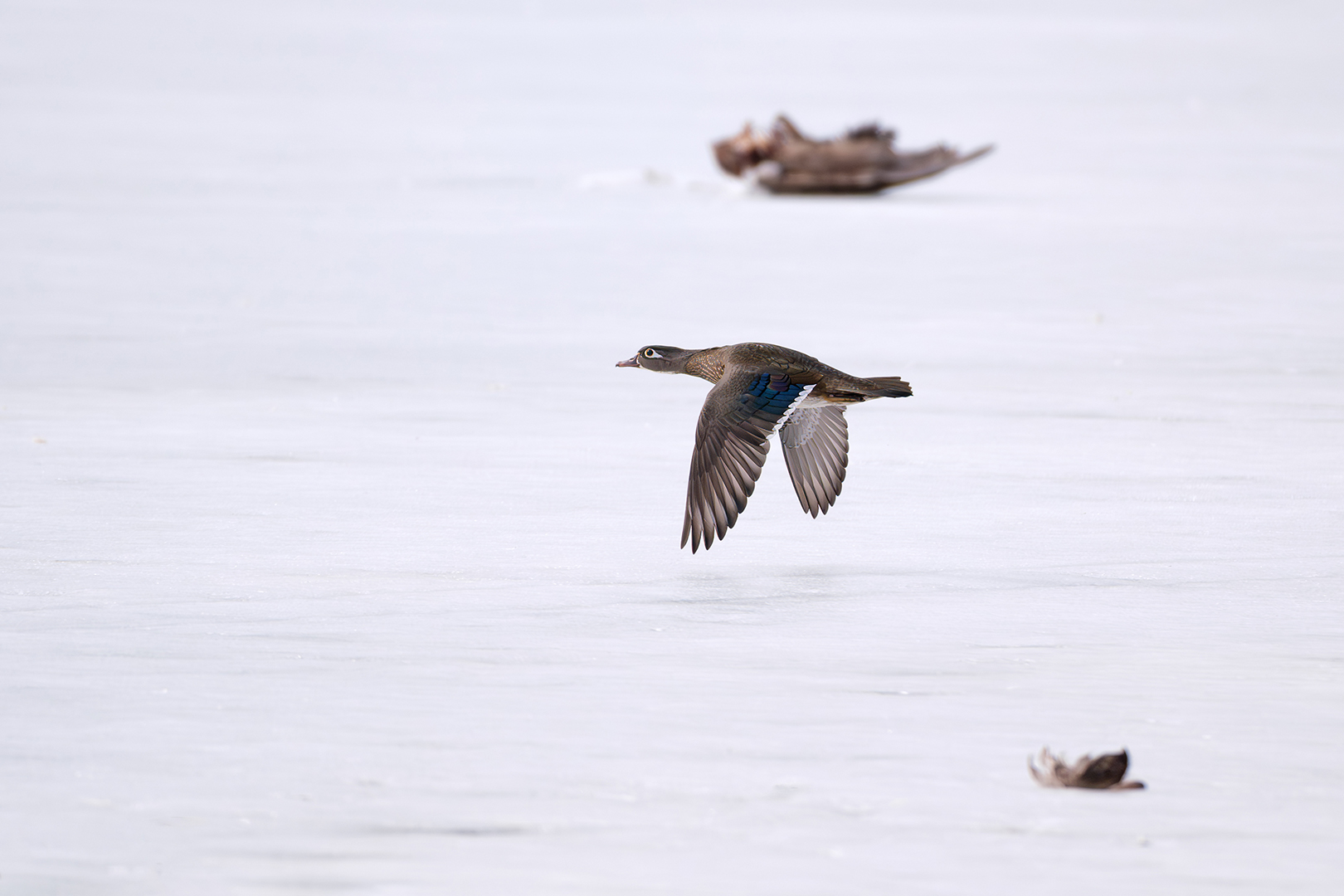
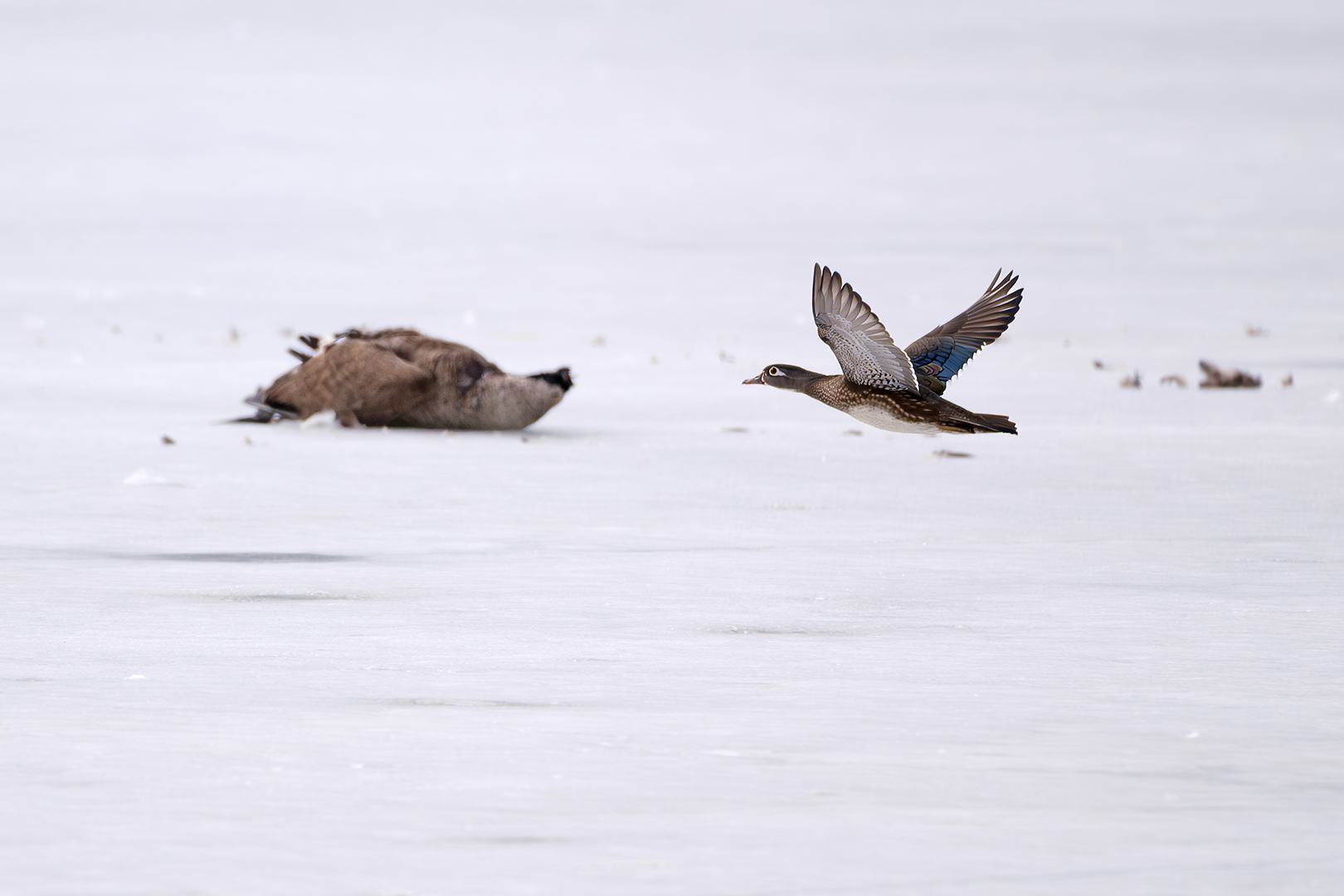
I've had a hard time deciding how to present photos of the many dead birds laying on the ice hear in NE Queens, NYC. It's a rather sad sight and I feel for the birds that have lost loved ones. I've chosen not to take close up images or wide views of the carcuses. When I saw them in a burst I took of a female wood duck flying across Kissena Lake, I felt these captured the reality without being too detailed.
Comments and suggestions welcome,
Morris
1)
X-H2SXF500mmF5.6 R LM OIS WR lens500mmf/5.61/3200s800 ISO+0.7 EV
2)
X-H2SXF500mmF5.6 R LM OIS WR lens500mmf/5.61/3200s800 ISO+0.7 EV
n.v.m. wrote:
looks to me like the victim of a predator. why are there scattered parts in the image?
The second has that appearance. That bird was initially in one piece laying on it's back just as you see the two birds in the first image. Among the other photographers there that day there was one that works in bird rehabilitation and I asked this very question and wondered why the eagles are not cleaning up the mess. She stated that they have tested a number of birds that were collected, some in pieces as seen in the second photo and that they have all tested positive for Avian Flu. The water is also testing positive. Not all the birds are dying, just as with the Covid Pandemic, it's the week that sacrum. The extreme cold we have had is probably making it worse.
It's been tough watching some bird numbers collapse during the last few years of avian flu. I end up deleting the images since I just can't stomach it most of the time.
Very sad, but I found your reporting tastefully done Morris.
We've had things like rabies outbreaks here in central FL that hit everything from stray cats to racoons etc, parvo and canine distemper, red tide, mosquito born illnesses, now outbreaks of avian flu to worry about and a host of others that effect cow's, never mind urban sprawl, etc. Who knows the long term effect of the sewage leak into the Potomac? I know one of the ways the feds tracked Covid outbreaks was testing the water at the local sewage treatment plants for concentrations of virus in the pre-treated water... It's almost like the plagues of Egypt out there for the animals... sometimes it is easy to forget it's not just humans dealing with this stuff.
A lot of old common sense stuff people used to do for prevention has been lost to the younger generation... like not leaving anything outside that could hold water facing upward where mosquitos could breed, isolating your animals more effectively, there were no such things as fenced off dog parks where things are more concentrated. City dumps with biological waste, that birds feed on. Some preventative stuff was relegated to old wives tales, but some stuff worked and has been lost to history. Seems almost like we have to re-learn old lessons over and over and learn some new one's too.
chuck4242 wrote:
It's been tough watching some bird numbers collapse during the last few years of avian flu. I end up deleting the images since I just can't stomach it most of the time.
It is very sad yet some birds are flourishing and I like to focus on the good
---------------------------------------------
Erictator wrote:
Very sad, but I found your reporting tastefully done Morris.
We've had things like rabies outbreaks here in central FL that hit everything from stray cats to racoons etc, parvo and canine distemper, red tide, mosquito born illnesses, now outbreaks of avian flu to worry about and a host of others that effect cow's, never mind urban sprawl, etc. Who knows the long term effect of the sewage leak into the Potomac? I know one of the ways the feds tracked Covid outbreaks was testing the water at the local sewage treatment plants for concentrations of virus in the pre-treated water... It's almost like the plagues of Egypt out there for the animals... sometimes it is easy to forget it's not just humans dealing with this stuff.
A lot of old common sense stuff people used to do for prevention has been lost to the younger generation... like not leaving anything outside that could hold water facing upward where mosquitos could breed, isolating your animals more effectively, there were no such things as fenced off dog parks where things are more concentrated. City dumps with biological waste, that birds feed on. Some preventative stuff was relegated to old wives tales, but some stuff worked and has been lost to history. Seems almost like we have to re-learn old lessons over and over and learn some new one's too.
Eric
Thank you Eric,
The biologist that invented tracking COVID in drinking water works at Queens College where I used to work and am now the President of the retirement association. He did a talk for us and it was fascinating the things they learned using this method. They took a lot of samples from all over the city and later the country.
From the Ano Nuevo State Park Facebook Page: We received confirmation from the U.S. Department of Agriculture’s National Veterinary Services Laboratory that seven weaned elephant seal pups at Año Nuevo have tested positive for the highly pathogenic avian influenza (HPAI) H5N1. This marks the first detection of HPAI in a marine mammal in California and the first known cases in northern elephant seals. The cases were identified after research teams from UC Santa Cruz (UCSC) and UC Davis (UCD) observed abnormal respiratory and neurological signs in several seals. Samples were collected and tested through the California Animal Health and Food Safety Laboratory System, with federal confirmation received Tuesday evening. This rapid detection reflects years of coordinated surveillance and preparation. Researchers had increased monitoring efforts due to the spread of avian influenza across North and South America and its devastating impact on related species, including southern elephant seals in Argentina in 2023. State Parks is working closely with USCS, UCD, NOAA Fisheries, the California Department of Fish and Wildlife, and the West Coast Marine Mammal Stranding Network as they continue monitoring along the coast. As a precaution, we have temporarily closed public access to seal viewing areas and canceled guided tours for the remainder of the season. We will continue working with our partners and will rely on experts to determine when it is safe to reopen closed areas – the primary concern now is the health of the elephant seals, visitors and staff. While the risk to the general public remains very low, HPAI can spread between animals and people. Do not approach or handle live or deceased marine mammals. We recognize this news is concerning, please know that we have the best experts in the field following this issue and we will continue to share updates via social channels as appropriate and necessary....Show more →
In addition, some elephant seals have been found dead outside of the reserve (including 3 today). They have been swabbed for bird flu testing, but the results are not available yet.
vbnut wrote:
Unfortunately it's not just affecting birds.
From the Ano Nuevo State Park Facebook Page:
In addition, some elephant seals have been found dead outside of the reserve (including 3 today). They have been swabbed for bird flu testing, but the results are not available yet.
I just found this while reading the NY Times:
"A lethal form of bird flu, which has already killed tens of thousands of elephant seals in the Southern Hemisphere, is now spreading in a colony of elephant seals in California, scientists announced on Wednesday."'
Sad to see
There were recent articles, including NYTimes, about the drastic decline in birds. Avian flu, climate warming, pollution, loss of habitat, etc - the drop has been very noticeable in places I routinely visit.
RockvilleBob wrote:
Sad to see
There were recent articles, including NYTimes, about the drastic decline in birds. Avian flu, climate warming, pollution, loss of habitat, etc - the drop has been very noticeable in places I routinely visit.
Yes it is very sad. I've read the stories in the NYTimes. A week ago with all the snow my feeders were under siege and now that it's melting and I think the Spring Migration has started my feeders are lonely. The good thing is that the wood peckers are getting some private time at them and besides being good for them, I'm enjoying seeing the Red-Bellied and Downy storing food and eating in the trees near my kitchen window.