p.3 #1 · Sony silently applying gain at certain apertures
Jonas B wrote:
Sony A1, fw 4.00, Voigtländer 50/1.2 SE
for each exposure there is a f-number and under that the averaged level of the pixels (in aRGB before converting to web-fomat and sRGB).
I guess the difference between f1.0 and 1.0 and f1.1 and 1.1 are bigger.
Were you shooting RAW or JPEG?
p.3 #3 · Sony silently applying gain at certain apertures
...and, to add to Daran's question: can you confirm that the vignetting correction is written in the raw file (despite being turned off in the settings)?
p.3 #4 · Sony silently applying gain at certain apertures
Ruthenium -> everything is off in the raw files. Sony (and other manufacturers) hide these overrides entirely. I just looked at the EXIF in some pics I took with the Nokton and all lens comp settings are flagged as off. Waiting for Jonas' confirmation but I'm 99% certain it'll be the same for him.
p.3 #5 · Sony silently applying gain at certain apertures
ruthenium wrote:
...and, to add to Daran's question: can you confirm that the vignetting correction is written in the raw file (despite being turned off in the settings)?
Hi,
I think so. Camera setting says "Shading comp" OFF.
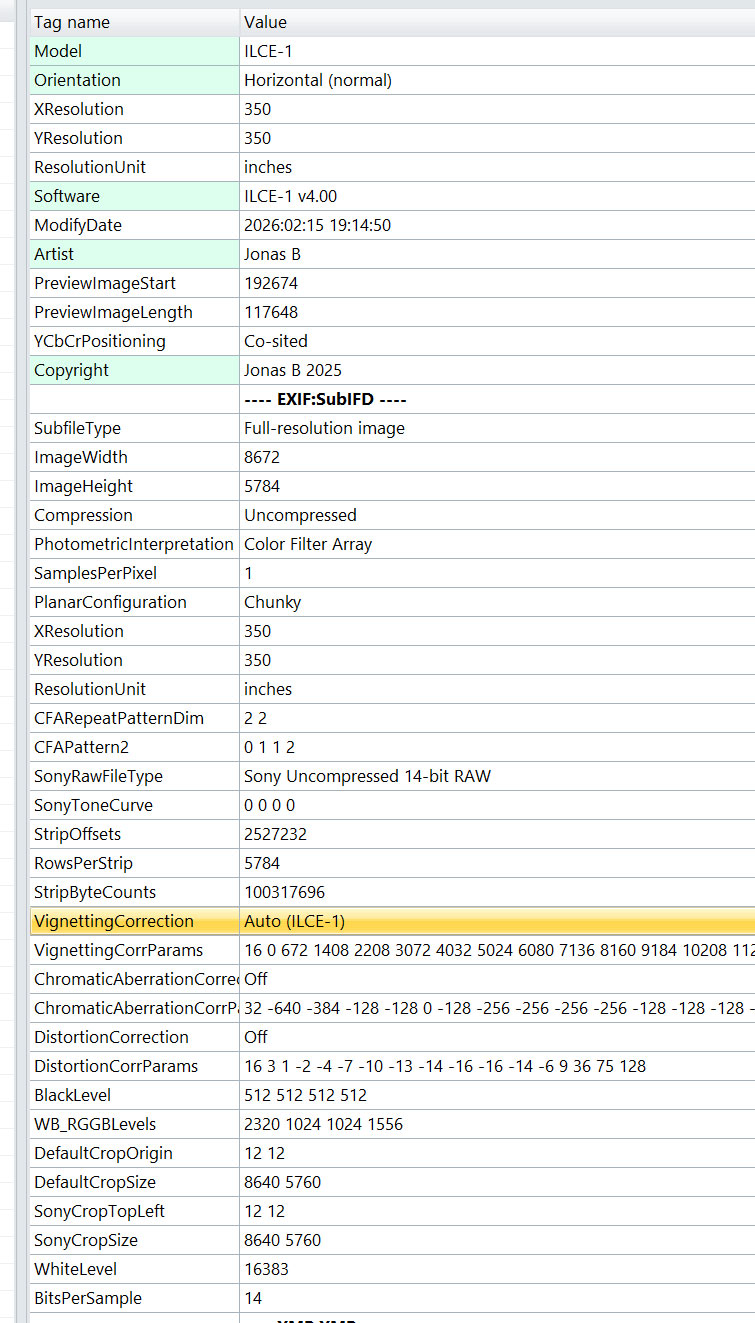
Here is part of what EXIFtools GUI reads from the f1.2 file (and I see I should change year at the Copyright info):
Looks like Auto?
Also a reminder: the crops are from the central 5% of the image only. RGB-values were measured in Photoshop from the crops.
p.3 #6 · Sony silently applying gain at certain apertures
Jonas B wrote:
Hi,
I think so. Camera setting says "Shading comp" OFF.
Here is part of what EXIFtools GUI reads from the f1.2 file (and I see I should change year at the Copyright info): https://photos.imageevent.com/jonas_b/fotoforum2022andfw/A1_gain_at_large_f-stops_EXIF.jpg
Looks like Auto?
Also a reminder: the crops are from the central 5% of the image only. RGB-values were measured in Photoshop from the crops.
The ISO override is a separate process, as it adds exposure uniformly and doesn't just correct vignetting. Shooting two pics with and without vignetting comp shows the correction is clearly targeted at the vignette and doesn't touch the center exposure.
EDIT: very interesting to see you have it set to auto, mine were all off including vignetting comp:
p.3 #7 · Sony silently applying gain at certain apertures
ImDaJim wrote:
The ISO override is a separate process, as it adds exposure uniformly and doesn't just correct vignetting. Shooting two pics with and without vignetting comp shows the correction is clearly targeted at the vignette and doesn't touch the center exposure.
Yes, that's why I reminded any possible reader about the crops size and position.
But why does it say Auto in EXIF when set to OFF in the camera? (And why does it say ISO100 in EXIF when we clearly have an increased gain at the larger apertures? And what idiot decided vignetting correction should be done in the raw file? And...)
p.3 #8 · Sony silently applying gain at certain apertures
Jonas B wrote:
Yes, that's why I reminded any possible reader about the crops size and position.
But why does it say Auto in EXIF when set to OFF in the camera? (And why does it say ISO100 in EXIF when we clearly have an increased gain at the larger apertures? And what idiot decided vignetting correction should be done in the raw file? And...)
Yes, this is infuriating to say the least. These are baked in the raw files, people have discussed this exact issue on these forums. I'm realizing the initial test done in that thread also shows the increase in global brightness even before enabling vignette comp: https://photos.smugmug.com/photos/i-9c2v79D/0/fe263c8b/XL/i-9c2v79D-XL.gif
p.3 #12 · Sony silently applying gain at certain apertures
Jonas B wrote:
Hi,
I think so. Camera setting says "Shading comp" OFF.
Here is part of what EXIFtools GUI reads from the f1.2 file (and I see I should change year at the Copyright info): https://photos.imageevent.com/jonas_b/fotoforum2022andfw/A1_gain_at_large_f-stops_EXIF.jpg
Looks like Auto?
Also a reminder: the crops are from the central 5% of the image only. RGB-values were measured in Photoshop from the crops.
Thank you for checking and confirming!
It is also possible that there is a parameter/setting in EXIF, different from ISO, that adds digital gain.
For example, that may or may not be relevant, Fuji RAF files have "Exposure Compensation Bias" (that should not be confused with the Exposure compensation that one can set in camera).
Something that can be interesting to do is to find all instances of differences in the EXIF of two raw files, e.g., one with f/1.2, with and without connection between the lens and the body.
This can be easily done in exiftool. I can do this, if supplied with the raw files.
Another question is whether that Vignetting Correction that appears as Auto is a writable tag in the EXIF. If yes, then again this should be useful to know what should be the effect of replacing the Auto by Off with exiftool.
My questions in this thread have been mostly concerned with two technical issues: one is whether the observed differences in image brightness are seen in the raw files (that you confirmed), and what exact entry in the EXIF has the instruction that tells the post-processing app about the need to add gain? I guess my interest here is purely "academic" thus, I may want to apologize for asking possibly meaningless technical questions of no practical use, if this happens to be the case.
p.3 #14 · Sony silently applying gain at certain apertures
ruthenium wrote:
[...]My questions in this thread have been mostly concerned with two technical issues: one is whether the observed differences in image brightness are seen in the raw files (that you confirmed), and what exact entry in the EXIF has the instruction that tells the post-processing app about the need to add gain? I guess my interest here is purely "academic" thus, I may want to apologize for asking possibly meaningless technical questions of no practical use, if this happens to be the case.
Do I read you right when thinking you think the gain is made in the postprocess, in my case by ACR rather than by the camera?
You can have the two f1.2 files, see your PM.
p.3 #15 · Sony silently applying gain at certain apertures
I opened the two images taken at f/1.2 in RawTheerapy. They are indeed different there as well. As I really don't know the details of the inner works of the converters (not for ACR, nor for RawTheerapy) I don't know what this mean.
My guess is that the gain (increased ISO) is made in the camera for the images taken at large aperture openings when using lenses communicating f-values with the camera..
p.3 #16 · Sony silently applying gain at certain apertures
Jonas B wrote:
Do I read you right when thinking you think the gain is made in the postprocess, in my case by ACR rather than by the camera?
You can have the two f1.2 files, see your PM.
I don't know whether some correction (whether it is gain, or shading compensation, or something else) is applied in-camera on the raw data and thus is "baked-in", or whether there is some "soft" control written in EXIF, or mabe even both.
Questions of this kind can be non-trivial. Some information can possibly be gained by experimentation, however there is a limit to what one can do without the insider knowledge.
Thank you for sharing the files - I shall have a look at these later today.
p.3 #17 · Sony silently applying gain at certain apertures
If you convert the raws to DNGs using Adobe's free DNG Converter and then use Exiftool -BaselineExposure against the DNGs you'll see what if any raw exposure bias is in the metadata for the raws.
p.3 #18 · Sony silently applying gain at certain apertures
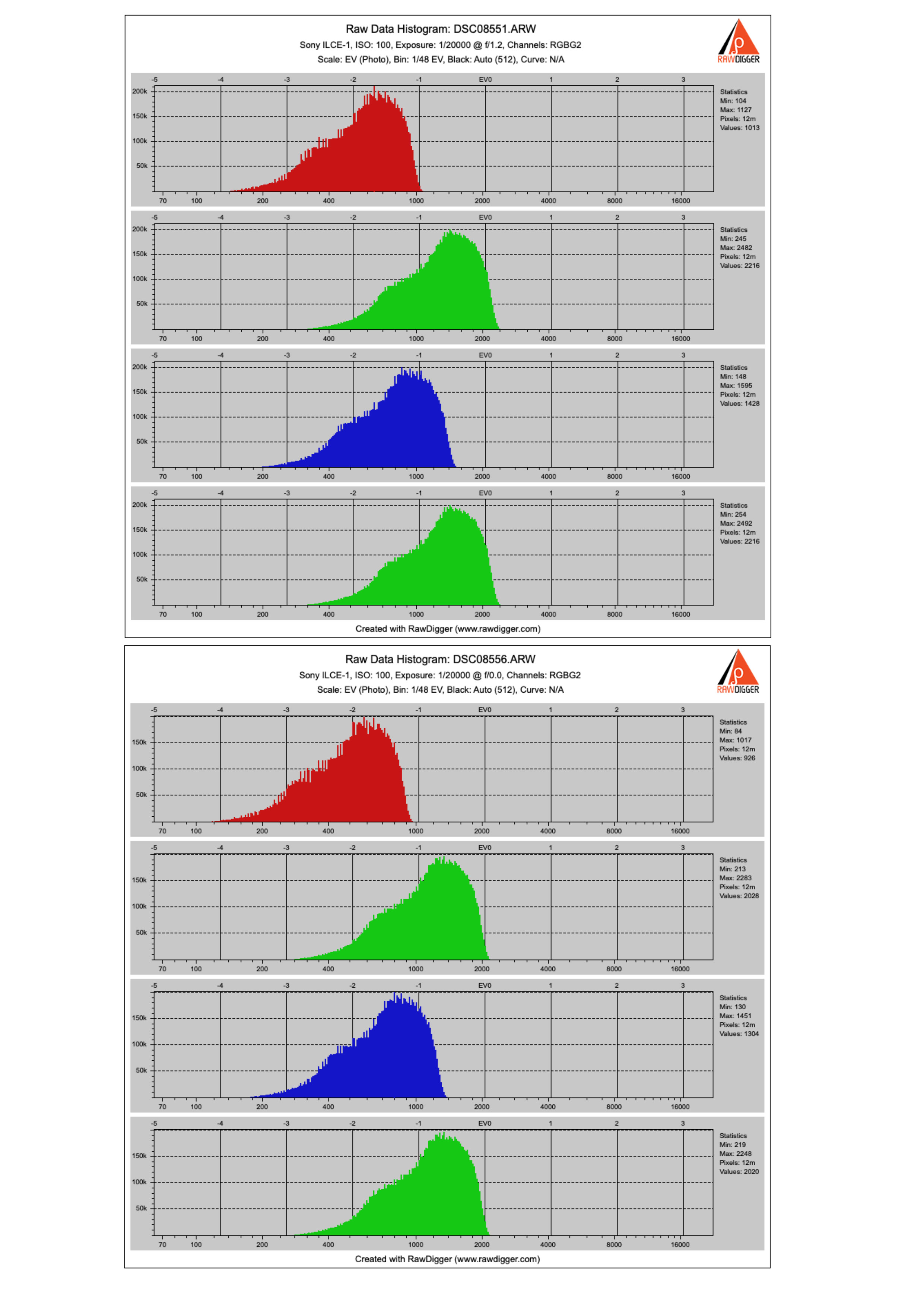
I looked at the raw files (from Jonas) with the lens aperture set to f/1.2: the 1st file (DSC08551.ARW) is with the lens properly connected, and the 2nd (DSC08556.ARW) with the lens disconnected (electronically) from the body.
In RawDigger, the raw histograms display a visible difference: the first is slightly brighter, as expected from the original post by Jonas. See the histograms below.
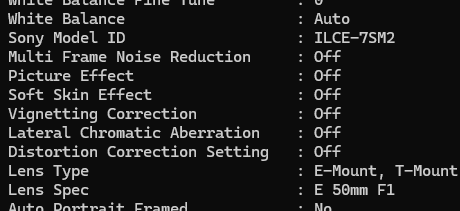
What is a bit confusing is that RawDigger shows "Vignetting Correction: Off" for the 1st file (DSC08551.ARW).
Exiftool reports the same:
exiftool '-*Correction*' DSC08551.ARW
Chromatic Aberration Correction : Off
Distortion Correction : Off
Vignetting Correction : Off
Distortion Correction Setting : Off
exiftool '-*Correction*' DSC08556.ARW
Chromatic Aberration Correction : No correction params available
Distortion Correction : No correction params available
Vignetting Correction : Off
Distortion Correction Setting : Off
What I find confusing is that when specifically comparing all and any differences(!) between the EXIF of the two files with exiftool, the report shows the following.
Here, for every tag the information for the first raw file (with the lens connected) appears in the second line. E.g., Vignetting Correction is Auto (ILCE-1), Chromatic Aberration Correction is Off, etc. for DSC08551.ARW
Hopefully someone may know better what "[SubIFD] Vignetting Correction" here refers to. As a tentative guess, I wonder if this might be with reference to the embedded jpeg, but I shouldn't speculate.
I am left with the impression that the difference in brightness between the two files is due to real differences in the raw data. That is, that the difference in brightness between the two files is not a result of some different post-processing of the data.
p.3 #19 · Sony silently applying gain at certain apertures
snapsy wrote:
If you convert the raws to DNGs using Adobe's free DNG Converter and then use Exiftool -BaselineExposure against the DNGs you'll see what if any raw exposure bias is in the metadata for the raws.
p.3 #20 · Sony silently applying gain at certain apertures
The light source in this case was a LED panel made for film scanning. So, pretty bright and evenly spread rays of light, but quite intense for f/1.2. Also, not totally flicker free as can be seen in the image series.
With a filter I could have darkened the source and used a slower shutter speed and then the histogram curves would have been nicer. Well, next time... ;-)
This test is not hard at all to repeat with your own camera provided you have a fast lens with manually driven aperture and electronic contacts. Perhaps somebody with a more recent camera and a CV 40/1.2?
Thank you ruthenium for checking everything, digging into the raws... and I'll just continue thinking the increased gain takes place in the camera.