CharleyL
Offline
• • •
Upload & Sell: Off
|
 p.1 #8 · Requesting minimal lighting setup suggestions p.1 #8 · Requesting minimal lighting setup suggestions | |
" I have the dome attachment on and bounce off the wall behind me shooting in manual, 1/20th-1/60th of a second at f4ish ISO 250-400 flash in auto and just change my exposure by adjusting iso."
Bouncing off the back wall is good, ceiling to reflect toward your subjects is usually better, if the walls and ceiling are white. Avoid bouncing off a colored wall or ceiling, because the color mixes with the flash and will affect your shots.
I don't believe these settings. Auto mode is likely saving your shots. It doesn't pay attention to any of your settings, as your camera decides what to do almost entirely without you, when in "Auto Mode".
The way described below will let you manually control your camera to make maximum use of it's capability for this kind of shot. Learning how to use your camera in "Manual Mode" will make you a far better photographer. Once you learn more about how to use your camera, learning how light works to get the lighting right for your shots will be the next thing to learn, and it's harder and takes longer to learn than your camera I frequently use "Auto Mode" or "TTL" when taking a first shot in a shoot. Then I use the camera settings that it went to as my first settings when I switch to "Manual Mode" . I then adjust to get my shots perfect from there. Don't be afraid to take "Test Shots" as we all do to get things right before we start shooting. It's easy to erase them later with a digital camera. These two camera settings average the light levels in your shot and change the camera settings based on these averages. If taking several similar shots and anything changes (like an added light colored sweater is added), the next shot taken will be darker overall, because of this added light sweater. A professional photo shoot is never done in Auto or TTL mode for this reason. It can be fixed in Photo editing programs, but "getting it right" out of the camera saves time, money, and looks better.
Setting your camera shutter speed to the camera sync speed setting will get you a huge amount more light from what you have with this setup. The sync speed is the longest shutter speed that you can use without seeing a dark bar at an edge of your shot. The dark bar happens when the flash duration ends before the camera shutter closes. Shortening your shutter speed just enough so as not to see the dark bar, makes maximum use of the flash duration. You then adjust the flash brightness to achieve the exposure level that you want without using long exposures that can show movement in your shots. For my Canon cameras, a shutter speed of 1/200 or 1/250 of a second works best for me. You can use shorter shutter speeds (higher fraction denominator), but it's a waste of the light from the flash. There are times when this is necessary, but not very often.
Outdoors or in constant light, shutter speed is the usual way of adjusting film or digital exposure. When using flash in manual mode, you set your camera shutter speed so as to make maximum use of the flash duration, but the shutter needs to close just before the flash duration ends. You then adjust the brightness of the flash(s) for the desired exposure, and leave the camera adjustments alone. I think you will find that your speedlite has far more power than you are using.
A good ISO setting will be easier to achieve, and testing different settings of this will let you better see the Christmas Tree and Lights, even if they are in the more shadowed parts of the room. It's a camera sensitivity control that lets you see more into the darker areas of your shots, and raising it even higher works well, and can even let you take night shots under a street light with low or no flash. but avoid the maximum ISO settings of your camera, as these can introduce noise (colored confetti) in the black unlit areas of your shots.
F4 is a bit short on depth of focus for this shoot. F8 or maybe F12 will let you see their heads in focus well, with closer and farther away from their heads being slightly out of focus. Higher yet will let even more of the shot be in focus. But raising the F-Stop settings require increased light levels. Higher settings also raise the low level cut-off of the light that the camera sees. I usually work in the F-8 area in my studio, so I can leave the ceiling room lights ON, and the camera won't see the room lights. Only the light seen by the camera is the bright flash, and I am in full control of it's the photo's exposure without the camera seeing the room light.
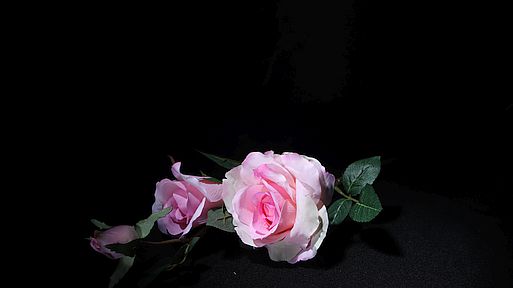
The photo attached was taken this way. I intentionally lowered the light level to make everything behind the flowers in total darkness (according to the camera) but the room lights were on. Learn what the inverse/square law of light is (not the math, just how it works. Light diminishes rapidly at distance and spread. At 1' from the light source, it is 1/2 the light level. At 2" distance it is 1/2 again, so 1/4 of the light level. This continues for every foot of distance from light to subject and background, and why you need a whole lot of light at longer distances. I adjusted the flash for this photo so that everything behind the flowers (my gear stored back there) did not show in the photo.
I've been a photographer since 1952, went totally digital in 1998, and have a fully equipped photo/video studio in my home. I know what works and what does not. I'm only trying to help you. I help many photographers develop a better understanding of photography. Try what I have said. Let me know if you have questions, here or via PM (Personal Message).
Charley
|


