Rainbow Chaser wrote:
Amazing food for thought from you guys. I think the first step is just to let the R100 shine when given ample, quality light.
See if you agree with my thought process:
Among primes like those mentioned in this thread (and none heavier), is there one that can be expected to show off what the R100 is capable of in good light, especially for people photos in JPEG mode? This might simply be another way of asking which prime, if any, matches uniquely well with the R100 for this kind of photography.
The reason I'm asking is because I could start with such an exemplary lens. Later, when I add another lens, I'm in a good position to compare results. When comparing to the best (or better), I'll be able to see the compromises made by another lens.
Somewhere along the path (maybe over years), I can figure out how to handle low light and the lack of IBIS.
If the "best" happens to be low-light capable, then so much the better....Show more →
Ample, quality light sounds like you are going to try to shoot portraits on a bright sunny day, arguably the worst time, especially if you dont have a flash. People often get the "bedt" performance lens on here but you really need the best FL more
I really dont agree with using a single prime. Id much rather have 18-55 and 55-250 on an adapter, see the fl you actually use, do you need a faster lens, etc. They used to say to start out using 50mm, you might get confused or goof something up, but goofing up is part of the creative process, and I don't think i'm going to get confused that easily
I like teles, the "ideal" portrait FL used to be 85-105mm on FF/film, call it 50 to maybe 85mm or so on the R100. Doesn't get wide angle distortion on head shots by then, you might be able to get head shots using 28mm I'd rather have longer. 50/1.8 should excellent by 5.6-8,maybe before, but it's not a good choice as an only lens imo, really.
bman212121 wrote:
You can use The Digital Picture's charts to give you a general idea of the differences. Here are the first two lenses stopped down to F4.
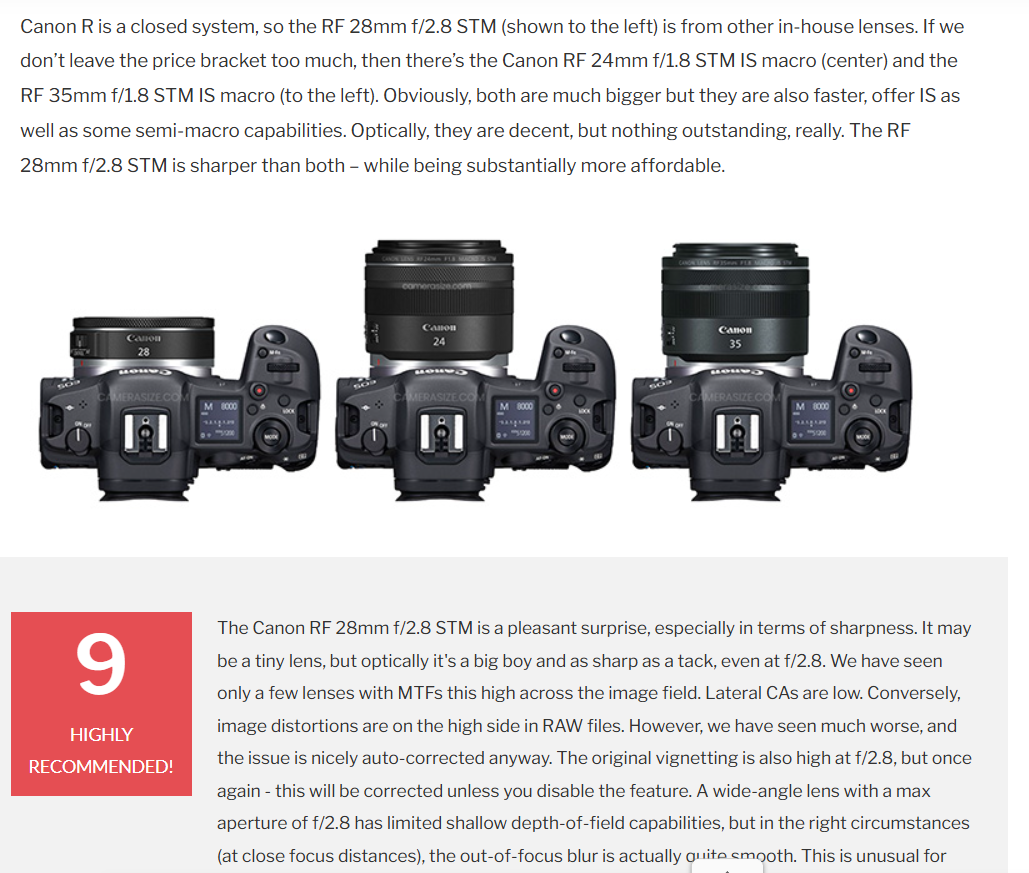
The RF 24mm is a bit sharper in the center of the image, the RF 28mm is more consistent across the frame meaning that it has similar sharpness from the center all the way to the edge.
Why those two differences matter and how you would utilize them.
The RF24mm is going to help enhance items in the center of the frame. Gochugogi's pictures of flowers are a great example where you want the viewer to look at the flower, and don't really care about the background that's around the outside. The 24mm is going to aide you with that because eyes tend to be drawn toward the sharper areas.
The RF28mm can be better when your subject fills the entire frame, and you want detail out to the edges. tsangc's image of the plane is a great example of that because the wing goes all the way to the edge of the frame, and the lettering on the wing is not centered in the view. A more consistent frame can help with sharpness to keep the fuselage of the plane sharp while still highlighting the wing.
Those a very subtle details that when first using the lens you probably won't notice. But over time if you really hone in on a lens you can utilize those differences to your advantage.
Unfortunately there isn't a chart for the sigma lens in Canon mount. There's a lot to unpack now because in EF all of the 3rd parties didn't autofocus as well as native lenses, but I'm not sure if that's the case in RF mount now.
One final comment is that you're going to have to determine what's most important to you in features. the RF28mm F2.8 STM is a pancake style lens and is much smaller and cheaper than the RF24mm. The RF24mm has image stabilization, macro capabilities, and the ability to have a more shallow Depth of Field. It also costs twice as much. If I were picking for myself I wouldn't choose either of those, I'd be picking the RF 24 - 70mm F2.8L. The compromise is that it's double the size, three times the weight and four times the cost. But the image quality will be good no matter where you use it. That lens is in the complete opposite direction you are trying to go, which is why I don't think I'm the right person to give you a great answer between the lenses you are choosing. ...Show more →
I own both the RF 28 2.8 STM and the RF 24 1.8 IS Macro STM and found my RF 24 1.8 IS Macro STM sharper across the frame at the same apertures, at least on my APS-C R7 (my only use). APS-C uses the sweet spot of the image, whereas FF “sees” more defects towards the edges of the frame. The RF 28 2.8 STM was a big disappointment for me—not that good towards the edges—and the only RF lens I regret buying. Corners are dark, even on APS-C. A real bow-wow. I agree, the RF 24-70 2.8L IS USM is a wonderful optic but, for me, not wide enough for walk-around use on APS-C and too heavy for travel and carrying about town. I mainly use mine on FF for video on a tripod. Great for talking head and music sessions.
Gochugogi wrote:
I own both the RF 28 2.8 STM and the RF 24 1.8 IS Macro STM and found my RF 24 1.8 IS Macro STM sharper across the frame at the same apertures, at least on my APS-C R7 (my only use). APS-C uses the sweet spot of the image, whereas FF “sees” more defects towards the edges of the frame. The RF 28 2.8 STM was a big disappointment for me—not that good towards the edges—and the only RF lens I regret buying. Corners are dark, even on APS-C. A real bow-wow. I agree, the RF 24-70 2.8L IS USM is a wonderful optic but, for me, not wide enough for walk-around use on APS-C and too heavy for travel and carrying about town. I mainly use mine on FF for video on a tripod. Great for talking head and music sessions. ...Show more →
I also find that my RF 24mm f/1.8 IS STM is better than Bryan's charts would indicate. I think he might have tested a poor sample.
Unfortunately, I think some people may discount this lens a bit based on his testing.
I don't have the 24 1.8, but my 28 2.8 & 35 1.8 are sharp wide open, but I would give the edge to the 28, and agree with the writer of the article. I'll have to post some shots taken with the 28 on my R100 later.
Jim
Z250SA wrote:
As the headline on this thread is rather general, Lenses for the R100
This is intentional. Party of my task is to find out which, if any, lenses, among all choices, are uniquely special for RF-S. Some have understandably pushed back, urging me to pick a focal length first. They might be right, but it's not how I usually operate.
Z250SA wrote:
The RF 24-240 deserves far more positive comments here around than it gets.
I have an open mind and am willing to consider. Compared to RF-S 18-150mm f/3.5-6.3 IS STM, your suggestion has much more reach. I can easily do without the wide end anyway. I haven't confirmed, but the RF-S 18-150mm might have more limited apertures in the 70-200mm equivalent focal range.
However, the RF-S 18-150mm is less than half the weight. While I've never worn a harness, I can consider it to start carrying a full-frame superzoom. What would be the benefit, especially in the 70-200mm equivalent focal range? Can I expect better image quality in exchange for wearing a harness? I'm really not trying to be funny -- just trying to make sense of the options.
Rainbow Chaser wrote:
This is intentional. Party of my task is to find out which, if any, lenses, among all choices, are uniquely special for RF-S. Some have understandably pushed back, urging me to pick a focal length first. They might be right, but it's not how I usually operate.
I have an open mind and am willing to consider. Compared to RF-S 18-150mm f/3.5-6.3 IS STM, your suggestion has much more reach. I can easily do without the wide end anyway. I haven't confirmed, but the RF-S 18-150mm might have more limited apertures in the 70-200mm equivalent focal range.
However, the RF-S 18-150mm is less than half the weight. While I've never worn a harness, I can consider it to start carrying a full-frame superzoom. What would be the benefit, especially in the 70-200mm equivalent focal range? Can I expect better image quality in exchange for wearing a harness? I'm really not trying to be funny -- just trying to make sense of the options....Show more →
I had the 24-240 for a while, using it on my R100 & RP for construction progress pictures. The range was very useful; I could get a full shot of field activities, and at the turn of the wrist, I could grab a shot of an iron worker tying rebar, all without moving. It was a very good lens and never let me down. I sold it on the B/S Forum when that project was completed a few years ago.
Jim
The RF16 2.8 looks like it might be excellent on crop. Distortion greatly reduced, problematic vignetting cut out by aps, center resolution supposed to be good anyway. One major reason id recommend it is that 24mm isnt wide , on aps, if youre going primes
Ive seen stuff I dont agree with on TDP , I like Optical limits
Rainbow Chaser wrote:
This is intentional. Party of my task is to find out which, if any, lenses, among all choices, are uniquely special for RF-S. Some have understandably pushed back, urging me to pick a focal length first. They might be right, but it's not how I usually operate.
I have an open mind and am willing to consider. Compared to RF-S 18-150mm f/3.5-6.3 IS STM, your suggestion has much more reach. I can easily do without the wide end anyway. I haven't confirmed, but the RF-S 18-150mm might have more limited apertures in the 70-200mm equivalent focal range.
However, the RF-S 18-150mm is less than half the weight. While I've never worn a harness, I can consider it to start carrying a full-frame superzoom. What would be the benefit, especially in the 70-200mm equivalent focal range? Can I expect better image quality in exchange for wearing a harness? I'm really not trying to be funny -- just trying to make sense of the options....Show more →
At 41% the weight of the 24-240 I have no doubt that the RF-S 18-150 would be a far better fit to the R100 and the better single lens option. The 29mm FF angle of view of 18mm on crop is a bit too narrow for an allround lens to my taste. I really like, and still sometimes use, the EF-S 15-85 on a 1200D. The 15-85mm (24-136mm FF) is a lens I would preorder if Canon would announce one for RF or RF-S. Especially adapted on a small RF-S body, the EF-S 15-85 is a monster pup.