Canon R7 Mk II (rumored) versus Sony A7 V
AmbientMike
Offline
Activity
[X]
Details
p.3 #1Canon R7 Mk II (rumored) versus Sony A7 V
aCuria wrote:
AmbientMike wrote
R7 is 15fps in mechanical shutter, which is apparently the same as Sony using the 3rd party glass people complain about Canon not havingSo I don't see any slow readout speed in ES on the R7 being much trouble
Most people shoot more than just action... they also shoot landscapes, travel, architecture, portraits, macro, astro, food and so on. In those cases a Sony user can throw on inexpensive third-party glass and be perfectly fine.
eg: the Sigma 14-28, 35 art, 50i, 65i, 85 art, 135 art, 20-200, Tamron 25-200, 50-300, ...
For sports or fast action, both the Sony and Canon shooters have to pay the price of entry, which is the 70-200/2.8GM, 100-300L, 300GM, 400GM, 600GM and so on.
I am really not confused, at all. Not unusual to see people using fairly expensive telephoto 3rd party glass on Sony. Apparently limited to 15fps
Ive been using 3rd party glass longer than I care to admit, certainly before digital.
https://www.bhphotovideo.com/c/product/1881814-REG/sigma_598965_300_600mm_f_4_dg_os.html/?ap=y&smp=y&store=420&gad_source=1&gad_campaignid=21058084064&gbraid=0AAAAAD7yMh0ufQ6l0jfxRmtNx6wRyRLVW&gclid=EAIaIQobChMI-MLE2JrokQMVxHR_AB0zOxCuEAQYASABEgIJS_D_BwE
Dec 31, 2025 at 10:06 AM
p.3 #2Canon R7 Mk II (rumored) versus Sony A7 V
jeffro wrote:
Exactly why I had the R7 and sold it...lack of crop sensor lenses.
Yeah they're not coming. The only four I see that are really missing:
- the 22/2 from the EOS M - would be incredible to see this updated and ported
- the 32/1.4, same as above
- a true 55-250 successor for RF mount (maybe make it 55-300?)
- a fast, standard lens like the 17-55 IS USM, would be great if it were an 'L' lens this time too
I'm not expecting to see any of them this decade.
mogul wrote
Canon would have to start making crop sensor glass...why buy a crop sensor and have to use FF glass? They would also have let 3rd party glass come to the party.Yeah they're not coming. The only four I see that are really missing:
- the 22/2 from the EOS M - would be incredible to see this updated and ported
- the 32/1.4, same as above
- a true 55-250 successor for RF mount (maybe make it 55-300?)
- a fast, standard lens like the 17-55 IS USM, would be great if it were an 'L' lens this time too
I'm not expecting to see any of them this decade.
Dec 31, 2025 at 10:09 AM
AmbientMike
Offline
Activity
[X]
Details
p.3 #3Canon R7 Mk II (rumored) versus Sony A7 V
johnctharp wrote:
AmbientMike wrote
R7 is 15fps in mechanical shutter, which is apparently the same as Sony using the 3rd party glass people complain about Canon not havingSo I don't see any slow readout speed in ES on the R7 being much trouble
That's why it's number one on the list for the hypothetical R7 II (if they fixed that alone, that'd be enough...), why Fuji gets disparaged, and why the Sony A7 V is such a massive upgrade over the previous A7 IV, despite being basically the same camera at the same resolution.
I can only imagine the complaints about the Canon cripple hammer and how horrible Canon is for limiting 3rd party to 15 fps if the situation were reversed
But if Sony does it, its perfectly okay, even on the Canon board
Dec 31, 2025 at 10:14 AM
p.3 #4Canon R7 Mk II (rumored) versus Sony A7 V
AmbientMike wrote:
I can only imagine the complaints about the Canon cripple hammer and how horrible Canon is for limiting 3rd party to 15 fps if the situation were reversed
But if Sony does it, its perfectly okay, even on the Canon board
I reserve the right to disparage limitations, from any manufacturer (as I did above with Sony).
Dec 31, 2025 at 11:05 AM
p.3 #5Canon R7 Mk II (rumored) versus Sony A7 V
AmbientMike wrote:
I am really not confused, at all. Not unusual to see people using fairly expensive telephoto 3rd party glass on Sony. Apparently limited to 15fps
https://www.bhphotovideo.com/c/product/1881814-REG/sigma_598965_300_600mm_f_4_dg_os.html/?ap=y&smp=y&store=420&gad_source=1&gad_campaignid=21058084064&gbraid=0AAAAAD7yMh0ufQ6l0jfxRmtNx6wRyRLVW&gclid=EAIaIQobChMI-MLE2JrokQMVxHR_AB0zOxCuEAQYASABEgIJS_D_BwE
If someone is buying a $6600 300-600mm f/4, chances are they know what they are doing and their use case for whatever reason does not prioritize having more than 15fps. Honestly, I have not seen this lens in the wild at all, it makes much more sense to buy the 300GM and a TC.
Personally I would like to see higher fps on 3rd party E mount glass that's for sure.
What I don't like about the Canon RF lineup, is that Canon gimped the auto-focus performance on lenses like the RF24mm f/1.8 STM on purpose.
In comparison the cheaper Sony 20/1.8G has the same linear motors as the 24/1.4GM, and will autofocus as fast!
Even the 28-60mm kit lens has linear motors.
In my book, gimping auto-focus performance on first party lenses by using STM motors, is far worse than limiting the fps on 3rd party lenses. After all, whats the point of high fps when hit rate is just going to be poor?
I don't see how Canon is going to fix this problem without discontinuing half their RF lens lineup.
The equivalent of 3rd party glass in the Canon RF ecosystem is EF lenses, and lets not forget that Canon limits the burst rate on many of the EF lenses as well. Some notable ones are the 135L, 85/1.2L, 200/1.8L, 600/4L v1... there's an entire laundry list of EF glass that cant shoot at high burst rates.
Dec 31, 2025 at 11:06 AM
p.3 #6Canon R7 Mk II (rumored) versus Sony A7 V
aCuria wrote:
If someone is buying a $6600 300-600mm f/4, chances are they know what they are doing and their use case for whatever reason does not prioritize having more than 15fps.
Personally I would like to see higher fps on 3rd party E mount glass that's for sure.
I think we would all like to see these limits removed, or if they're hard limits, having those limits explained both by Sony PR and by the camera when using said lenses.
aCuria wrote:
Honestly, I personally have not seen this lens in the wild at all, personally it makes much more sense to buy the 300GM and a TC.
This doesn't make any sense. People use zooms instead of primes with TCs for different situations.
aCuria wrote:
What I don't like about the Canon RF lineup, is that Canon gimped the auto-focus performance on lenses like the RF24mm f/1.8 STM on purpose.
In comparison the cheaper Sony 20/1.8G has the same linear motors as the 24/1.4GM, and will autofocus as fast!
The Sony is twice the price of the Canon! And it's stabilized, and it focuses closely, and these are two entirely different focal lengths!
aCuria wrote:
Even the 28-60mm kit lens has linear motors.
That's nice. You shooting fast action with the kit lens? Do you think Canon shooters are? How applicable is this critique?
aCuria wrote:
In my book, gimping auto-focus performance on first party lenses by using STM motors, is far worse than limiting the fps on 3rd party lenses. After all, whats the point of high fps when hit rate is just going to be poor?
I don't see how Canon is going to fix this problem without discontinuing half their RF lens lineup.
When are Sony and their premier third-party partners going to update all of their lenses to use linear motors?
Do you think that's actually required, and that STM lenses cannot keep up?
aCuria wrote:
The equivalent of 3rd party glass in the Canon RF ecosystem is EF lenses, and lets not forget that Canon limits the burst rate on many of the EF lenses as well. Some notable ones are the 135L, 85/1.2L, 200/1.8L, 600/4L v1... there's an entire laundry list of EF glass that cant shoot at high burst rates.
Yeah, some truly ancient EF lenses for which Sony has no comparable contemporary offerings have older USM motors and slower aperture actuators because they were designed for the original tranche of 1D cameras. How terrible! Whatever will the three people still using those lenses professionally do when limited to slightly lower burst rates!
Dec 31, 2025 at 11:22 AM
AmbientMike
Offline
Activity
[X]
Details
p.3 #7Canon R7 Mk II (rumored) versus Sony A7 V
Canon came out with 32mp aps so long ago, it's old (2019.) Sony and i believe Nikon are still 26mp. So tell me how Canon is behind on tech
And, yes, 25+ year old Canon super teles that Sony has no equivalent for are limited frame rates. But for instance I believe even the ~$4k 200-400 isnt limited, other v2 IS, too, I believe
But if you want to complain about focus motors in wides go ahead i guess if that's the Sony edge
And, yes, 25+ year old Canon super teles that Sony has no equivalent for are limited frame rates. But for instance I believe even the ~$4k 200-400 isnt limited, other v2 IS, too, I believe
But if you want to complain about focus motors in wides go ahead i guess if that's the Sony edge
Dec 31, 2025 at 12:29 PM
p.3 #8Canon R7 Mk II (rumored) versus Sony A7 V
I can say with absolute confidence that I have never missed a shot with my RF 24mm f/1.8 IS STM MACRO due to its focusing motors. (In fact, all of the STM primes track just fine in my experience.) I also appreciate having the internal stabilization when paired with my R8 bodies.
In any case, Canon's latest STM tech, as seen in the RF 16-28 2.8 IS and RF 28-70 2.8 IS zooms, is very fast and virtually silent, so future brand warriors will have to find some other thing to fixate on.
In any case, Canon's latest STM tech, as seen in the RF 16-28 2.8 IS and RF 28-70 2.8 IS zooms, is very fast and virtually silent, so future brand warriors will have to find some other thing to fixate on.
Dec 31, 2025 at 12:44 PM
p.3 #9Canon R7 Mk II (rumored) versus Sony A7 V
John, I don’t know where it comes from, but it is a bit of a myth that the lenses for Fujifilm’s APS-C system don’t hold up to the 40MP sensor. Mine certainly do.
As to IBIS, with the exception of the recent GFX100 rf, which unfortunately omitted it, most recent Fujifilm cameras do have IBIS.
johnctharp wrote:
I think Fujifilm undersantds this, and that's why they have chosen to build out a full line of quality APS-C cameras and lenses that exceeds that from their competition, and why they went with their miniMF format systems which do offer (in the eyes of certain buyers) a difference that FF arguably cannot replicate. (There's an argument that the advantage doesn't mean enough to many photographers to justify the cost and slower system and shortage of optics, but that's a different discussion.)I don't think they'd really gain anything from full-frame either - I was pointing that out in a roundabout way. Full-frame is saturated (even beyond the big three, with say Panasonic and Leica even 'reasonably' competing), and the bar is very, very high when it comes to performance even at the lowest end (see R8 or Z5 II).
And while I do appreciate Fuji's APS-C focus, they're also the only company to do so (if we don't count Pentax, which, well, we don't). My main issue with Fuji, separate from this thread, is that they didn't really capitalize on some potential...Show more →
When I see people describe Fujifilm AF as "abominable" or similar I think "hyperbole!" ;-) It is generally a bit behind the AF leaders, but the increment of difference is smaller than "abominable" and most of the time isn't meaningful.
YMMV.
As to IBIS, with the exception of the recent GFX100 rf, which unfortunately omitted it, most recent Fujifilm cameras do have IBIS.
johnctharp wrote:
gdanmitchell wrote
John, FWIW, I don't think it would make a lot of sense for Fuifilm to offer a full frame product at this point. In order to make headway they would have to lower their price-point well below that of the current Big Three (Sony, Canon, Nikon) and/or come up with something technologically/functionally well beyond them in order to induce enough owners to switch from their current systems.I think Fujifilm undersantds this, and that's why they have chosen to build out a full line of quality APS-C cameras and lenses that exceeds that from their competition, and why they went with their miniMF format systems which do offer (in the eyes of certain buyers) a difference that FF arguably cannot replicate. (There's an argument that the advantage doesn't mean enough to many photographers to justify the cost and slower system and shortage of optics, but that's a different discussion.)
And while I do appreciate Fuji's APS-C focus, they're also the only company to do so (if we don't count Pentax, which, well, we don't). My main issue with Fuji, separate from this thread, is that they didn't really capitalize on some potential...Show more →
gdanmitchell wrote
I think they are on the right track, though I'd _really_ like to see them "full-frame-ize" their minniMF systems a bit more — expand the range of lenses to better meet the needs of current FF users and improve the technology in other ways to bring performance closer to high MP FF systems.)gdanmitchell wrote
As to the autofocus issue, as a person who has used Fujifilm as his second system for about a dozen years, it is real but vastly overblown, depending on what you are photographing. In every day photography it really is not an issue at all. Heck, I do street photography with Fujifilm cameras and I rely on their AF with great success. On the other hand, if you are, say, photographing birds in flight, in my view they are still behind the Big Three.When I see people describe Fujifilm AF as "abominable" or similar I think "hyperbole!" ;-) It is generally a bit behind the AF leaders, but the increment of difference is smaller than "abominable" and most of the time isn't meaningful.
YMMV.
gdanmitchell wrote
(Also, trying my damnedest to pull this discussion away from the mudslinging cliff that a few — not you — may be leading us to. Oh, and Happy New Year everyone! I'm off early this morning for my traditional New Year's Celebration — a two day in-the-field meetup with a small group of like-minded fellow photographers and 10,000+ snow and Ross's geese!)Dec 31, 2025 at 12:58 PM
p.3 #10Canon R7 Mk II (rumored) versus Sony A7 V
johnctharp wrote:
So I don't see any slow readout speed in ES on the R7 being much troubleIt's not the framerate, it's the tracking ability. Slow readout means that regardless of the processing and firmware, the camera just isn't getting enough information to reliably track rapidly moving subjects.
That's why it's number one on the list for the hypothetical R7 II (if they fixed that alone, that'd be enough...), why Fuji gets disparaged, and why the Sony A7 V is such a massive upgrade over the previous A7 IV, despite being basically the same camera at the same resolution.
Despite slow sensor A7IV AF was on par (or better) than any of the competitors. A7rV, despite even slower sensor, has also excellent AF.
I agree that faster sensor readout potentially improves AF. However there seems to be many other factors such as software and camera processing power.
AmbientMike wrote
R7 is 15fps in mechanical shutter, which is apparently the same as Sony using the 3rd party glass people complain about Canon not havingSo I don't see any slow readout speed in ES on the R7 being much trouble
That's why it's number one on the list for the hypothetical R7 II (if they fixed that alone, that'd be enough...), why Fuji gets disparaged, and why the Sony A7 V is such a massive upgrade over the previous A7 IV, despite being basically the same camera at the same resolution.
Despite slow sensor A7IV AF was on par (or better) than any of the competitors. A7rV, despite even slower sensor, has also excellent AF.
I agree that faster sensor readout potentially improves AF. However there seems to be many other factors such as software and camera processing power.
Dec 31, 2025 at 01:15 PM
|
p.3 #12Canon R7 Mk II (rumored) versus Sony A7 V
johnctharp wrote:
The Sony is twice the price of the Canon! And it's stabilized, and it focuses closely, and these are two entirely different focal lengths!
This isn’t about price because even the kit lens uses linear motors.
It’s not about focal length either, the Sony 24G also uses linear motors.
Sony just doesn’t really gimp autofocus motors in general.
And focusing close doesn’t mean USM can’t be used, the RF 100L Macro uses USM just fine.
johnctharp wrote:
That's nice. You shooting fast action with the kit lens? Do you think Canon shooters are? How applicable is this critique?
I think I am completely justified in wanting the best AF motors in a kit lens.
Just because I’m not shooting sports doesn’t mean I don’t want fast, reliable autofocus. It’s what lets me catch a child’s fleeting smile, a pet’s sudden movement, or a spontaneous moment on the street, instead of missing it entirely.
johnctharp wrote:
When are Sony and their premier third-party partners going to update all of their lenses to use linear motors?
All of Sony’s new lenses use linear motors afaik.
Sigma put the same HLA motors from their ART line onto their new 20-200, even though it’s a cheaper lens.
Tamron does not gimp their lenses either. The inexpensive 17-40/4 uses VXD, and so does the 25-200.
johnctharp wrote:
Do you think that's actually required, and that STM lenses cannot keep up?
I owned STM lenses and they focus a lot more slowly than USM that’s for sure. VCM is a step in the right direction IMO.
johnctharp wrote:
aCuria wrote
If someone is buying a $6600 300-600mm f/4, chances are they know what they are doing and their use case for whatever reason does not prioritize having more than 15fps.Personally I would like to see higher fps on 3rd party E mount glass that's for sure.
aCuria wrote
Honestly, I personally have not seen this lens in the wild at all, personally it makes much more sense to buy the 300GM and a TC.aCuria wrote
What I don't like about the Canon RF lineup, is that Canon gimped the auto-focus performance on lenses like the RF24mm f/1.8 STM on purpose.In comparison the cheaper Sony 20/1.8G has the same linear motors as the 24/1.4GM, and will autofocus as fast!
aCuria wrote
Even the 28-60mm kit lens has linear motors.aCuria wrote
In my book, gimping auto-focus performance on first party lenses by using STM motors, is far worse than limiting the fps on 3rd party lenses. After all, whats the point of high fps when hit rate is just going to be poor?I don't see how Canon is going to fix this problem without discontinuing half their RF lens lineup.
aCuria wrote
The equivalent of 3rd party glass in the Canon RF ecosystem is EF lenses, and lets not forget that Canon limits the burst rate on many of the EF lenses as well. Some notable ones are the 135L, 85/1.2L, 200/1.8L, 600/4L v1... there's an entire laundry list of EF glass that cant shoot at high burst rates.Dec 31, 2025 at 02:02 PM
p.3 #13Canon R7 Mk II (rumored) versus Sony A7 V
aCuria wrote:
Sony just doesn’t really gimp autofocus motors in general.
Neither does Canon, but here you are arguing that STM motors are somehow 'insufficient' while they are currently used in inexpensive lenses that absolutely can track action.
I think you need to reevaluate your perspective here. All STM motors are not the same, nor were USM motors, nor are linear motors. The implementation in a lens matters as much or more than the overall lens motor type.
Dec 31, 2025 at 02:38 PM
p.3 #14Canon R7 Mk II (rumored) versus Sony A7 V
artsupreme wrote:
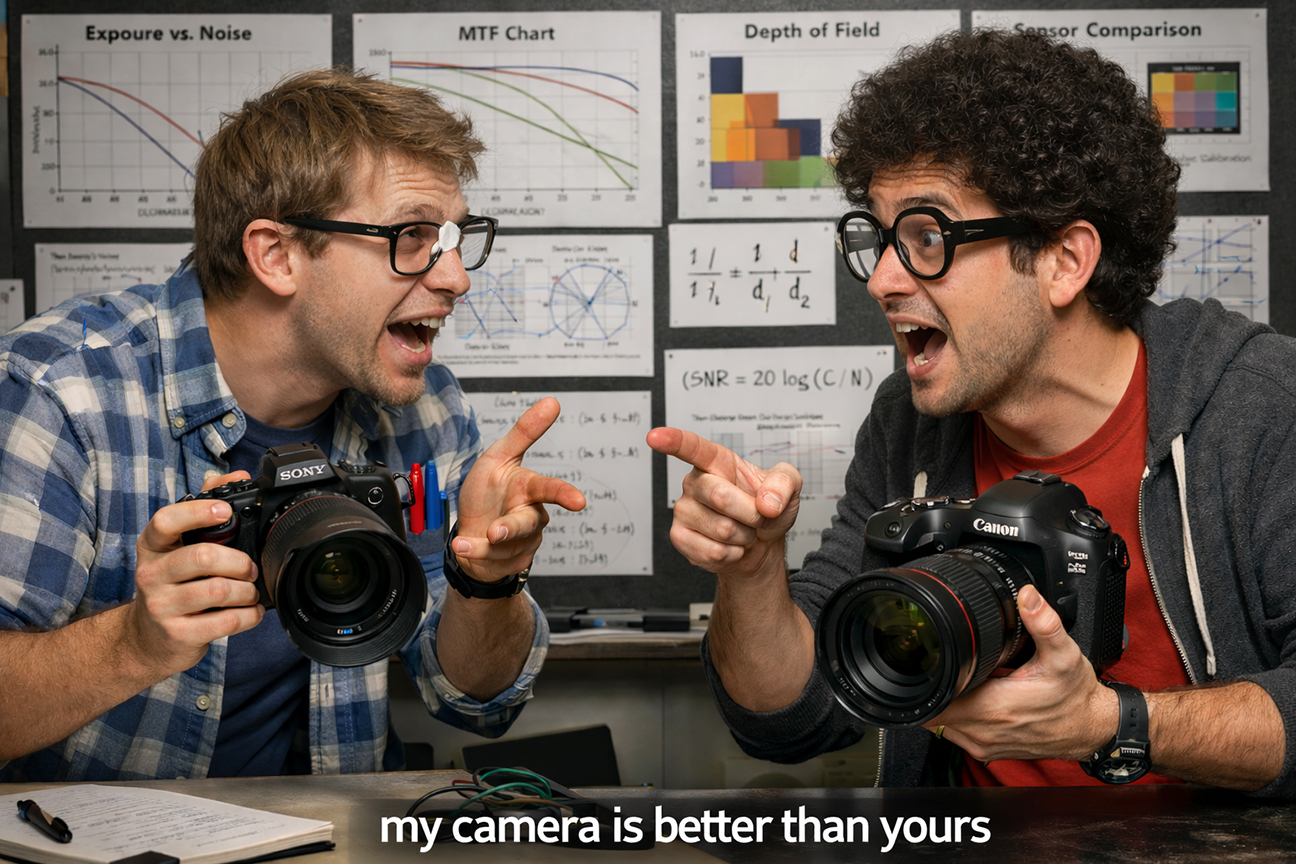
“My camera is better than yours!”
No MINE is better! And bigger! And faster! ;-)
(Taking a coffee break from today’s bird photography. It seems to be raining!)
“My camera is better than yours!”
No MINE is better! And bigger! And faster! ;-)
(Taking a coffee break from today’s bird photography. It seems to be raining!)
Dec 31, 2025 at 04:00 PM
p.3 #15Canon R7 Mk II (rumored) versus Sony A7 V
Basically needs a fast readout sensor, 30FPS or more and precapture. Then I'd buy it over an A7V if there weren't other obstacles to switching systems.
A ~30MP stacked or partially stacked APS-C sensor (Canon APS-C being 1.6x) would give a huge reach advantage over a 33MP FF A7V. A 30-32MP Canon APS-C sensor has the pixel density of a 76.8-82MP FF sensor. That is crazy advantage for birds.
An R7II with 30MP stacked and precapture with Canon's top notch BEAF and decent BIF tracking paired with a RF100-500 would be a killer combo for birds.
That all said...if history of the Canon 7 series is any indication then none of that will happen and it will be compromised in numerous ways making it a no go from the start.
Jan 01, 2026 at 06:56 AM
p.3 #16Canon R7 Mk II (rumored) versus Sony A7 V
Contentment with my current kit keeps me from worrying about the question, but I am happy to see Canon pushing the format into higher performance spaces. Assuming it doesn't bankrupt them, I'm hoping it'll force Sony to take the format more seriously.
Jan 01, 2026 at 03:16 PM
p.3 #17Canon R7 Mk II (rumored) versus Sony A7 V
freaklikeme wrote:
Contentment with my current kit keeps me from worrying about the question, but I am happy to see Canon pushing the format into higher performance spaces. Assuming it doesn't bankrupt them, I'm hoping it'll force Sony to take the format more seriously.
I'd be nice if anyone tried to put out a pro cropper somewhere between the D500 and the old 1D (APS-H) series.
No one, including Fuji, is willing to go 'all out' on a crop system larger than M43.
Jan 01, 2026 at 03:33 PM
p.3 #18Canon R7 Mk II (rumored) versus Sony A7 V
johnctharp wrote:
Neither does Canon, but here you are arguing that STM motors are somehow 'insufficient' while they are currently used in inexpensive lenses that absolutely can track action.
I think you need to reevaluate your perspective here. All STM motors are not the same, nor were USM motors, nor are linear motors. The implementation in a lens matters as much or more than the overall lens motor type.
I do not know what you talking about because stopped taking misfocused pictures when I moved from Nikon DSLR to Sony mirrorless I am (mostly) Sony shooter but I am sure CaNikon would do the same job.
Better go out shooting. These discussions were relevant 10-15 years ago but now most cameras a good enough in every way (not only AF). Sony is really good, has been for years, and Canon and Nikon catching it very well. Fuji maybe not, that does not matter if you like the film simulations
aCuria wrote
Sony just doesn’t really gimp autofocus motors in general.I think you need to reevaluate your perspective here. All STM motors are not the same, nor were USM motors, nor are linear motors. The implementation in a lens matters as much or more than the overall lens motor type.
I do not know what you talking about because stopped taking misfocused pictures when I moved from Nikon DSLR to Sony mirrorless
I am (mostly) Sony shooter but I am sure CaNikon would do the same job.Better go out shooting. These discussions were relevant 10-15 years ago but now most cameras a good enough in every way (not only AF). Sony is really good, has been for years, and Canon and Nikon catching it very well. Fuji maybe not, that does not matter if you like the film simulations
Jan 01, 2026 at 03:40 PM
p.3 #19Canon R7 Mk II (rumored) versus Sony A7 V
tuomkok wrote:
I do not know what you talking about because stopped taking misfocused pictures when I moved from Nikon DSLR to Sony mirrorless I am (mostly) Sony shooter but I am sure CaNikon would do the same job.
Well yes, and each company has their respective strengths in each generation and market segment of cameras and lenses (and the rest of the system).
tuomkok wrote:
Better go out shooting. These discussions were relevant 10-15 years ago but now most cameras a good enough in every way (not only AF). Sony is really good, has been for years, and Canon and Nikon catching it very well. Fuji maybe not, that does not matter if you like the film simulations
Tell that to other folks lol, with: 'STM' means gimping lenses etc. Anything would be an improvement over the AF in my 6D lol!
I do not know what you talking about because stopped taking misfocused pictures when I moved from Nikon DSLR to Sony mirrorless
I am (mostly) Sony shooter but I am sure CaNikon would do the same job.Well yes, and each company has their respective strengths in each generation and market segment of cameras and lenses (and the rest of the system).
tuomkok wrote:
Better go out shooting. These discussions were relevant 10-15 years ago but now most cameras a good enough in every way (not only AF). Sony is really good, has been for years, and Canon and Nikon catching it very well. Fuji maybe not, that does not matter if you like the film simulations
Tell that to other folks lol, with: 'STM' means gimping lenses etc. Anything would be an improvement over the AF in my 6D lol!
Jan 01, 2026 at 04:02 PM
p.3 #20Canon R7 Mk II (rumored) versus Sony A7 V
johnctharp wrote:
I am (mostly) Sony shooter but I am sure CaNikon would do the same job.Well yes, and each company has their respective strengths in each generation and market segment of cameras and lenses (and the rest of the system).
Tell that to other folks lol, with: 'STM' means gimping lenses etc. Anything would be an improvement over the AF in my 6D lol!
If anyone still has the impression that STM focusing is inadequate for action photography, this video might be worth a watch.
https://youtu.be/ZgK-N4TIVBc?si=Eb2W4zalFDAidiub
This is a Canon-sponsored video, but Noah Wetzel is a legit action / outdoor adventure shooter, and he gives this lens a pretty good workout. Plus, seeing him shoot extreme freeride mountain biking is pretty cool.
Mad respect for the athletes that had to carry their bikes back up the mountain for every take, haha.
tuomkok wrote
I do not know what you talking about because stopped taking misfocused pictures when I moved from Nikon DSLR to Sony mirrorless I am (mostly) Sony shooter but I am sure CaNikon would do the same job.tuomkok wrote
Better go out shooting. These discussions were relevant 10-15 years ago but now most cameras a good enough in every way (not only AF). Sony is really good, has been for years, and Canon and Nikon catching it very well. Fuji maybe not, that does not matter if you like the film simulationsIf anyone still has the impression that STM focusing is inadequate for action photography, this video might be worth a watch.
https://youtu.be/ZgK-N4TIVBc?si=Eb2W4zalFDAidiub
This is a Canon-sponsored video, but Noah Wetzel is a legit action / outdoor adventure shooter, and he gives this lens a pretty good workout. Plus, seeing him shoot extreme freeride mountain biking is pretty cool.
Mad respect for the athletes that had to carry their bikes back up the mountain for every take, haha.
Jan 01, 2026 at 04:16 PM