I have an old epson film scanner for 35mm that I haven’t used for a decade. Now that I have a Canon 5DSR I’m looking to scan some 35mm negatives.
I have some 3D printers and I can work my way through CAD software. So I’m looking at ways to set up the 5DSR for ‘scanning’ film with a Macro 105MM Canon L lens.
What are the best ways to keep film flat for scanning? From what I remember, wet on a piece of glass gives the flattest, but not really looking to do that. Would grabbing the 35mm sprockets and adding tension just add warping? Or is 35mm really small enough that it is pretty flat.
Does mounting the frames in slides help?
I guess I’m not looking to make it more complicated than it needs to be, but I want to give myself the best chance of good pics. Letting AI loose on dust looks interesting.
Are there 3D printed solutions out there already? I’ve looked in the past and not really found anything.
A cottage industry has evolved to supply gear for scanning negatives with a digital camera. There were a few businesses making specialized adapters for Epson scanners but they have disappeared from the market.
A good starter setup would be a decent copy stand. You don't need to spend a lot but insure the camera mount is parallel to the base. The LOMO DigitaLIZA is a decent negative holder. It uses magnets to keep the holder closed and doesn't cost a fortune. They come in both a 35 and 120 version. The only downside is they're not capable of holding mounted slides. The last item is a light source.
For an all in one solution that will allow you to scan 135 negatives and slides plus multiple formats of 120, contains it's own light source and is very compact, look at the Sunray Skier Copybox. It's a bamboo box with a color balanced LED and interchangeable negative holders.
I have owned and used both of these systems and either one will make scanning negatives easier.
I'm also happy with my Essential Film Holder. If you're only doing 35mm there are some products that attach directly to your macro lens so you don't need a copy stand.
Check out the JJC 35mm film copying setup. It is not very expensive and includes a light source and film holder and a set of metal tubes to attach directly to your macro lens. I find it works quite well.
anselwannab wrote:
What are the best ways to keep film flat for scanning? From what I remember, wet on a piece of glass gives the flattest, but not really looking to do that.
Your memory is correct. Sandwich the dry film between two anti Newton ring pieces of glass (I use old 45MX Beseler 4x5 negative carriers) and just lay it on my Epson V700. Not as good as wet, but less messy, and fast. If you are determined to go the DSLR scanning route I would choose a well machined masking system that covers the rebate completely, and can advance the film.
I use the basic 35mm version. It keeps most film flat. The only film stock that was problematic was Adox HR-50. That one is known to curl. I modified the basic 35mm version for 120, and I did not know what I was doing in the software. I'm functional with what I came up with, but you'd probably do a better job than me. Or you can buy the 120 file from the Tone Carrier and not have to worry about that.
Does anyone have a recommendation for a 120 film holder that can keep film flat AFTER you've cut to 3 frame strips for storage in binder pages?
I'm currently trying to re-scan some 120, but the holders I have don't keep the edges of the film flat after they've been cut. I usually scan pre-cut, but this is the first time that I'm trying to re-scan, and am having a bear of a time keeping the outer 2 frames on my 3 frame strips flat.
A couple folks here mentioned the essential film holder, but have you run into this edge problem with wide and wants-to-curl 120 film?
Negative supply has masks for various sizes (I shoot 6x6) and say "The perfect starting point for scanning cut strips or full rolls of 35mm and 120 film quickly". But will it stay flat for real?
Cloud75 wrote: Negative supply has masks for various sizes (I shoot 6x6) and say "The perfect starting point for scanning cut strips or full rolls of 35mm and 120 film quickly". But will it stay flat for real?
I love my Negative Supply gear and it’s great for scanning full rolls. Cut rolls, not so much. If you have a lot of cut strips, a Lomo digitalZLA would be a better choice. Even better, although a little spendy, is the Skier Copybox II. It’s a bamboo box with a LED light source and adjustable 135/120 film holders.
Cloud75 wrote: Negative supply has masks for various sizes (I shoot 6x6) and say "The perfect starting point for scanning cut strips or full rolls of 35mm and 120 film quickly". But will it stay flat for real?
When I started using the Holga, I needed a carrier to do 120 film so I bought a Negative Supply Basic 120 Carrier. It works fine for full rolls but is a bit iffy for strips of three. The standard cassette holds the first and the last frame fairly flat, the full border cassette doesn't hold the short strips as flat.
I tried the Negative Supply Pro Carrier 120 MK II. I often struggled to get the film to feed and eventually sold it.
I have the Essential film holder for 35 and 120, and I've scanned quite a few cut rolls (3 frames for 120). It works well. For 4x5, I use a negative carrier with (anti-newton) glass on the bottom half. Again, works great. I was really a fan of glass carriers in the darkroom, but for scanning, the essential film holder works fine (no glass).
Superphotog wrote:
Has anyone tried using a film carrier from an enlarger to do this?
When the early adopters started using digital cameras for capture, enlarger negative carriers were the only way to hold film. The Bessler Negatrans suddenly became a very hot commodity.
I thought the neg carriers might work, and appreciate both comments on that approach. I have had a huge enlarger set up in storage now for 20 plus years…and while I don’t want darkroom work now, at least I can try out the carriers for scanning!
I picked up a lobster holder v2.1 with 6x6 masks. It holds cut 120 film flat all the way around, I’m pretty happy with it. Beats the valoi 360 120 holders I was using before, at least in terms of being able to hold the film flat from all sides. Those valoi ones are great until you cut the roll.
The day after the film has dried, I roll it in the opposite way to the curl and stick it back in the canister for a day or two. It takes the "cupping" out and it lies flat.
I am currently digitizing hundreds of 6x6cm films and mounted and unmounted Ektachromes.
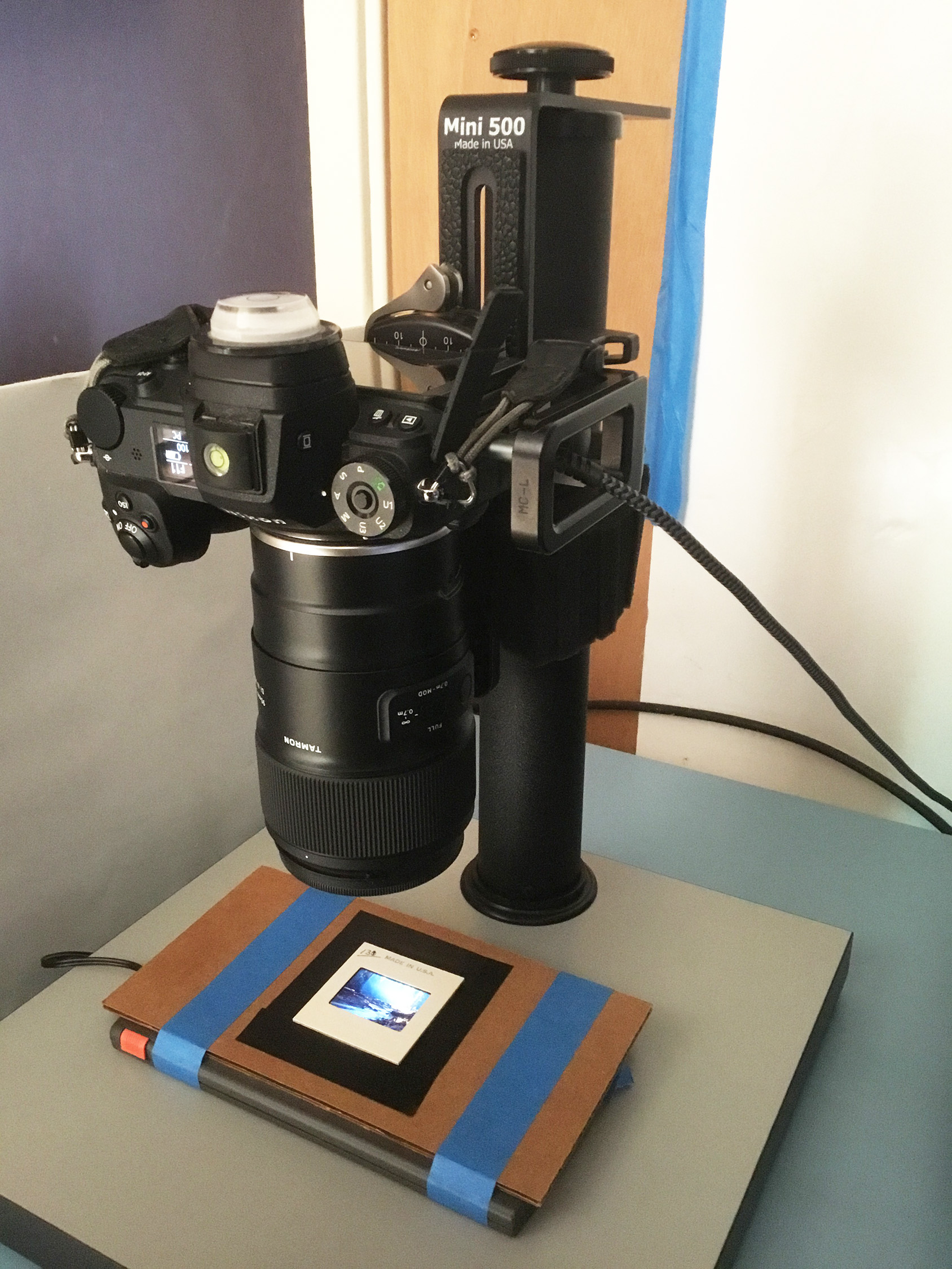
My copy setup, as pictured, is a Nikon Z7ii and Tamron 90mm macro, copying a slide being illuminated by 5000K soft even light beneath a simple card board barrier.
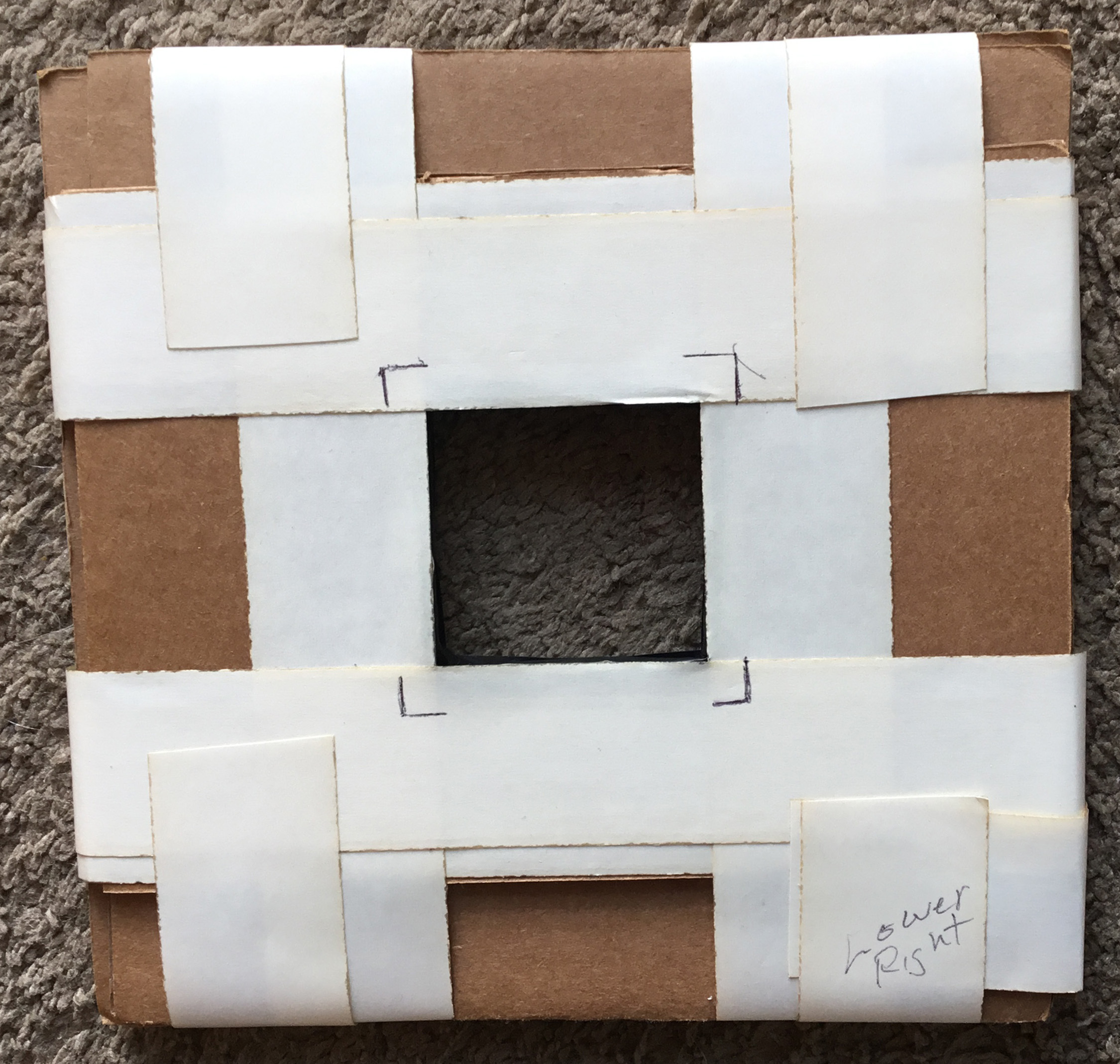
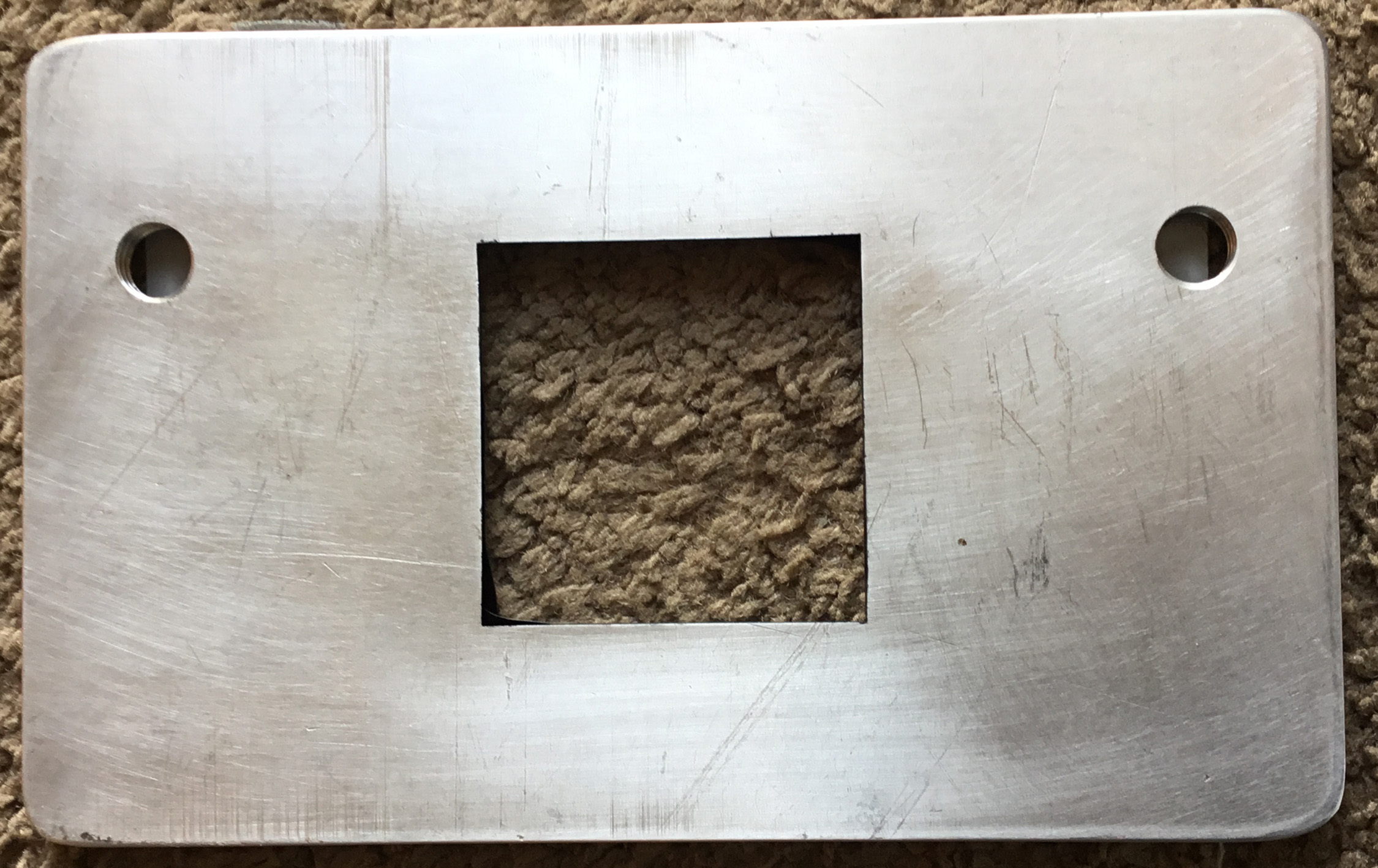
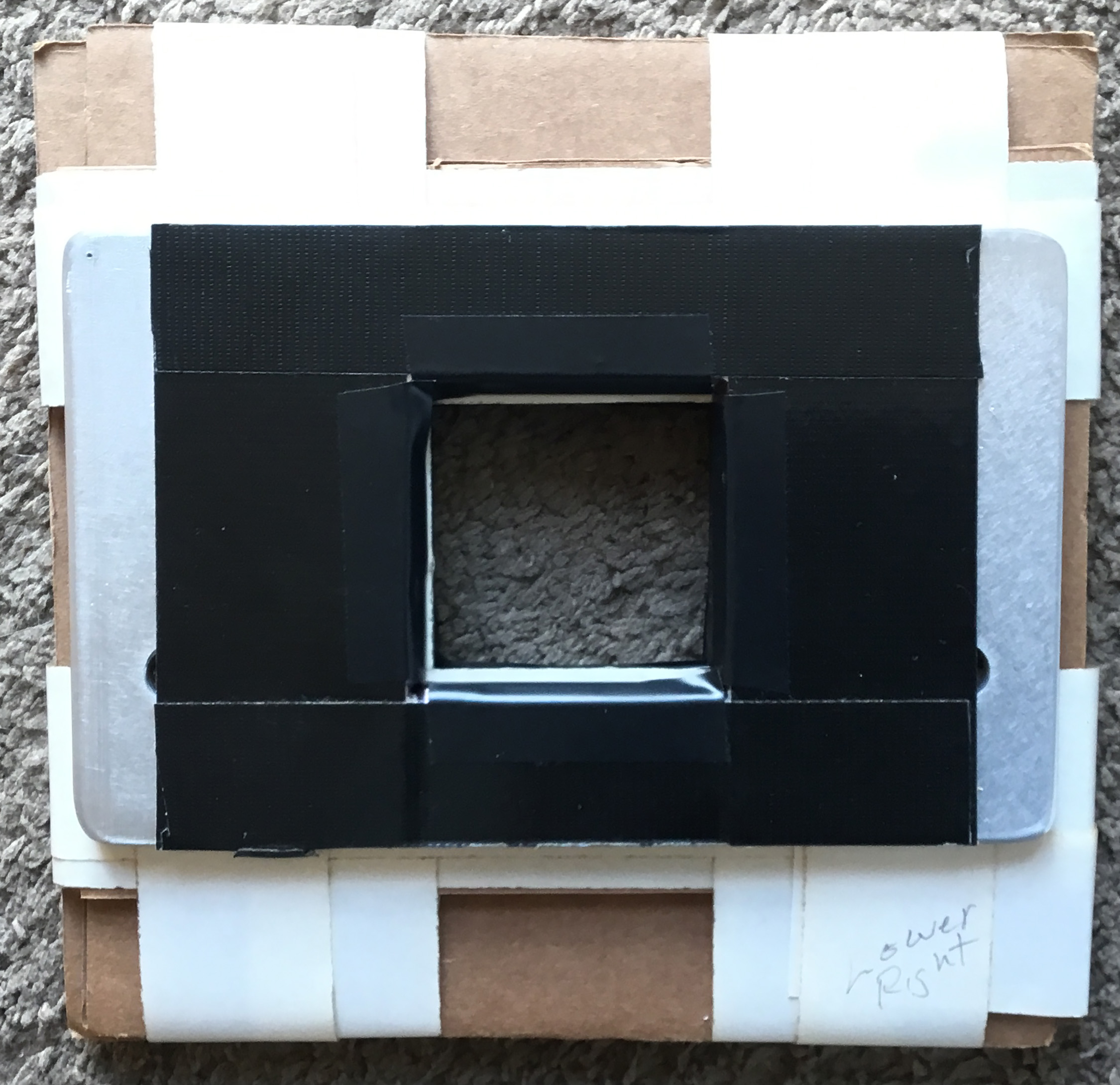
The next 3 images represent what I use for 6x6cm media: No media is pictured but I'm sure you get the idea:-)
1) a simple card board piece with smooth soft tape creating opening for 6x6cm film. The corner marks denote the positioning for a mounted 6x6cm slide. Unmounted film is simply placed on top of tape and if flat enough, does not need to be held down.
2) A polished aluminum plate that is dead flat and heavy can be used to flatten curly film or bent slide mounts.
3) When film doesn't want to lay flat, the plate is placed over it. The film is not harmed in the least by tape and plate.
My homemade stuff works better for me than bigger cumbersome holders, etc.
Dave
35mm slide being copied
Single image or a film strip is then laid carefully on top of tape
Polished aluminum plate holds down non-flat film. Holes do nothing