I've photographed concerts many times at ISO 6400 with great results, I recently purchase the Nikon 180-600 which is 1 stop slower than the lens I was using previously, if I bump the ISO 1 stop up it will even that out. I will shoot tests but I was Wondering what other peoples opinions are of ISO 12800 Thanks
I personally tend to cap my Z9 at 6400. 12800 can be usable if you have decent light where the stopped down aperture and fast-enough-shutter-for-focal-length factors are in play, but in a dark scene I find the images tend to be irrevocably ruined.
I'd go so far as to say I'd rather raise an ISO 3200 shot 2 stops than shoot at 12800 and get the "right" exposure. If you know what you're doing with denoise, you can still get nice images.
I go to 25,600 on my Z9. Out of the camera, raw images above 6400 can be rather noisy, but a small amount of Lightroom’s denoise feature (25 is usually plenty) and some even-handed editing* high ISO images look great. Not ISO 64 great, but great for slow lens and/or low light images that would otherwise be very noisy.
*You can’t raise an ISO 25600 image by 4 or 5 stops without serious consequences, but I’m not sure you can do that with any camera…
ahinesdesign wrote:
I go to 25,600 on my Z9. Out of the camera, raw images above 6400 can be rather noisy, but a small amount of Lightroom’s denoise feature (25 is usually plenty) and some even-handed editing* high ISO images look great. Not ISO 64 great, but great for slow lens and/or low light images that would otherwise be very noisy.
*You can’t raise an ISO 25600 image by 4 or 5 stops without serious consequences, but I’m not sure you can do that with any camera…
It's always helpful if you can show an example of something like this. I have never had a 25,600 image that didn't have insane banding on the Z9.
You're going to get different answers from different shooters because ISO is just a rough proxy of what the exposure was like. A low-key High ISO image like a night scene is going to be a lot noisier than a high-key image at the same ISO, for example the images Scott posted above.
Personally I think Z9 at iso 12800 in your usage should be fine.
I shot a bit of concert, bar etc and in dimly lit area with lots of dark stage/background and a few bright object under strong light, Z9 retained contrast and color very well and a little noise reduction especially with DXO works really well.
RoamingScott wrote:
It's always helpful if you can show an example of something like this. I have never had a 25,600 image that didn't have insane banding on the Z9.
Here you go (Z9 + 180–600mm, ISO 25600). I don't see any banding in my high ISO images, but a heavier hand with denoise would make it smoother at the expense of fine detail.
I can see the banding, though the color noise portion has been dealt with 🤷🏼♂️
ahinesdesign wrote:
Here you go (Z9 + 180–600mm, ISO 25600). I don't see any banding in my high ISO images, but a heavier hand with denoise would make it smoother at the expense of fine detail.
Just because you or your clients don’t care doesn’t mean it doesn’t exist. There is obvious horizontal noise banding, most easily visible in the wood areas.
It’s nearly impossible to have an educated, objective conversation when topics are hand waved away due to low standards. This is a growing problem on this forum.
ahinesdesign wrote:
I guess its a good thing my clients nor I object to the image quality
RoamingScott wrote:
I can see the banding, though the color noise portion has been dealt with 🤷🏼♂️
[irony]I see obvious banding in the shirt. Strangely enough it follows the shapes of her body.[/irony]
Nowhere else in the image. Perhaps you could educate us and point out exactly where you see banding, a sample would be great.
And I have also never seen any banding in my Z9 high ISO images processed normally. It may be possible to generate some by lifting shadows a lot, but I am generally able to expose my images well.
What would the objective be. Perfection? To refuse to do the shoot if it’s indoors in a darker room? The possibility of PDAF banding is currently a trade off for the other benefits that the on sensor focus offers.
While not perfect the shot is pretty usable for conditions and iso used.
RoamingScott wrote:
Just because you or your clients don’t care doesn’t mean it doesn’t exist. There is obvious horizontal noise banding, most easily visible in the wood areas.
It’s nearly impossible to have an educated, objective conversation when topics are hand waved away due to low standards. This is a growing problem on this forum.
jpelt78 wrote:
What would the objective be. Perfection? To refuse to do the shoot if it’s indoors in a darker room? The possibility of PDAF banding is currently a trade off for the other benefits that the on sensor focus offers.
While not perfect the shot is pretty usable for conditions and iso used.
I'm not concerned with perfection in images, I'm concerned about preciseness of language in threads where objective questions are being asked.
Me: I've seen banding a LOT at 25,600
Them: I don't see banding at 25,600, look!
Me: That's clearly banding
Them: Well who cares, not me
I literally don't care what people shoot at, what quality work they deliver, or what standards they hold themselves to. That's between them and their clients, and most clients are happy with work I myself wouldn't be if delivered to me, and that's fine.
RoamingScott wrote:
I personally tend to cap my Z9 at 6400. 12800 can be usable if you have decent light where the stopped down aperture and fast-enough-shutter-for-focal-length factors are in play, but in a dark scene I find the images tend to be irrevocably ruined.
I'd go so far as to say I'd rather raise an ISO 3200 shot 2 stops than shoot at 12800 and get the "right" exposure. If you know what you're doing with denoise, you can still get nice images.
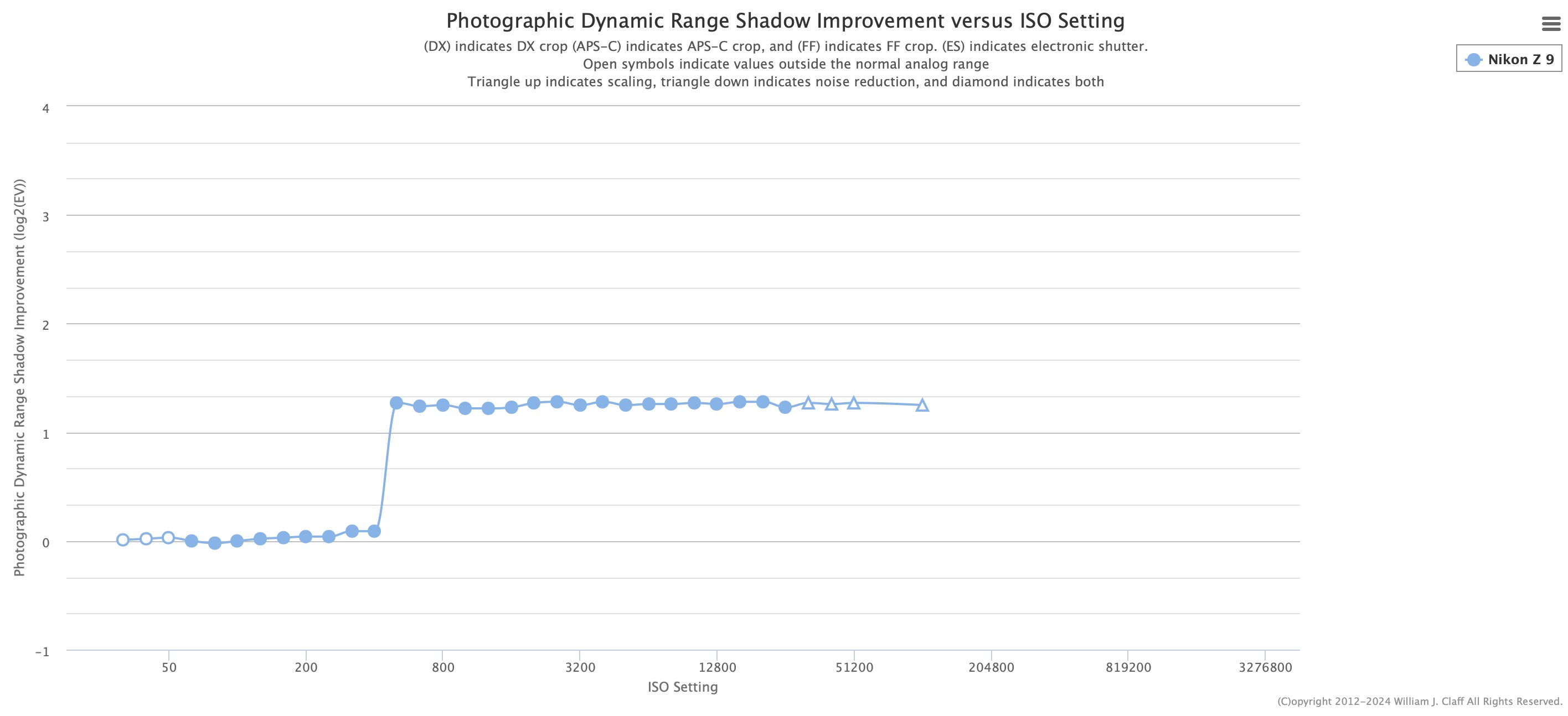
According to photonstophotos data the Z9 should be identical IQ if you shoot 3200 and raise it 2 stops vs shooting 12800 from the get go. But we know that Nikon AF is significantly affected by a proper exposure while shooting so if one cares about AF then shooting at 12800 will be better than 3200 and raising in post.
Cliff L. wrote:
The dynamic range and colour fidelity tends to suffer noticeably, but ISO 25,600 is still useable on the Z9.
This is a beautiful example of what is possible. I was out this morning before sunrise photographing red foxes on the run. I had to shoot at ISO 12800 for the first 5 to 10 minutes, then dropped to 6400 as soon as I could. While DR is an issue, I think your point about color and color depth is the real cost of high ISO photography with the Z9. Personally, 6400 is my normal upper limit where I can "restore" color and detail through post-processing. Once I get beyond 6400, I find that it is harder to bring back the colors.
Regardless, I'd rather crank up the ISO instead of missing photographic opportunity.
RoamingScott wrote:
I'm not concerned with perfection in images, I'm concerned about preciseness of language in threads where objective questions are being asked.
Me: I've seen banding a LOT at 25,600
Them: I don't see banding at 25,600, look!
Me: That's clearly banding
Them: Well who cares, not me
I literally don't care what people shoot at, what quality work they deliver, or what standards they hold themselves to. That's between them and their clients, and most clients are happy with work I myself wouldn't be if delivered to me, and that's fine.
Still interested in you pointing out where exactly you see banding in the violin player image.