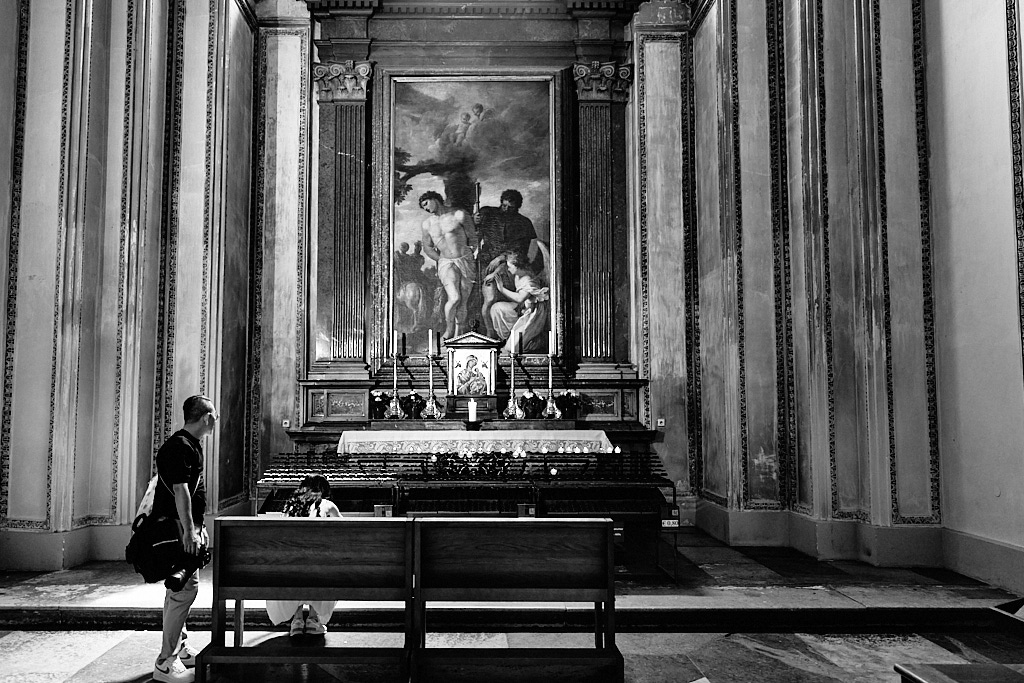
Impressive cathedral, and disturbing tableau! I did a little research, couldn't find out which martyred saint is depicted with protruding arrows. The other human in the painting is dark, holding a staff while an angel attends to his arrow wound as cherubs in the clouds look on. The architecture of the walls funnels the viewer in to the center scene.
GoodEgg wrote:
Impressive cathedral, and disturbing tableau! I did a little research, couldn't find out which martyred saint is depicted with protruding arrows. The other human in the painting is dark, holding a staff while an angel attends to his arrow wound as cherubs in the clouds look on. The architecture of the walls funnels the viewer in to the center scene.
Thanks! After several rounds of back and forth conversation with Claude.ai this seems to be the painting, but the artist is still elusive:
"Great! I found a helpful clue. According to one source, "The painting above this altar is of St. Sebastian. Rows of candles represent prayers left by parishioners." Salzburg – Reliquarian This describes a side altar in Salzburg Cathedral where candles are lit for prayers, which matches your description perfectly.
So it appears this painting depicts St. Sebastian, the Christian martyr who is often depicted as a young man tied to a tree or post and pierced with arrows. This would be consistent with the dramatic Baroque religious imagery visible in your photograph.
However, I wasn't able to find the specific artist's name for this particular St. Sebastian painting in the side chapel. The cathedral has works by various Baroque artists from the 17th century period, but without more detailed documentation about each individual side chapel artwork, I cannot definitively identify the painter of this specific St. Sebastian altarpiece.
Do you recall seeing any other details or inscriptions near the painting that might help identify the artist?"
one last search on ChatGPT this time: The painting "The Martyrdom (Death) of St. Sebastian" in Salzburg Cathedral (Salzburger Dom) was created by Konrad Laib (also spelled Konrad Leyp). He was a German painter active in the mid-15th century, and this particular work is dated 1449.
Laib's painting of St. Sebastian is one of the earliest known works in Salzburg Cathedral and is notable for its Gothic style and expressive emotional detail.