I must conclude that the competition is fierce at that price point. I am unsure of the depreciation of this Sony vs the Leica and Fuji peers. So it is a no from me.
No flip screen? Deal breaker for me. Not sure why Sony went backwards on this.
There are other spec's that to me do not add to a total value package of $5100.00 USD
I’ll spend $6500 on a mechanical rangefinder body only camera with twelve shutter speeds, but no way would I spend $5000 on a 61mp, Zeiss Sonnar T* equipped, BIONZ XR processor packing, built in close up mode braggin’, high sensitivity low noise, super low light AF capable POS.
What do they take me for, a dumba$$?
Desmolicious wrote:
I’ll spend $6500 on a mechanical rangefinder body only camera with twelve shutter speeds, but no way would I spend $5000 on a 61mp, Zeiss Sonnar T* equipped, BIONZ XR processor packing, built in close up mode braggin’, high sensitivity low noise, super low light AF capable POS.
What do they take me for, a dumba$$?
Where else are you going to find a RF digital camera for $6.5K? Last I checked, Leica bodies are closer to $10K!
As for Sony, I think they're aware that some people will complain about the lack of IBIS, a flip screen, EVF specs, etc....or say it's too expensive. But they also know their lineup has something for everyone, and in the end, people will just buy the model that fits what they are looking for...
Based on inflation alone, the previous version of the RX1 released in 2015 would have a 2025 price of about $4500. The additional ~15% could be attributed to various things, such as current tariffs. It's worth noting the EU pre-VAT price is closer to the inflation adjusted value...
At $5100 it's still cheaper than a Leica Q3. There isn't any other competition in this category so it's no surprise Sony isn't undercutting Leica by much. That it'll be a low volume product is just one more reason to pad the MSRP, though it does feel like Sony's cutting the corners a bit with respect to EVF/viewfinder and rear display specs.
But that Sonnar lens is a very nice one, so it's great it's seeing the light again. It's a shame though that Sony has gone with the dog-slow 61MP sensor. At least from my point of view, and use cases, if I was to get one, I'd rather skip the leaf shutter and go fully e-shutter with their 50MP stacked sensor.
I don't have a problem with the price, it's the specs at that price that are hard to accept. I still want one, though
No flip screen doesn't bother me. The flip screen on the Q3 is an abomination and ruins the aesthetic. Can't believe the nearly invisible tilt screen on the X100V/VI exists, and Leica still chose to basically glue a pack of playing cards onto the back of the camera. All of these tilt screens can go pound sand anyway since they don't tilt vertically. If the Q3's had vertical tilt, I could almost excuse the thickness.
I really believe the Japanese and German engineers are doing everything they can within their budget to pack these cameras with features. We only see the outside, but on the inside, they're building these little marvels, trying to keep the design as compact as possible but also reliable. When a small size is the main design goal, it makes sense that some compromises have to be made. The problem is that we often judge a camera's price based on things like EVF resolution, but we forget this is the smallest full-frame camera out there. It's in a class of its own, and there just isn't room for a high-res, high-magnification EVF.
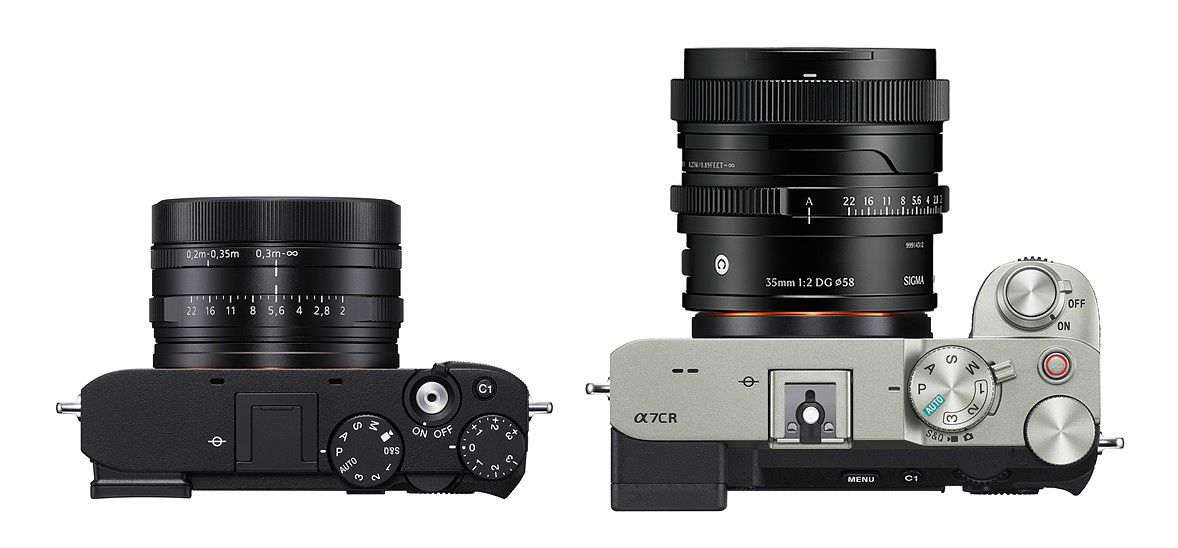
Regarding the lack of IBIS, if you compare the A7CR to the RX1R III side by side, it becomes pretty clear that adding IBIS increases thickness significantly. especially with a full-frame sensor and all the components needed to support it. The A7CR is already impressive for what it includes. Physically, it is just not possible right now to fit everything into such a slim RX1 body...
That's the same reason the Leica M doesn't have IBIS. They want to keep the thickness close to the old film bodies and that matters to them.
With cameras like the Q or SL,, I think the engineers are really trying to keep things as thin as possible. So when they add a flip screen, it has to sit on the outside. It might not look as clean, but it's the tradeoff if we want that feature. I'm sure in the future they'll find new ways to arrange the parts inside and the design will get better.
The RX1R III uses the same sensor, EVF, and processor as the A7CR.
Fred Miranda wrote:
Where else are you going to find a RF digital camera for $6.5K? Last I checked, Leica bodies are closer to $10K!
As for Sony, I think they're aware that some people will complain about the lack of IBIS, a flip screen, EVF specs, etc....or say it's too expensive. But they also know their lineup has something for everyone, and in the end, people will just buy the model that fits what they are looking for...
Who’s talking digital? You missed the mechanical 12 shutter speed thing…
Fred Miranda wrote:
I really believe the Japanese and German engineers are doing everything they can within their budget to pack these cameras with features. We only see the outside, but on the inside, they're building these little marvels, trying to keep the design as compact as possible but also reliable. When a small size is the main design goal, it makes sense that some compromises have to be made. The problem is that we often judge a camera’s price based on things like EVF resolution, but we forget this is the smallest full-frame camera out there. It's in a class of its own, and there just isn't room for a high-res, high-magnification EVF.
Regarding the lack of IBIS, if you compare the A7CR to the RX1R III side by side, it becomes pretty clear that adding IBIS increases thickness significantly. especially with a full-frame sensor and all the components needed to support it. The A7CR is already impressive for what it includes. Physically, it is just not possible right now to fit everything into such a slim RX1 body...
That's the same reason the Leica M doesn't have IBIS. They want to keep the thickness close to the old film bodies and that matters to them.
With cameras like the Q or SL,, I think the engineers are really trying to keep things as thin as possible. So when they add a flip screen, it has to sit on the outside. It might not look as clean, but it's the tradeoff if we want that feature. I'm sure in the future they'll find new ways to arrange the parts inside and the design will get better....Show more →
Sony started the spec wars. I’ll accept this camera as their change of heart.
This will all blow over anyway as soon as the first reports of overheating start coming in
Oldwino wrote:
I think it’s interesting that Sony has designed a camera to compete with the Leica Q2, which is discontinued.
Or, the original Leica Q was designed to compete with the original RX1?
Sony hasn't designed anything with this new camera. They've just re-released something that previously existed, but with somewhat updated components/specs. Perhaps to fill a bit of a market void because of how much the Leica Q has increased in price.
rscheffler wrote:
Or, the original Leica Q was designed to compete with the original RX1?
More or less. Those were really the two main options at the time, and for a while people were weighing the RX1 II against the Q or Q2. Even though both have built-in lenses and full-frame sensors, I never really saw them as being in the same class. The Q isn't much smaller than an M body, while the RX1 series stands out for its compactness. It's not exactly pocketable like the APS-C GR series, but it's probably the smallest full-frame option with a high-performing lens.