darwinphoto wrote:
Scanning the classifieds I notice the older Fuji lenses seem to be a real bargain. Great lenses at obscenely low prices. Things like:
I assume it is because these lenses are not as sharp in the corners when folks zoom into a 40 MP image. Or is there some other reason?
All of these lenses are sharp. The reason they've become "bargain" is because most have been superseded by newer models. (23 1.4 and 56 1.2 mostly). The 35 1.4 still commands a high amount in the B&S, because as old as it is, it's still a pretty darn good lens.
Towncaptain wrote:
I swear to you from f1.4, this thing was so sharp. I even compare it to the 18mm f1.4 I had and it was 99.9% close. You could test it out on a chart if you want and lets see how your copy does
Now, that's a rally bold statement
Your claim contradicts every single professional lab test I've found on internet, same as every single opinion I found.
Do You have any test shots (preferably RAW files) to backup Your words?
(Ps. I've had three copies of XF 16/1.4 so I've pretty good idea how this lens performs in every aperture)
No unfortunately I dont keep those files. It's just for my own personal use. It couldve been a one-off special 16mm f1.4 cause you seem to really knock it down. And like I said, youre welcome to try it out on the B&H test chart. Check out my profile on Kijiji as well, Towncaptain. You can see I have 3 different copies as well, the last one being bitingly sharp
BeatX wrote:
Now, that's a rally bold statement
Your claim contradicts every single professional lab test I've found on internet, same as every single opinion I found.
Do You have any test shots (preferably RAW files) to backup Your words?
(Ps. I've had three copies of XF 16/1.4 so I've pretty good idea how this lens performs in every aperture)
I have both the first and second gen 23 f/1.4 and indeed the second gen is much sharper, even on a 26.1MP X-T4. However that’s the last thing I care about honestly.
What bothered me for the first-gen lenses is that we were forced to choose between glass and AF + WR. I owned both the 23 f/1.4 and the 23 f/2 for this reason and hated I had to do that.
The newer gen f/1.4 lenses solved that problem so I can imagine people letting the first gen lenses go. I wish they didn’t all grow in size, but I guess they need to support a 40MP system now.
fivesixeight wrote:
The newer gen f/1.4 lenses solved that problem so I can imagine people letting the first gen lenses go. I wish they didn’t all grow in size, but I guess they need to support a 40MP system now.
I don’t think that lenses had to grow in size for the 40MP sensor. Again, there are plenty of smaller lenses that perform great on the 40MP cameras, including those in the list in the first post in the thread.
I’m not sure what is up with some of the larger replacements — is it something Fujifilm thought there were doing for video users? A thought that bigger lenses look impressive and might sell for more?
And, as a contrast, they have made some newer lenses smaller — e.g. take a look at the newer version of the 16-55mm f/2.8.
gdanmitchell wrote:
I don’t think that lenses had to grow in size for the 40MP sensor.
I'd go further and say it's outright unfortunate they did. Any lens you carry and use is way better than the ones you left behind in the camera cabinet...
On the flip side, that trend has meant some great bargains for those of us willing to put up with the "old" design flaws. Yes I can see some visible "improvement" if I compare the same images at 100% view on my 40mp files, but none of the relatively minor gains I've seen would make a just okay image a great final image. In fact, I personally go back to character/feel and find those lend to a better final image than just about anything else. To wit, I put low value diffusion filters on most of my lenses to add a hint of character, so clearly "optimum sharpness" doesn't mean all that much to me...
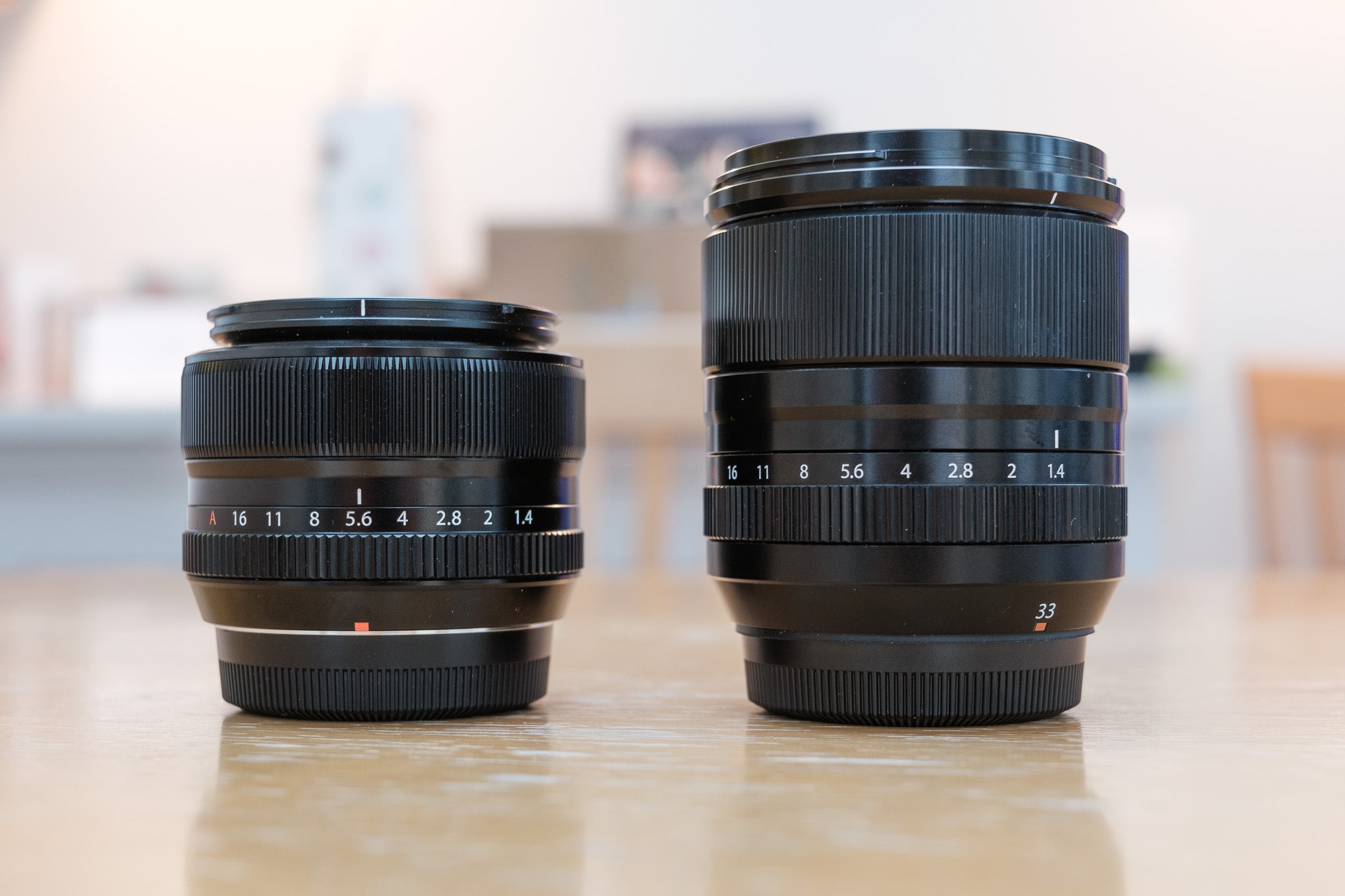
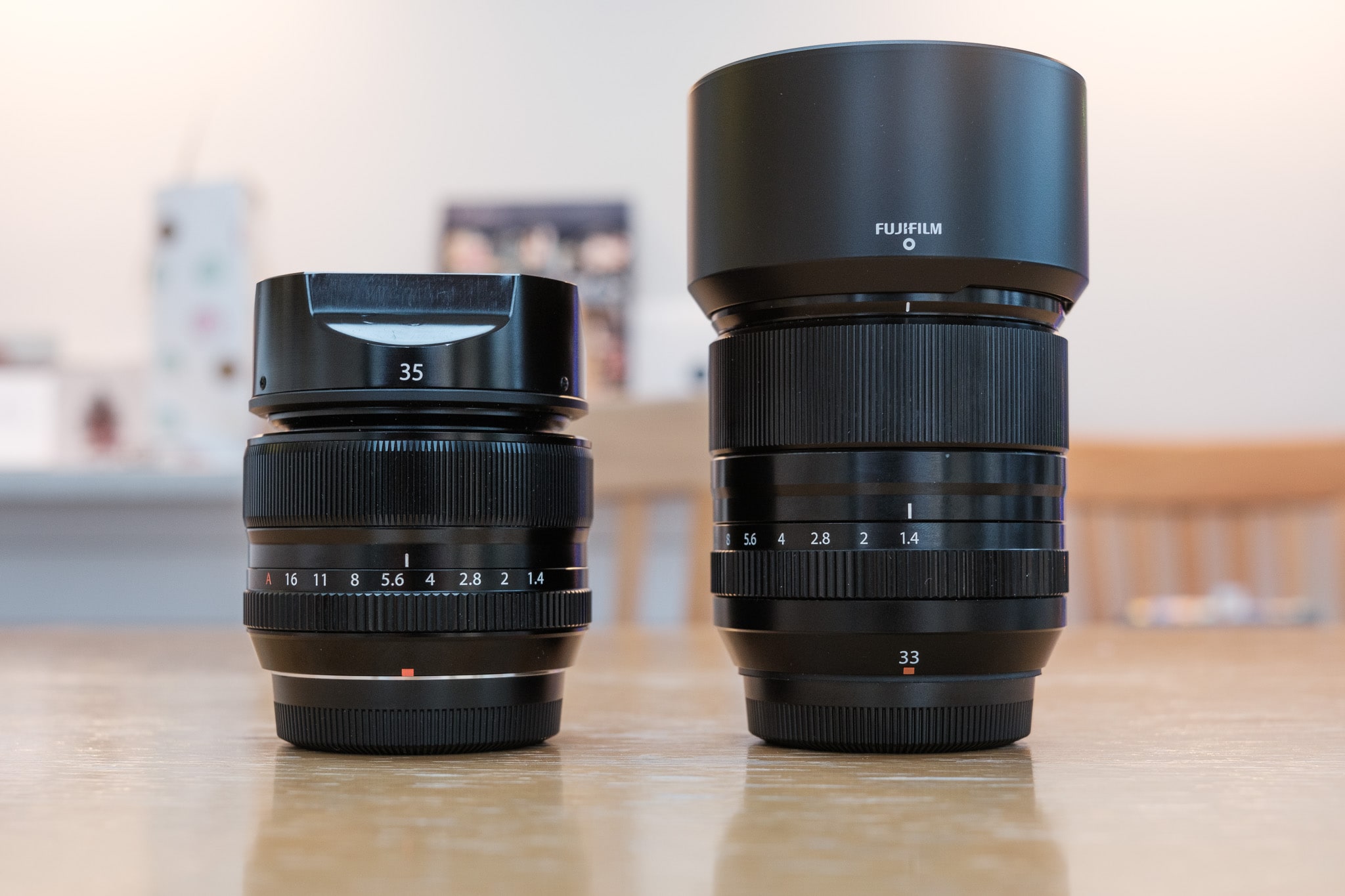
I don't really get the complaints about the newer Fujiluxes being too big. The 23 may be longer than its predecessor but it's noticeably skinnier. The 33 isn't really *that* much bigger than the 35 f/1.4. They're still all generally smaller than modern full frame equivalents and they fit quite well at least on a X-T5 or X-H2 body. If they're too big for you, get the older versions or the Fujicron versions which are tiny in comparison.
As with everything in optics, it's all about tradeoffs.
mivadep wrote:
I don't really get the complaints about the newer Fujiluxes being too big. The 23 may be longer than its predecessor but it's noticeably skinnier. The 33 isn't really *that* much bigger than the 35 f/1.4. They're still all generally smaller than modern full frame equivalents and they fit quite well at least on a X-T5 or X-H2 body. If they're too big for you, get the older versions or the Fujicron versions which are tiny in comparison.
As with everything in optics, it's all about tradeoffs.
1) 6.6 oz for the 35/1.4 vs 12.6 oz for the 33/1.4
mivadep wrote:
I don't really get the complaints about the newer Fujiluxes being too big. The 23 may be longer than its predecessor but it's noticeably skinnier. The 33 isn't really *that* much bigger than the 35 f/1.4. They're still all generally smaller than modern full frame equivalents and they fit quite well at least on a X-T5 or X-H2 body. If they're too big for you, get the older versions or the Fujicron versions which are tiny in comparison.
As with everything in optics, it's all about tradeoffs.
As I mentioned above, the increase in size in newer models is not universal — see the 16-55mm f/2.8 v.1 and v.2, where the latter is actually smaller and lighter.
The 33mm f/1.4, however, is a LOT bigger than the 35mm f/1.4. Given the excellent quality of the older lens in this case, it is hard for me to see that any performance/optical gains are worth it.
gdanmitchell wrote:
As I mentioned above, the increase in size in newer models is not universal — see the 16-55mm f/2.8 v.1 and v.2, where the latter is actually smaller and lighter.
The 33mm f/1.4, however, is a LOT bigger than the 35mm f/1.4. Given the excellent quality of the older lens in this case, it is hard for me to see that any performance/optical gains are worth it.
The 35 1.4 is a museum piece, typical of the old pre aspheric standard lenses for 35mm, with lots of uncorrected aberration to give the character people love. Correcting that for a 1.4 max aperture takes a lot more glass, makes them bigger, have you seen the latest fast 50s for full frame? Tests show much better edge performance at large apertures. If you want similar and f/2 is enough then the 35 f/2 will do nicely.
As far as the 16-55 is concerned, the old one was an oddity, far heavier than the opposition offerings for no better performance, the new one is at last better and no heavier than my 12 yearold 17-50 Tamron and it's contemporary Nikon lenses for aps-c.
gyoung143 wrote:
The 35 1.4 is a museum piece, typical of the old pre aspheric standard lenses for 35mm, with lots of uncorrected aberration to give the character people love. Correcting that for a 1.4 max aperture takes a lot more glass, makes them bigger, have you seen the latest fast 50s for full frame? Tests show much better edge performance at large apertures. If you want similar and f/2 is enough then the 35 f/2 will do nicely.
As far as the 16-55 is concerned, the old one was an oddity, far heavier than the opposition offerings for no better performance, the new one is at last better and no heavier than my 12 yearold 17-50 Tamron and it's contemporary Nikon lenses for aps-c.
Based on my long experience with the 35mm f/1.4 you are grossly exaggerating the supposed issues with the lens. It is really an excellent performer already.
I had the 35mm f/2 for about a month. I got it as part of a "kit" with the XPro2 back in the day. I was curious because a) the smaller lens would make sense for the way I use Fujigilm cameras, b) it was said to AF much more quickly due to a newer mechanism than in the f/1.4, and c) is also said (by some) to be optically superior to the f/1.4... and by others to be inferior!
I tested both lenses against one another pretty extensively during that month. At the end of the month decided that there clearly was little meaningful difference between them in terms of IQ,AF performance, or other functional issues. (Notice the word “meaningful” in the previous sentence.) If I tried really hard by staring back and forth at 100% and 200% magnification crops displayed side-by-side on my 27" monitor then maybe, possibly, but just barely if at all, the f/1.4 might have been a tiny bit better in the far corners.
In the end I decided that they are essentially equivalent in terms of image quality, and any AF speed difference was so small as to be meaningless. (If it exists, it was imperceptible in my testing.) I kept the f/1.4 because it is reasonably small and I do night street photography. But if I didn't think f/1.4 was a big advantage (and not all photographers need the extra stop) I would consider the excellent f/2 lens at a lower cost and smaller size and weight if f/2 seems sufficient.
mivadep wrote:
Fair, I concede the point on the 35 vs 33. I didn't realize the 35 was so lightweight!
Its small size and weight is really pretty remarkable for being a f/1.4 lens. That's one of the big attractions.
mivadep wrote:
I don't really get the complaints about the newer Fujiluxes being too big. The 23 may be longer than its predecessor but it's noticeably skinnier. The 33 isn't really *that* much bigger than the 35 f/1.4. They're still all generally smaller than modern full frame equivalents and they fit quite well at least on a X-T5 or X-H2 body. If they're too big for you, get the older versions or the Fujicron versions which are tiny in comparison.
As with everything in optics, it's all about tradeoffs.
To me a lens's length matters much more than girth -- the girth is somewhat already covered by the size of the body, while it's the length that makes the whole package grow in a third dimension. A longer lens also sticks out more and more likely to hit stuff when you have the camera on your body on a strap.
The other issue is that with this new generation the sizes are really not any smaller than equivalent full-frame lenses. The 23mm f/1.4 is a full 1cm longer than the Sigma 35mm f/2 FE, for example, but on FF you have the option to get even shallower DoF while that path is quite limited on APS-C.
The Fujicrons are small until you compare the 23mm f/2 to the Zony 35mm f/2.8.
I'm mostly a 35mm (equivalent) guy but the discussions about 35mm f/1.4 also demonstrates this point. And the 56mm f/1.2 non-WR vs WR.
gdanmitchell wrote:
Based on my long experience with the 35mm f/1.4 you are grossly exaggerating the supposed issues with the lens. It is really an excellent performer already.
I had the 35mm f/2 for about a month. I got it as part of a "kit" with the XPro2 back in the day. I was curious because a) the smaller lens would make sense for the way I use Fujigilm cameras, b) it was said to AF much more quickly due to a newer mechanism than in the f/1.4, and c) is easy said (by some) to be optically superior to the f/1.4... and by others to be inferior!
I tested both lenses against one another pretty extensively during that month and at the end of the month decided that there clearly was little meaningful difference between them in terms of IQ,AF performance, or other functional issues. If I tried really hard by staring back and forth at 100% and 200% magnification crops displayed side-by-sice on my 27" monitor that maybe, possibly, but just barely if at all, the f/1.4 might have been a tiny bit better in the far corners.
In the end I decided that they are essentially equivalent in terms of image quality, and any AF speed difference was so small as to be meaningless. I kept the f/1.4 because it is reasonably small and I do night street photography. But if I didn't think f/1.4 was a big advantage (and for many it is not) I would get the excellent f/2 lens at a lower cost and smaller size and weight.
Its small size and weight is really pretty remarkable for being a f/1.4 lens. That's one of the big attractions....Show more →
The differences exist, as any set of objectives tests (with measurements) does show. I didn't have any pre ownership of the 1.4 to affect my judgement, and have no use for 1.4 generally in what I do so chose as I did when buying my Leica lenses years before, I bought the 35 and 23 f/2s.
I don't care if the lens is old or new. If the price is right and the lens is fit for purpose, for me, I get it.
I don't have any new lenses for fuji or any other system. What I bought I when is what I have.
I don't do forensics with my camera. The photos I have taken hang on the walls of my family and friends.
When I visit them, I often ask myself which camera and lens made that shot! Must have been a lucky shot.
I have the 14/2.8, the 35/1.4, the 16/1.4, the 90/2, the 50/2. I sold of the 56/1.2. Now I just travel with the
16-50 LM WR.
gyoung143 wrote:
The differences exist, as any set of objectives tests (with measurements) does show. I didn't have any pre ownership of the 1.4 to affect my judgement, and have no use for 1.4 generally in what I do so chose as I did when buying my Leica lenses years before, I bought the 35 and 23 f/2s.
Gerry
I have the old 35mm f1.4 and the 35mm f2. I much prefer the 35mm 1.4. It is quite sharp wide open in the centre. I dont think the 35mm f2 is any better. And edge performance at any sensible aperture is fine and again no worse than the 35mm f2.
Geoff D F wrote:
I have the old 35mm f1.4 and the 35mm f2. I much prefer the 35mm 1.4. It is quite sharp wide open in the centre. I dont think the 35mm f2 is any better. And edge performance at any sensible aperture is fine and again no worse than the 35mm f2.
I've never seen a test with mtf figures that didn’t show the f/2 better than the old 1.4, especially at the edges at larger apertures.
gyoung143 wrote:
I've never seen a test with mtf figures that didn’t show the f/2 better than the old 1.4, especially at the edges at larger apertures.
Gerry
Not sure how often you need edge to edge sharpness when shooting at f1.4. At f1.4 your edges are generally out of focus any way, so while test charts will show you a superior edge performance for f2, whether it is really relevant in real world usage is a different story.
There was definitely a bit of a trend of creating technically superior mirrorless lenses which are larger and heavier. But more recently there has also been an opposite trend of creating smaller lenses better matched to smaller bodies. For example the early Nikon Z f1.8 lenses are fairly large for f1.8 lenses but for the more recent 35mm 1.4 and 50mm 1.4 Z lenses Nikon has backed off a little bit from technical excellence and gone for more practical designs which keep the size and weight reasonable and are still optically very good.
curious80 wrote:
Not sure how often you need edge to edge sharpness when shooting at f1.4. At f1.4 your edges are generally out of focus any way, so while test charts will show you a superior edge performance for f2, whether it is really relevant in real world usage is a different story.
There was definitely a bit of a trend of creating technically superior mirrorless lenses which are larger and heavier. But more recently there has also been an opposite trend of creating smaller lenses better matched to smaller bodies. For example the early Nikon Z f1.8 lenses are fairly large for f1.8 lenses but for the more recent 35mm 1.4 and 50mm 1.4 Z lenses Nikon has backed off a little bit from technical excellence and gone for more practical designs which keep the size and weight reasonable and are still optically very good....Show more →
Not at 1.4 very often, but for interiors the best possible edge performance at 2 and 2.8 is handy, more so with wide angles but even at 'standard' fov when recording detail. In this case edge performance at 2, 2.8 etc is much more use to me than the availability of 1.4. That's what makes the 35 1.4 a treat portrait lens ( as designed by Fuji), but the f/2 is more useful generally.