I don’t have a Sony dual charger, but I have been using the following set-up that I really like.
- A 65W multi-port USB-C (x3) & A (x2) charging block. It's compact and affordable.
- I use a camera grip and typically connect a USB-C cable from the charging block to the camera to charge the batteries.
- I also have an llano Dual Slot Battery Charger, which I really like. It has a lid and a charge level indicator. When I need to charge batteries while using my camera and don’t have access to power, I place the exhausted batteries in this charger and use a small PD power pack. The lid keeps the batteries secure in the charging slots while in my camera bag. Both the power pack and the llano charger can also charge my phone. I only use a 10,000mAh power pack as I find the others too large.
- I use the 65W USB-C charger for my MacBook Pro when traveling. It doesn’t charge as quickly as the Mac charger, but it’s much smaller, and I usually charge my Mac overnight at the hotel so speed isn't a concern.
I have the charger and it's great. It works with every usb-c to usb-c cable that I have, and I plug it into whatever brick I have lying around. In fact, I'm glad Sony DIDN'T provide a dedicated cable, because if I forget the cable on a trip, I'm SOL. It would be nice if the could charge off a computer but I guess the unit's power needs are higher. That's not the brick's fault.
It's very convenient to charge two batteries at a pop, so I consider the charger a win.
Steve
This charger is useful. I already had a 30W AC adapter and USB-C cables that are just fine to charge two batteries at a time. Charges quick and is much more compact than the Watson dual charger that I now leave at home.
“3A min” means “3 Amperes of current”. 30 Wattt Power Delivery is only part of the equation since Power Delivery is Volage x Current and there are a lot of 30 Watt systems that can’t supply 3 Amperes of current.
Also use a thin Baseus USB C Charger, 65W 2 Port With mine that I bought separately since I don’t own an A1 II yet.
The Sony charger only needs 15V@2A. USB-CD PD compatible cables are normally specced at 3A or 5A. Of course there are a ridiculous number of cables out there; some support PD well and some do not.
Blueridger wrote:
I have the charger and it's great. It works with every usb-c to usb-c cable that I have, and I plug it into whatever brick I have lying around. In fact, I'm glad Sony DIDN'T provide a dedicated cable, because if I forget the cable on a trip, I'm SOL. It would be nice if the could charge off a computer but I guess the unit's power needs are higher. That's not the brick's fault.
It's very convenient to charge two batteries at a pop, so I consider the charger a win.
Steve
Does the first battery charging go through a start cycle when another battery is installed later?
The 2x charger is readily for sale and not related to the A1 II? Perhaps I misunderstood, so it would be useable for all cameras.
"Use a USB PD power supply with an output of 30 W (15 V / 2 A) or more and a USB Type-C cable (USB-C - USB-C) that supports 3 A or more."
This is NOT complicated, the Sony battery charger needs to negotiate 15v @ 2A, so you need a decent charger that can provide this.I don't understand why people are confused
The higher capacity chargers (>=100w) are more useful. This way you can charge more than just the camera batteries. Laptops, tablets, phone, remote trigger, power bank, headphones can be charged together.
Use a cable that says "USB 4.0, 40 Gbps, 240w" this the latest spec, and can be used as a backup data cable too.
In the future we will have chargers that can do 240w out of a single port.
The point of this charger is that it provides the ability to charge one or two batteries from any USB-C PD power source of sufficient capacity. That could be a laptop or a monitor (some monitors offer PD sufficient to charge a laptop. It could be a PD power battery. It could be a charger (phone chargers are generally not strong enough, but some USB-C iPad chargers are good and as far as I know any USB-C laptop charger will work.
If you have a battery charger that plugs into mains, then it requires a main power cable (or prongs to plug into power), and you can only plug it into one particular mains power socket, and there are many - US, European, UK, Australian - they are all different; That's very limiting.
Yes, there is the frustration of seeing it sit there blinking the lights and not charging when you choose the wrong USB-C power source, but that's easily fixed - I had that problem when using an inexpensive 37W dual USB-C power supply. If you plug this in plus something else, the power supply divides the power between the two USB-C sockets, and this charger need 30W - it was getting 18.5, or thereabouts. Unplug the second cable, and it worked perfectly.
The problem is not with the charger - it's with the user not paying attention to the requirements. A 10W charger won't supply enough power. A 20W charger won't. but a 30W (or higher) charger works fine.
You can carry this charger and any appropriate USB-C PD cable, and use it with power sources anywhere in the world - only the power source needs to match the local power point.
You can charge your power, laptop, and camera batteries using the same power source. If the power source is low powered, you may charge one at a time. If it's high powered, you may be able to change more than one - or maybe you charge your laptop, and plug the battery charger into the laptop.
And you can buy a single large battery block that support PD output and charge all those same device from that. We've seen batteries with ratings like 20Ah (yeah, labelled 20000mAh) in electronics stores, but they come in much bigger sizes - visit some of the camping super-stores and you can find much larger capacities. You can run your stuff off the big ones for days on location - some even come with solar charging.
So don't tell me it's more efficient to build the charging circuit into the battery charger. Sony is moving with the times - time you did too.
Tony Ross wrote:
The point of this charger is that it provides the ability to charge one or two batteries from any USB-C PD power source of sufficient capacity. That could be a laptop or a monitor (some monitors offer PD sufficient to charge a laptop. It could be a PD power battery. It could be a charger (phone chargers are generally not strong enough, but some USB-C iPad chargers are good and as far as I know any USB-C laptop charger will work.
If you have a battery charger that plugs into mains, then it requires a main power cable (or prongs to plug into power), and you can only plug it into one particular mains power socket, and there are many - US, European, UK, Australian - they are all different; That's very limiting.
Yes, there is the frustration of seeing it sit there blinking the lights and not charging when you choose the wrong USB-C power source, but that's easily fixed - I had that problem when using an inexpensive 37W dual USB-C power supply. If you plug this in plus something else, the power supply divides the power between the two USB-C sockets, and this charger need 30W - it was getting 18.5, or thereabouts. Unplug the second cable, and it worked perfectly.
The problem is not with the charger - it's with the user not paying attention to the requirements. A 10W charger won't supply enough power. A 20W charger won't. but a 30W (or higher) charger works fine.
You can carry this charger and any appropriate USB-C PD cable, and use it with power sources anywhere in the world - only the power source needs to match the local power point.
You can charge your power, laptop, and camera batteries using the same power source. If the power source is low powered, you may charge one at a time. If it's high powered, you may be able to change more than one - or maybe you charge your laptop, and plug the battery charger into the laptop.
And you can buy a single large battery block that support PD output and charge all those same device from that. We've seen batteries with ratings like 20Ah (yeah, labelled 20000mAh) in electronics stores, but they come in much bigger sizes - visit some of the camping super-stores and you can find much larger capacities. You can run your stuff off the big ones for days on location - some even come with solar charging.
So don't tell me it's more efficient to build the charging circuit into the battery charger. Sony is moving with the times - time you did too....Show more →
I have started using gallium charging bricks, both at home and on my travels. They are high capacity, fast. When the new Sony dual charger is plugged in, they charge very very fast with two batteries mounted.
EB-1 wrote:
It's definitely a rip-off. Efficiency is not ideal either because you need a PD charger, cable and the Sony battery charger. Power efficiency is better if the charger is all in one and it uses fewer materials, so should be lighter weight and simpler to use. There is a fallacy that somehow one PD charger can be used for multiple products, saving something, but it doesn't work when you need to charge phone, tablet, laptop computer, and several camera batteries at the same time.
EBH
I have more than one charger that does all this at the same time. Although to be honest I don’t think I’ve ever actually been in that situation. But I have had my MBP, camera charger and a pair of headphones attached to this.
Tony Ross wrote:
If you have a battery charger that plugs into mains, then it requires a main power cable (or prongs to plug into power), and you can only plug it into one particular mains power socket, and there are many - US, European, UK, Australian - they are all different; That's very limiting.
I alway use a small, lightweight power strip without surge varistors that plugs into the plug adapter in the various countries. Sometimes we had only one usable outlet in the whole tent.
So don't tell me it's more efficient to build the charging circuit into the battery charger. Sony is moving with the times - time you did too.
Perhaps you mean efficiency as in human factors. I was interested in the double conversion power efficiency and cable/sockets losses. It may not be terribly high, but a single power supply from mains to battery should be more efficient and reliable. I designed my first power supply in the late 1970s and can't help think of those things.
Ultimately I will buy the 2-slot USB C charger not because it is USB, but in spite of it. It seems to be the only 2-slot Sony charger around that charges at full speed (1.6A peak). I will do some power testing later.
Here's the charger I'm using. I've got no idea of how the speed of a recharge compares, but it sure is convenient. And it's a 3 battery charger. 2 batteries is so outdated. ;-)
Specs are not clear; there is plenty of marketing fluff.
In order to charge three batteries at full Sony charging speeds (1.6A peak) it would need a 45W PD charger. Many chargers are limited to 10W and some to 18W. Only a few are beyond that.
Smallrigs has a 4-slot charger. https://www.amazon.com/SmallRig-Charger-NP-FZ100-Battery-Concept/dp/B0DYDMGFH1 I have the Canon version and it is stated 1A per channel, so probably the Sony is the same. Although the Smallrigs is a bit larger it weighs just a few grams less than the SOny 2-slot (Canon version measured). Depending on whether you need to charge more batteries slowly or fewer batteries more quickly you might find more slots valuable. If I only had one charger on travel I'd always go with OEM.
dallvr wrote:
I have started using gallium charging bricks, both at home and on my travels. They are high capacity, fast. When the new Sony dual charger is plugged in, they charge very very fast with two batteries mounted.
I tested the Sony 2-port USB-C and it charges two dead batteries in less than 2.5 hours, which is about the same as the plug-in charger. It has the same ridiculous 4 LEDs to confuse, probably indicating the same charging circuit. It appears well made and does not run hot like some cheap products. It looks like about 28W at peak charge, so I'd use a 45W or higher GaN PD supply. It asks for 15V regardless of current.
The problem is "USB-C" and it's total lack of standardization. That's why there are almost always a bunch of asterisks *** after every USB-C product spec. Sony's charger is no exception and says:
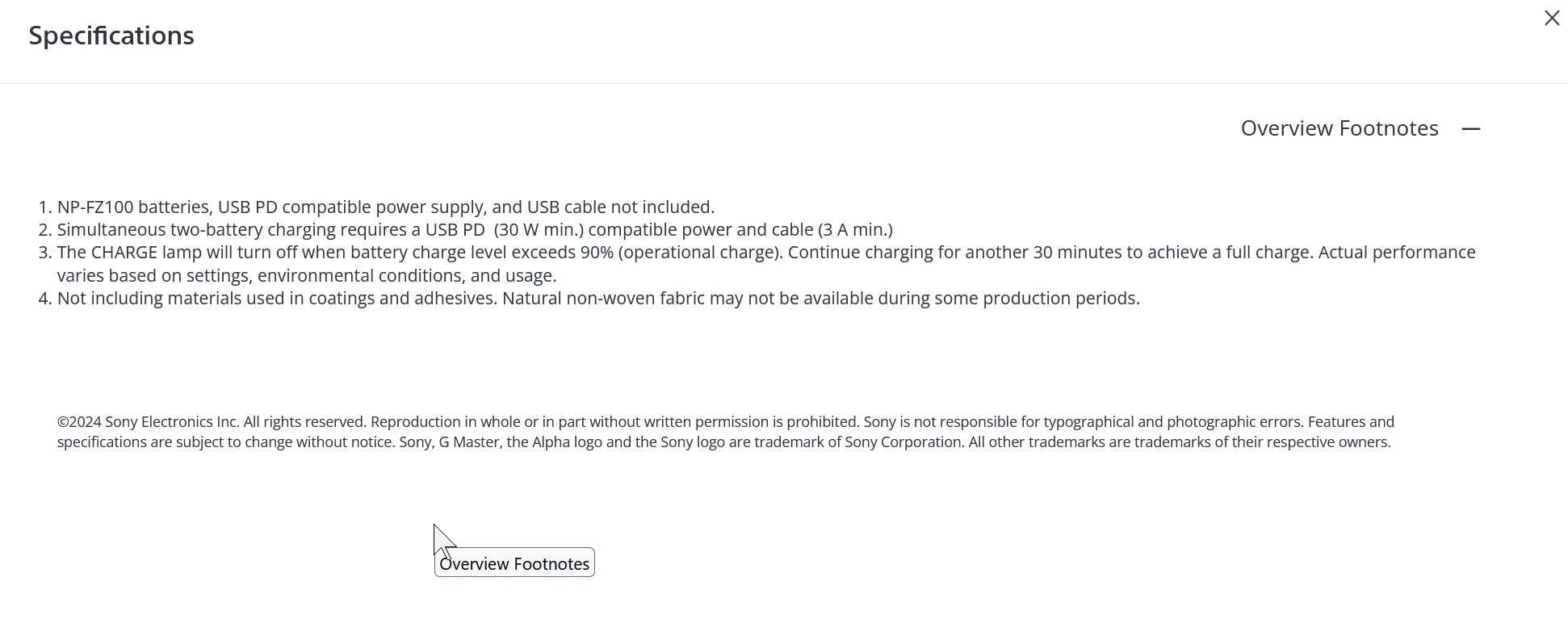
Simultaneous two-battery charging requires a USB PD (30 W min.) compatible power and cable (3 A min.)
I've been using ISDT NP2 dual chargers for years and they work great as long as you supply enough juice. They require 18W PD.
30W is good because it allows full speed charging of two batteries over the whole SOC. An 18W charge would be good for one battery at full speed and two will be slower.