Jeff
Offline
• • • • • •
Upload & Sell: On
|
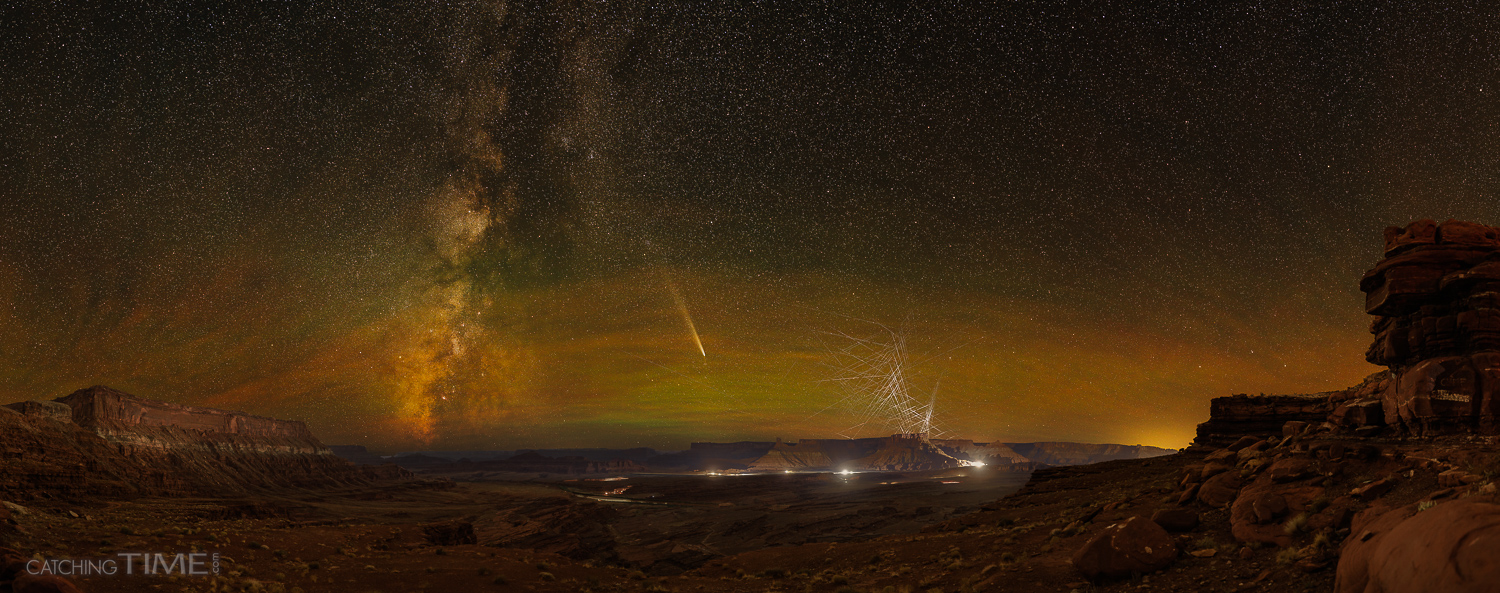
 p.1 #1 · Comet Tsuchinsan-Atlas and Starlink Satellite Flares, Hurrah Pass, UT p.1 #1 · Comet Tsuchinsan-Atlas and Starlink Satellite Flares, Hurrah Pass, UT | |
So this was my second try at photographing the elusive-to-the-northern-hemisphere comet, as my previous attempt 6 days prior was foiled by clouds just as true night set in. I returned after 5 days of waiting out the first winter-ish storm, and was rewarded by moderate temps, clear skies and a very transparent atmosphere!
Multiple orbital shells (43 and 53° inclinations) of the Starlink satellite constellation are shown converging at a point directly above the sun, and flare brightly for a short period when the sun is at the optimal declination below the horizon. Captured on 10/21/24 from the Hurrah Pass area west of Moab, UT, this was my first quality time with rapidly-disappearing Comet Tsuchinsan-Atlas without the dratted full moon in the sky.
The image is slightly cropped from the full 139x38" panorama (~220° wide), the 25 images for which were captured immediately prior to the onset of the satellite flaring. Approximately 40 minutes of flaring was composited onto the panorama image captured immediately prior to the onset of flaring. The handful of brightest flares on this night slightly exceeded the brightness of Jupiter, and occurred anywhere from 5 to 20+ seconds in duration; it's actually quite a spectacle to watch through binoculars, kind of like a 'slow-speed meteor shower' where you don't have to wonder where the streaks of light will fall!
Capture details:
- Canon R5
- Sigma 40mm/1.4 Art
- 10s, f/2, ISO 1600 (sky, 14 images)
- 60s, f/1.8, ISO 1600 (foreground, 11 images)
- 13s, f/2.2, ISO 1600 (flares, 211 images)
For more details on both the capture and the flaring phenomenon, check out this blog post if you are interested:
https://catchingtime.com/10-21-24-a-milkshake-a-snowball-and-some-poprocks/
Cheers,
Jeff
PS: As an aside, I know many people are becoming horrified by the change in the night skies over the last 5+ years, although its primary negative effect is currently upon radio astronomy. For casual observers, the night sky is not being 'ruined' for stargazing; yes, you will see satellites, most around the deeper twilight interval (and yes, night photographers will often capture them in images). I've recently started working with scientists from the IAU Centre for the Protection of the Dark and Quiet Sky as this flaring phenomenon is little documented, to date (at least in any meaningfully scientific way). If you are interested in what's going on with our night skies, I'd encourage you to check out these two organizations, the latter of which you may be familiar with:
https://cps.iau.org/about/
https://darksky.org
[EDIT: typo and formatting]
 © Jeff 2024
Comet T-A and Starlink 43 and 53° Satellite flaring, Hurrah Pass, UT [10/21/24]
[Canon EOS R5] f/2.0 10s 1600 ISO
Edited on Nov 10, 2024 at 08:51 AM · View previous versions
|