lifeandmylens
Online
• • • •
Upload & Sell: On
|
 p.1 #1 · ECN-2 Film Development Guide p.1 #1 · ECN-2 Film Development Guide | |
ECN-2 Development Guide
I've gotten probably a dozen requests for how I process my ECN-2 films and what chemicals to get. All the info you'll ever need is in Kodak's offcial recipe: https://www.kodak.com/content/products-brochures/Film/Processing-KODAK-Motion-Picture-Films-Module-7.pdf
But that document can be a bit daunting. So here is my summarized version of how to process Vision 3 films. I've included links to purchase the chemicals and supplies down below.
Option 1: Send to a Lab
I've heard good things about https://www.midwestfilmco.com and https://brooktreefilmlab.com - but haven't used either. If you're ok with cross processing in C-41, https://www.boutiquefilmlab.com is a great option.
Option 2: Cross Process in C-41
This is by far the easiest way to go next to sending to a lab. It may however result in slight color shifts, but if you are scanning it's nothing you can’t fix. And you probably already have all the chemicals except from the remjet removal bath. The biggest difference between this and regular C-41 films is dealing with the remjet. I also recommend dev at 3:00 instead of 3:15 because CD-4 is a stronger developer than CD-3.
1. Soak the film in the remjet solution for 25 seconds. Slosh around lightly.
2. Drain the solution and start rinsing. Vigorously shake during the rinse water. The first rinse will be almost black water coming out. Each subsequent rinse will be clearer water.
3. Once the remjet soak and rinse is done, develop just like C-41, except process for 3:00 (tweak to preference).
4. At the very end before the final rinse, take your reel with the film still on it and soak your film in a plastic tub filled with cool water (cool water helps harden the emulsion). Unspool the film while mostly under water (this helps prevent the remjet from coming in contact with the emulsion side).
5. Use pec pads to wipe the base side of the film to remove the remjet. I just wrap a pec pad around the film and apply pressure with my fingers and pull through. Repeat until the wipes come out clean.
6. Rinse the film one more time under running water, then do final rinse solution and hang to dry.
Option 3: ECN-2 Kits
The next easiest is to get premade ECN-2 kits from places like Bellini, Cinestill, Flic Film etc.
Option 4: ECN-2 with Raw Chemicals
Produces the best results for vision films, but is more work and more chemicals and much more money up front. I also use this for all my c-41 film like Portra 400 and even use it for my 8x10 sheets!
The cost per roll is the lowest (after you've recouped the initial investment). I heat the developer, fixer, bleach and rinse water to 106.5º. I also pre warm (not pre soak) )the film tank for about 5-10 minutes prior to development. The remjet however I do not heat up at all. I've seen adverse effects with too hot of a remjet solution. Even at 80º, you may need to tweak development time, so I just now do room temperature for the remjet solution. I keep my rinse water at 106º. So after the room temperature remote solution, you'll do several washes with water that is 106º. That'll help keep the developer temperature stable.
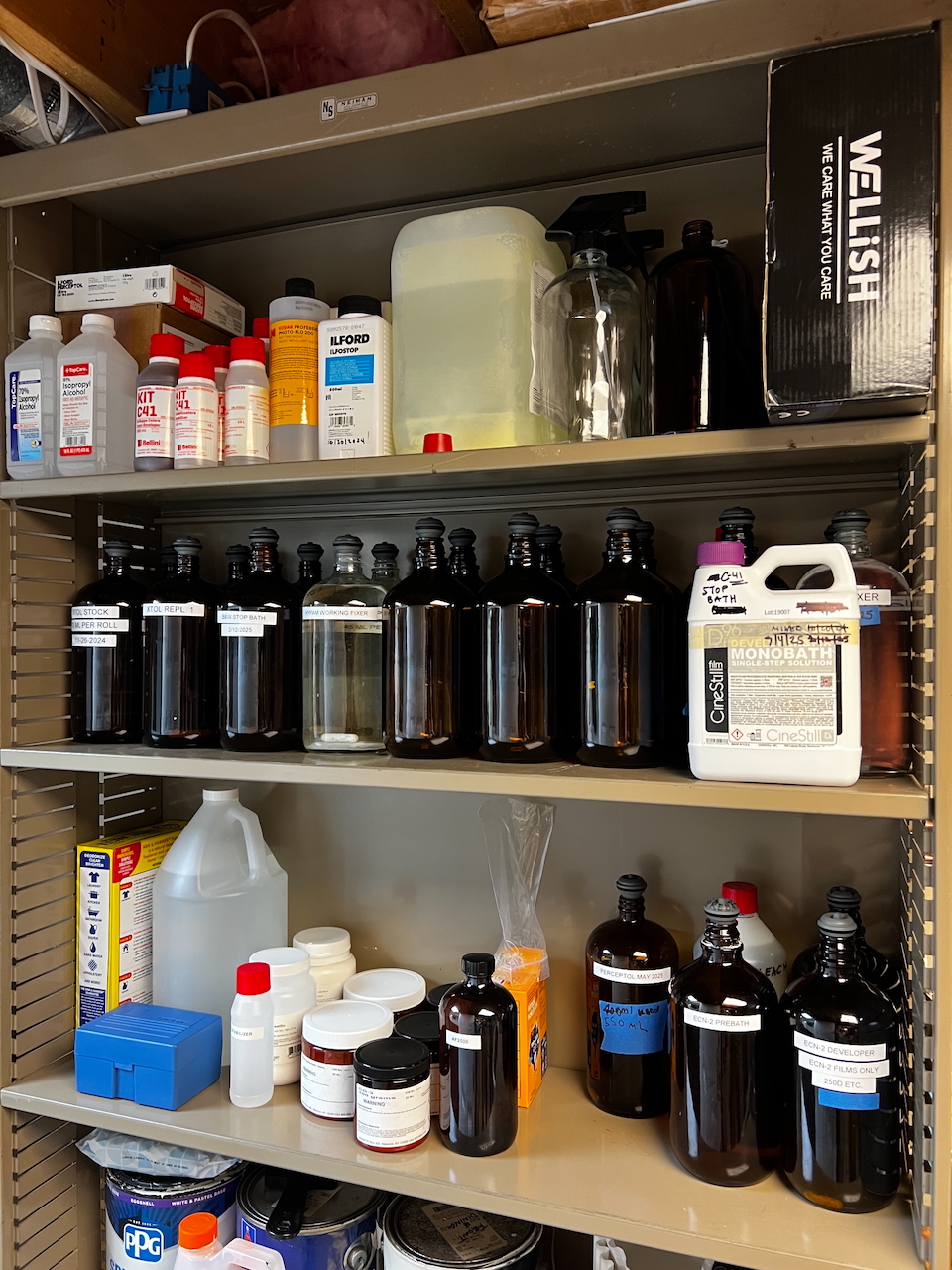
I save all the solutions after use. I put a funnel into each of the respective amber glass bottles (be sure to label them, including the caps), with a coffee filter and pour the solutions back into the bottles for storage.
I use a JOBO processor, but manual is fine as well.
1. Soak the film in the remjet solution for 25 seconds. Gently agitate or, continuously rotate on a jobo at 50 RPM.
2. Drain the solution and start rinsing. Shake during the rinse water or rotate on a JOBO at 50 RPM. The first rinse will be almost black water coming out. Each subsequent rinse will be clearer water. I do 5 rinses, you may need more or less.
3. Once the remjet prebath and rinse is done, pour in developer (I heat mine to 106.5º). Develop for 3:15.
4. Pour out developer and immediately pour in rinse water (I no longer use a stop bath). Agitate for 30 seconds (or rotate on a JOBO).
5. Rinse x 3.
6. Bleach for 3:15 (for the ECN-2 bleach, or follow the label for others)
7. Rinse x 3.
8. Fix for 2:30 (for the ECN-2 fix, or follow the label for others)
9. Rinse x3
10. Take your reel with the film still on it and soak your film in a plastic tub filled with cool water (cool water helps harden the emulsion). Unspool the film while mostly under water (this helps prevent the remjet from coming in contact with the emulsion side).
11. Use pec pads to wipe the base side of the film to remove the remjet. I just wrap a pec pad around the film and apply pressure with my fingers and pull through. Repeat until the wipes come out clean.
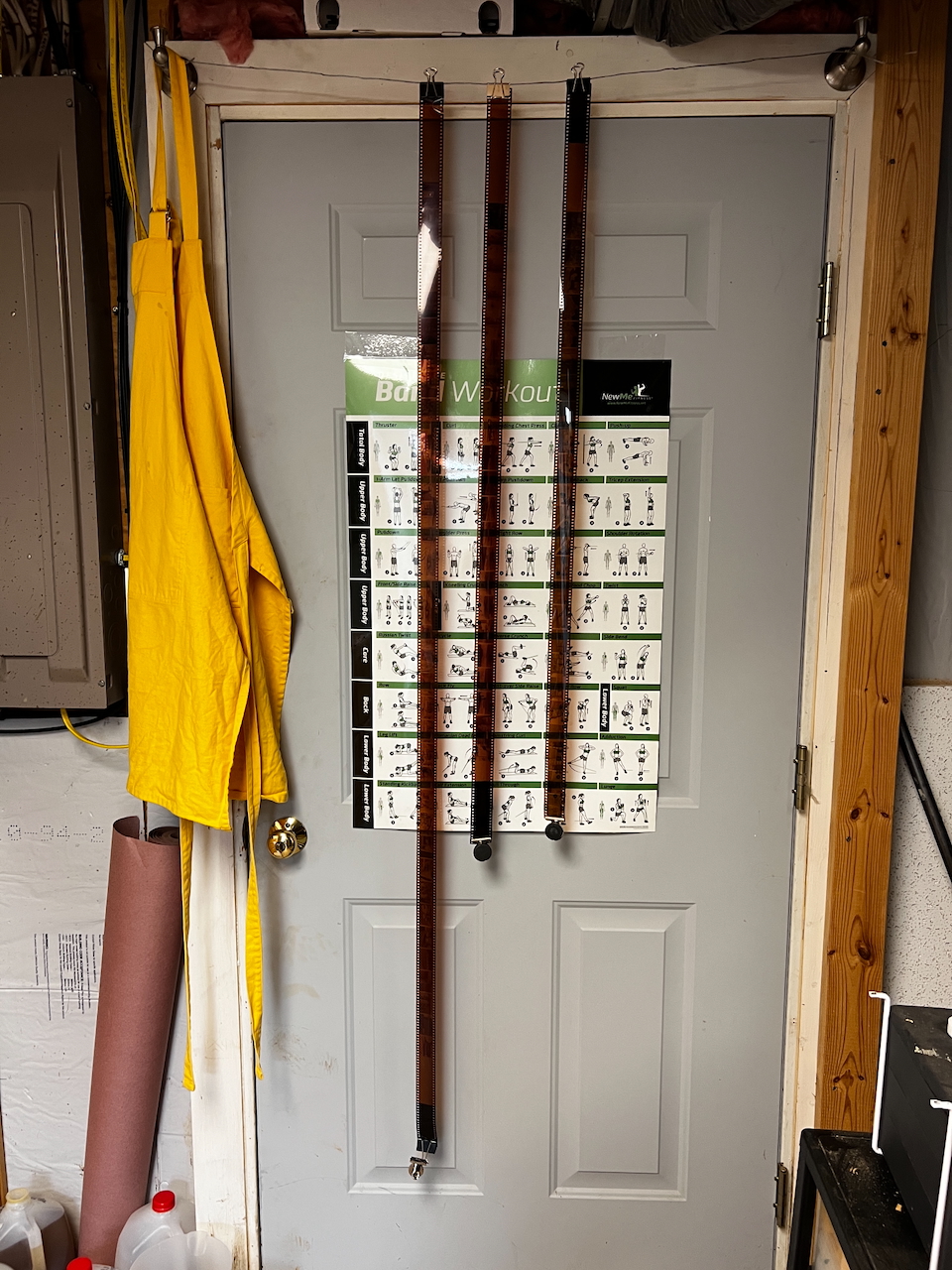
12. Rinse the film one more time under running water, then do final rinse solution and hang to dry.
Purchasing Chemicals and Supplies
There is a large upfront cost to source all the supplies and chemicals. But once you have them, the processing costs per roll is very low. In addition to the supplies below, you’ll want to wear safety glasses and nitrile gloves when dealing with any of the chemicals. Some of these are strong chemicals.
Source the chemicals:
Borax - https://www.bhphotovideo.com/c/product/123755-REG/Photographers_Formulary_10_0260_1LB_Borax_1_lb.html - $6.95
Sodium Sulfate (Anhydrous) - https://www.bhphotovideo.com/c/product/124085-REG/Photographers_Formulary_10_1320_1LB_Sodium_Sulfate_1.html - $9.95
Sodium Hydroxide - https://artcraftchemicals.com/products/sodium-hydroxide-part-1759?_pos=1&_psq=Sodium+Hydroxide&_ss=e&_v=1.0 - $10.15
Sodium Sulfite (Anhydrous) - https://artcraftchemicals.com/products/sodium-sulfite-anhy-part-1416?variant=42892711035127 - $6.63
Sodium Bromide (Anhydrous) - https://artcraftchemicals.com/products/sodium-bromide-part-1360 - $20.35
CD-3 - https://artcraftchemicals.com/products/cd-3-part-1090 - $29.58
Sodium Carbonate mono - https://artcraftchemicals.com/products/sodium-carbonate-mono-part-1340 - $7.85
Baking Soda - grocery store
Potassium Ferricyanide - https://artcraftchemicals.com/products/potassium-ferricyanide-part-1275 - $14.51
Ammonium Thiosulfate Solution 60% - https://www.bhphotovideo.com/c/product/123734-REG/Photographers_Formulary_10_0207_Ammonium_Thiosulfate_1.html - $19.95
Battery Acid - https://shop.advanceautoparts.com/p/diehard-powersports-battery-acid-1-liter-used-to-fill-serviceable-batteries-cycle-acid/11992543-p - $10.49 *or* household vinegar
Sodium Metabisulfite (Anhydrous) - https://www.bhphotovideo.com/c/product/124064-REG/Photographers_Formulary_10_1280_1LB_Sodium_Metabisulfite_1.html - $8.95
Photo Flo: https://www.bhphotovideo.com/c/product/28195-REG/Kodak_1464510_Photo_Flo_200_Solution.html - $13.99
KODAK Anti-Calcium, No. 4: Optional. The Kodak recipe calls for it, but probably has minimal impact especially if using distilled water. I have some for sale for less than retail if you really want it.
KODAK Stabilizer Additive: Optional. I have some for sale for less than retail if you really want it.
KODAK Antifoggant AF-2000: Optional. I have some for sale for less than retail if you really want it. If I had one of these "speciality" chemicals to use I'd pick to include this one.
Distilled water: grocery store.
Source the supplies:
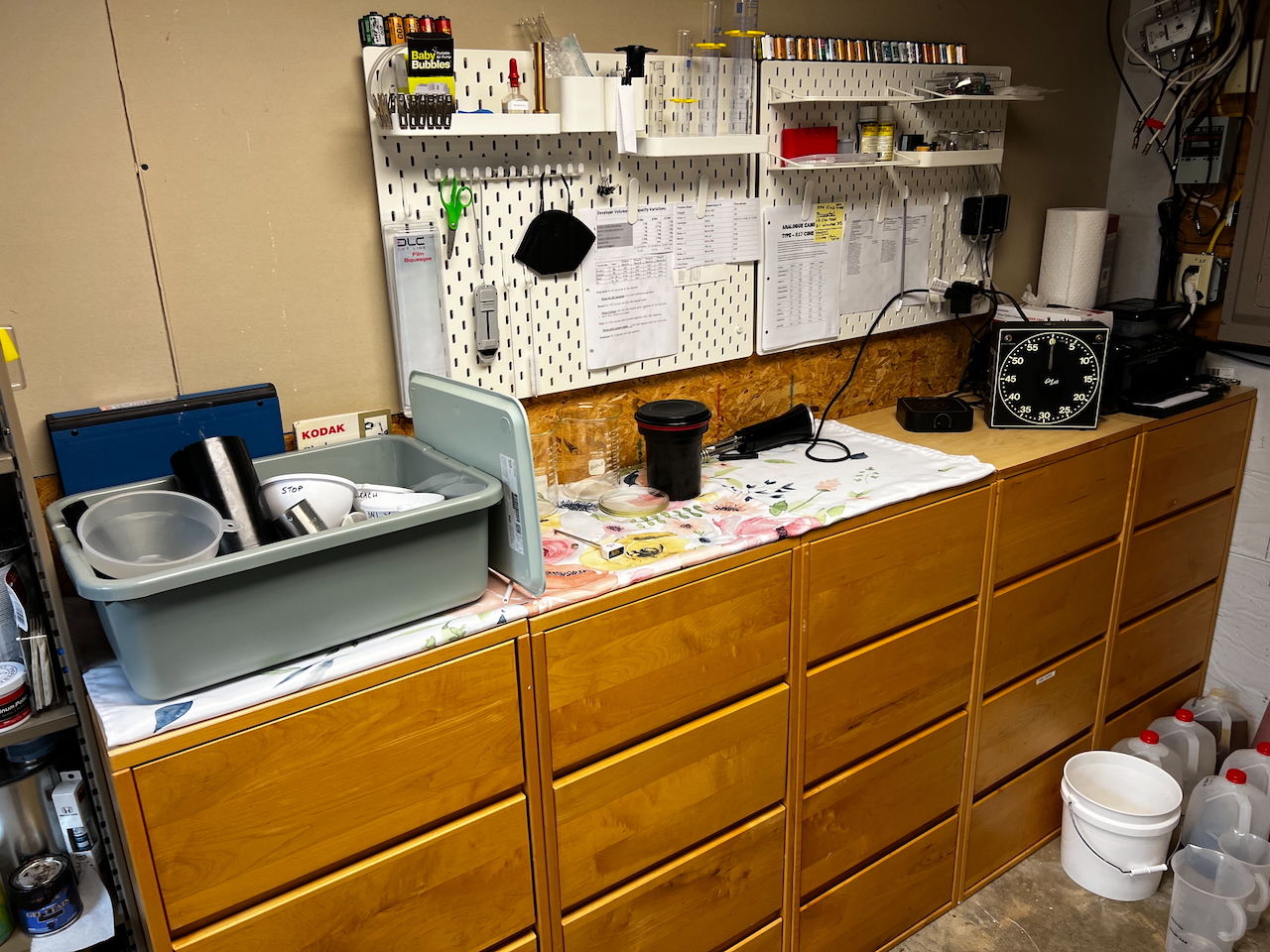
I assume you already have a sous vide or some way to heat the chemicals, a tank to process the film etc.
Magnetic Stirrer - https://www.amazon.com/gp/product/B0BVVJDYCY/ref=ppx_yo_dt_b_search_asin_title?ie=UTF8&psc=1 - $22.99
1 L Glass Beaker (I have multiple of these) - https://www.amazon.com/Corning-1000-1L-1000ml-9985-125-Griffin/dp/B07CX5GR4B/ref=sr_1_5 - $27.67
1 L Amber Glass Storage Bottles - https://www.amazon.com/gp/product/B0CJM5QQ5R/ref=ppx_yo_dt_b_search_asin_title?ie=UTF8&psc=1 - $25.99
Graduated Cylinders (optional) - https://www.amazon.com/gp/product/B086L2KPQF/ref=ppx_yo_dt_b_search_asin_title?ie=UTF8&psc=1 $29.99
Funnels - https://www.amazon.com/gp/product/B09SFBTXB4/ref=ppx_yo_dt_b_search_asin_title?ie=UTF8&psc=1 - $15.29
Coffee Filters - The larger the better. I use these https://www.samsclub.com/p/bunn-12-cup-paper-coffee-filters-2-500-pk-bags/143002
Pec Pads - https://www.bhphotovideo.com/c/product/71154-REG/Photographic_Solutions_PAD44_Pec_Pad_Photo_Wipes.html - $11.95
Scale - https://www.amazon.com/gp/product/B081V54SM2/ref=ppx_yo_dt_b_search_asin_title?ie=UTF8&psc=1 $74.99
Calibration Weights - https://www.amazon.com/gp/product/B08BY7YMC7/ref=ppx_yo_dt_b_search_asin_title?ie=UTF8&psc=1 $15.99
PH meter - I have an expensive one. But honestly I’d probably just skip getting one. Cheap ones are basically worthless and it can be a hassle.
Mixing the Solutions
Use the glass beakers with a magnetic stirrer. Add the heated water first and the chemicals in order, then top with water to make the desired solution. I mix each chemical for about few minutes.
Rem-Jet Removal Bath - 1 Liter
I use distilled water since it lasts for quite a while. There are several alternate pre baths you can use. All of them work to varying degrees. I have tried them all. This recipe works the best. But if you don't want to mess with lye, the next best is to use 58g washing soda + 19g baking soda in 1L of water.

Developer - 500mL
I use tap water since I one shot it. If you want to make 1 liter, just double all the amounts below. At under $1 a 500mL bottle, I can process 4 rolls with it and never worry about consistency. I’ve used 500mL of developer for 8 rolls and have not noticed any issues. I’d imagine it can be used for more than 8, but I have not tried. That'd be 16 rolls per liter for around $2!
I 3d printed some small containers and put the components in them and then put those in a ziplock bag. Others report that mixing a liquid solution with everything but the CD-3 works as well. I am unsure of the stability of the pH when it's mixed like this, so I prefer mixing fresh before each batch. Here's an example of a ready to go bag for 250mL of developer.


Stop Bath - 1 Liter
Update May 2026 - I no longer use a stop bath, but I'll leave my original instructions below.
You can also use Kodak’s indicator stop bath, or household vinegar that’s been diluted. I use battery acid from an auto parts store because it’s very cheap and very strong and what the Kodak recipe calls for. But it’s more dangerous of a chemical when not diluted, so just be careful. I use distilled water since it lasts for quite a while.

Bleach - 1 Liter
You can also use C-41 Bleach. Just follow the directions on the C-41 bleach if so. I use distilled water since it lasts for quite a while. Update May 2026: I no longer buffer my bleach, and get easily 40 rolls from 1 liter.

Fixer - 1 Liter
You can also use C-41 Fixer. Just follow the directions on the C-41 fixer if so. I use distilled water since it lasts for quite a while.

Final Rinse - 1 Gallon
The Kodak recipe calls for their stabilizer additive. But Photo Flo works just fine and is much easier to source. Directions are on the bottle. Usually something like 1:200 dilution. I always use distilled water since you don’t want any water spots.

Questions, just ask!
Edited on May 30, 2026 at 07:32 AM · View previous versions
|