GoroMajima wrote:
For me it is the opposite, never had so much fun shooting with a lens.
I love character and good rendering.. have the 85mm 1.4 GM, had Rxrii and Nikon 58mm 1.4G. Some of the best rendering lenses, but man the versatility is just too hard to beat. I am just able to take better pictures now imo.
Same here.
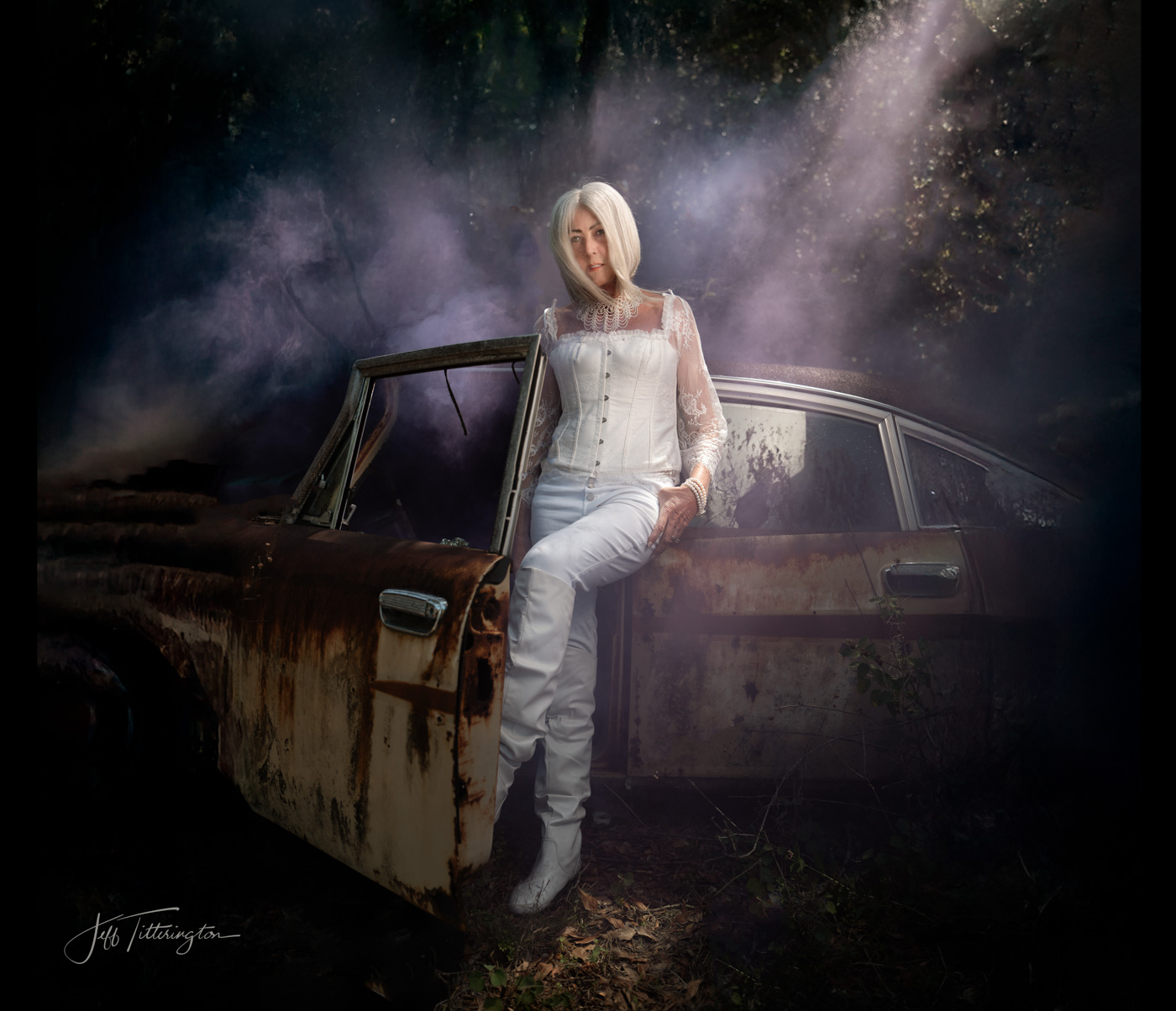
For portrait shooting sessions, I normally take the GM 24mm f1.4, Sigma 35mm f1.2 (to be replaced by the new Viltrox lens), GM 50mm f1.2, GM 85mm f1.4 II and 135mm f1.8. A couple weeks ago, I left all that gear at home and just took the GM 28-70mm f2. I did that with a lot of trepidation, but was actually thrilled with the results. The IQ from this lens is stellar! I never cared much for shooting f2.8 zooms in this FL range, but f2 make a big difference.
A1 II, GM 28-70mm f2, ISO 50, 28mm, f2.0, 1/800, AD 300 in HSS, purple smoke bomb in a junkyard
For portrait shooting sessions, I normally take the GM 24mm f1.4, Sigma 35mm f1.2 (to be replaced by the new Viltrox lens), GM 50mm f1.2, GM 85mm f1.4 II and 135mm f1.8. A couple weeks ago, I left all that gear at home and just took the GM 28-70mm f2. I did that with a lot of trepidation, but was actually thrilled with the results. The IQ from this lens is stellar! I never cared much for shooting f2.8 zooms in this FL range, but f2 make a big difference.
Very nice shot! Thank you for sharing your experience. I have been considering getting this lens for my one-lens travel kit, but it is hard to give up the GM 50/1.2. However, I might just take the leap on this.
Before Easter week I replaced my GM II 24-70mm F2.8 with this new GM 28-70mm F2.0. Have also to say... F2.0 vs. F2.8 makes big difference.
Do not miss the 24mm as I own the Sony G 20mm F1.8 - and for wide-angle shots there is always the time to change lens. 10 days trip to Italy conformed this.
With 50 or 60mp you can crop to APS-C, means 105mm - if you go only with this lens - still like F2.8.
I had concerns regarding flare - it is a non issue - at least as good as the GM II 24-70mm
I'm curious, to those who purchased and like the 28-70, which lenses you've recently sold b/c of overlap with this lens. I just purchased the lens today and am thinking: do I need the 135 F1.8 or not? Should I keep the lighter tamron 28-75 G2 or not (probably not)?
pulper11 wrote:
I'm curious, to those who purchased and like the 28-70, which lenses you've recently sold b/c of overlap with this lens. I just purchased the lens today and am thinking: do I need the 135 F1.8 or not? Should I keep the lighter tamron 28-75 G2 or not (probably not)?
I would think the 135 is much different than 70. Did you use the 135 along with the 28-75? If not, then you don’t need it, but if you used it, why would you not still use it?
chez wrote:
I would think the 135 is much different than 70. Did you use the 135 along with the 28-75? If not, then you don’t need it, but if you used it, why would you not still use it?
Good question.
I used the 135 to photograph indoor hockey through the glass. The 1.8 aperture really helped with that. It narrowed the DOF so helped get rid of some of the distractions in the hockey glass. The 28-75 (as well as my 70-200 GM v2) at 2.8 both were not nearly as good regarding this one element.
Obviously my needs are very specific. Now with F2 on the 28-70, I'm not sure I need the 135. But as you say, for most people the 135 is much different than 70. But Jeff above was able to keep his 135 at home and only took the 28-70 for a shoot.
I used the 135 to photograph indoor hockey through the glass. The 1.8 aperture really helped with that. It narrowed the DOF so helped get rid of some of the distractions in the hockey glass. The 28-75 (as well as my 70-200 GM v2) at 2.8 both were not nearly as good regarding this one element.
Obviously my needs are very specific. Now with F2 on the 28-70, I'm not sure I need the 135. But as you say, for most people the 135 is much different than 70. But Jeff above was able to keep his 135 at home and only took the 28-70 for a shoot. ...Show more →
I used the 135 to photograph indoor hockey through the glass. The 1.8 aperture really helped with that. It narrowed the DOF so helped get rid of some of the distractions in the hockey glass. The 28-75 (as well as my 70-200 GM v2) at 2.8 both were not nearly as good regarding this one element.
Obviously my needs are very specific. Now with F2 on the 28-70, I'm not sure I need the 135. But as you say, for most people the 135 is much different than 70. But Jeff above was able to keep his 135 at home and only took the 28-70 for a shoot. ...Show more →
Well there you go. If you are going to shoot hockey again, then I would think the 135 would be your choice. Don’t look at what others shoot with…look at your own needs.
I think the 28-70/2 is a very good lens optically. However I also think there are some problems with the statements here.
Stefan Official wrote:
Let’s take wedding photographers as an example:
Yes, you can shoot portraits at f/1.4, but the results often look artificial and unnatural due to the extreme blur. The choice of background hardly matters anymore – everything looks almost the same.
Often, it’s actually better to shoot at f/2.0 because you need to consider the background as part of the composition. The result is much more interesting. You can quickly tell whether a photographer is a beginner or more experienced:
Those who struggle with composition almost always default to f/1.4.
Let’s use the wedding scenario as an example. Say you’re shooting a full-body portrait from about 4–5 meters away using a 50mm lens at f/2, and you really like the background blur it gives.
Now imagine you want to frame the shot the same, but you need to stand closer to the subject due to space constraints, or because you are making the artistic choice to have slightly less background compression. In order to have the same amount of background blur as at 50/2 you would need to shoot at 35mm f1.4 or 25mm f1.0
Therefore it makes zero sense to say the amount of background blur at 50/2 is fine, but 35/1.4 is not, when the amount of background blur produced is actually identical.
Stefan Official wrote:
Yes, you can shoot portraits at f/1.4, but the results often look artificial and unnatural due to the extreme blur.
...
Many people don’t realize how big the difference between f/2.8 and f/2.0 is when it comes to bokeh and background blur. However, the difference between f/2.0 and f/1.8 – or even f/1.4 – is minimal. It’s so subtle that I can compensate for it in Lightroom in just a few seconds, and no one would ever notice.
Since f/1.4 gives us "extreme blur," but the difference between f/1.4 and f/2 is minimal, it follows that f/2 also delivers "extreme blur." In that case, we might as well stick with... f/2.8!
That said... the statement is simply incorrect. The increase in background blur between f/1.4 and f/2 is the same as between f/2 and f/2.8.
There IS something that can make the f/1.4 lenses appear to have less background blur, which is EFCS. Manny Ortiz recently did a video where he claims EFCS is used on the A1 when mechanical shutter is on, and he also claims it has deleterious effects on background blur at around 1/2500s. ?si=KR0zTn51hUY0AMwt&t=71 This might be why you think the difference between f/1.4 and f/2 is minimal.
Personally I have ND filters so I can carry lighter strobes, so I don't really run into the issue. My AD600 is far and away heavier than a ND filter.
Photos taken with the Sony 28–70 mm f2 GM lens (most with A7V and electronic shutter): RAW images 28-70 GM
I also have some GM prime lenses that are fantastic - smaller, lighter, and brighter - but I haven’t used them since I got the 28-70 f/2. I’m looking forward to using them again, but for now, I’m really enjoying the zoom
aCuria wrote:
I think the 28-70/2 is a very good lens optically. However I also think there are some problems with the statements here.
Let’s use the wedding scenario as an example. Say you’re shooting a full-body portrait from about 4–5 meters away using a 50mm lens at f/2, and you really like the background blur it gives.
Now imagine you want to frame the shot the same, but you need to stand closer to the subject due to space constraints, or because you are making the artistic choice to have slightly less background compression. In order to have the same amount of background blur as at 50/2 you would need to shoot at 35mm f1.4 or 25mm f1.0
Therefore it makes zero sense to say the amount of background blur at 50/2 is fine, but 35/1.4 is not, when the amount of background blur produced is actually identical.
Since f/1.4 gives us "extreme blur," but the difference between f/1.4 and f/2 is minimal, it follows that f/2 also delivers "extreme blur." In that case, we might as well stick with... f/2.8!
That said... the statement is simply incorrect. The increase in background blur between f/1.4 and f/2 is the same as between f/2 and f/2.8.
There IS something that can make the f/1.4 lenses appear to have less background blur, which is EFCS. Manny Ortiz recently did a video where he claims EFCS is used on the A1 when mechanical shutter is on, and he also claims it has deleterious effects on background blur at around 1/2500s. ?si=KR0zTn51hUY0AMwt&t=71 This might be why you think the difference between f/1.4 and f/2 is minimal.
Personally I have ND filters so I can carry lighter strobes, so I don't really run into the issue. My AD600 is far and away heavier than a ND filter. ...Show more →
To get straight to the point: that extreme f/1.4–f/1.2 blur look isn’t for me. It’s very easy to achieve, but it usually produces very similar, predictable results. To me, it lacks creative depth.
Some of the comments here feel overly theoretical. For me, it’s about delivering creative, varied, and deliberately composed images in practice. That’s exactly why I appreciate wedding photographers who go beyond this standard style.
Stefan Official wrote:
To get straight to the point: that extreme f/1.4–f/1.2 blur look isn’t for me. It’s very easy to achieve, but it usually produces very similar, predictable results. To me, it lacks creative depth.
Some of the comments here feel overly theoretical. For me, it’s about delivering creative, varied, and deliberately composed images in practice. That’s exactly why I appreciate wedding photographers who go beyond this standard style.
I often read this opinion, and yet I still laugh every time. Haven't you ever noticed that the degree of blur at a given focal length depends not only on the chosen aperture, but equally on the distance between the camera and the subject, as well as the background? And that a wide aperture is especially helpful when this distance (for whatever reason) is so great that the desired depth of field simply can't be achieved at f/1.8? In other words, anyone who talks about creativity should know that you don't always use things the same way everywhere, but rather according to the circumstances, adapted to the specific situation. And the great advantage of an f/1.2 lens is that I can stop it down to f/1.8 and beyond, whereas it's impossible to open an f/1.8 lens any wider. This doesn't mean that you absolutely need an f/1.2 lens, but simply that your argument against it is complete nonsense.
Nifty Fifty wrote:
I often read this opinion, and yet I still laugh every time. Haven't you ever noticed that the degree of blur at a given focal length depends not only on the chosen aperture, but equally on the distance between the camera and the subject, as well as the background? And that a wide aperture is especially helpful when this distance (for whatever reason) is so great that the desired depth of field simply can't be achieved at f/1.8? In other words, anyone who talks about creativity should know that you don't always use things the same way everywhere, but rather according to the circumstances, adapted to the specific situation. And the great advantage of an f/1.2 lens is that I can stop it down to f/1.8 and beyond, whereas it's impossible to open an f/1.8 lens any wider. This doesn't mean that you absolutely need an f/1.2 lens, but simply that your argument against it is complete nonsense....Show more →
Agreed. And for things like nighttime photography, architecture and landscapes at an F1.4 doesn't greatly impact blur, but does indeed help with lowering iso. Or shooting indoors, going brighter can be hugely impactful in a dark space, preventing iso from going into the stratosphere.