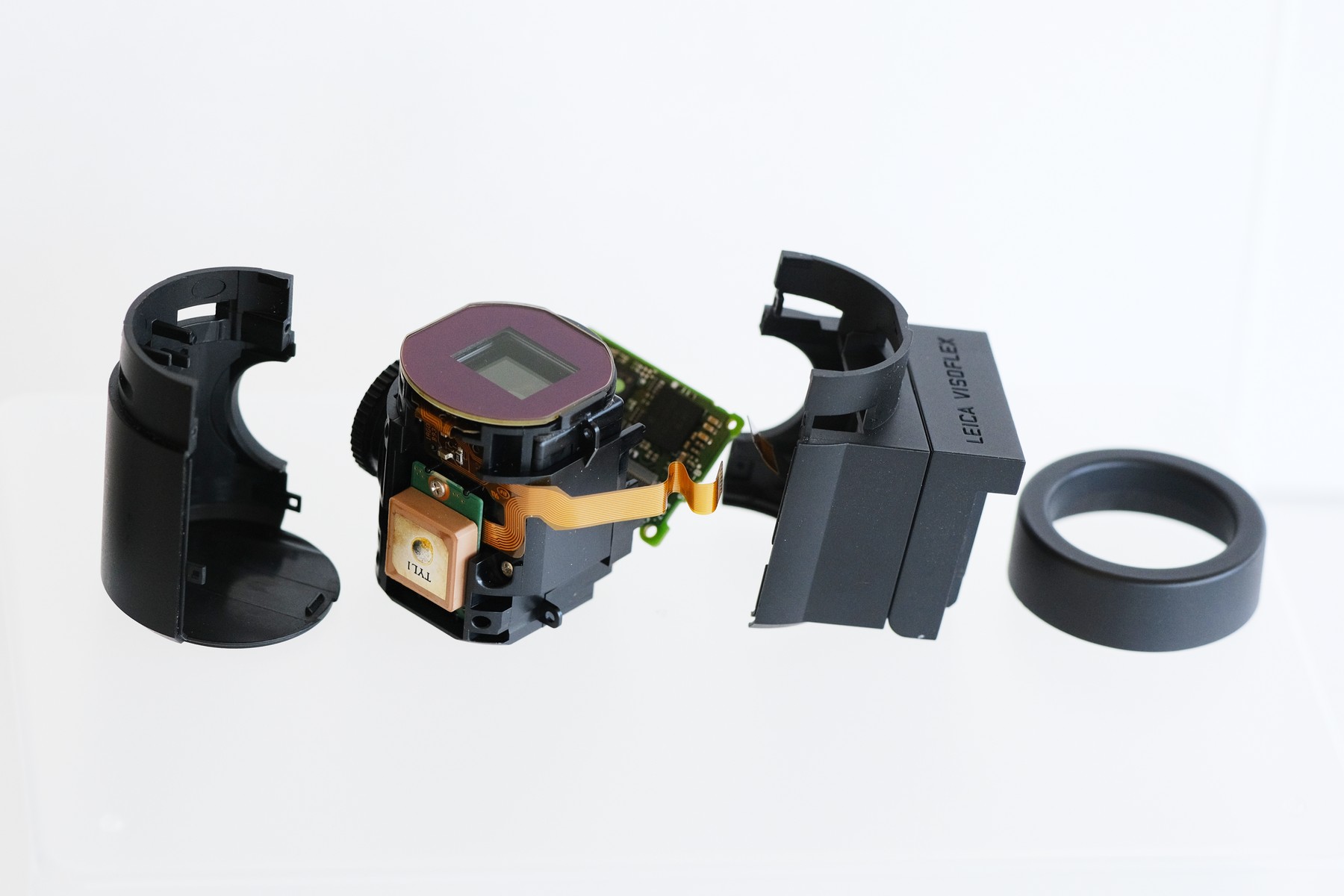
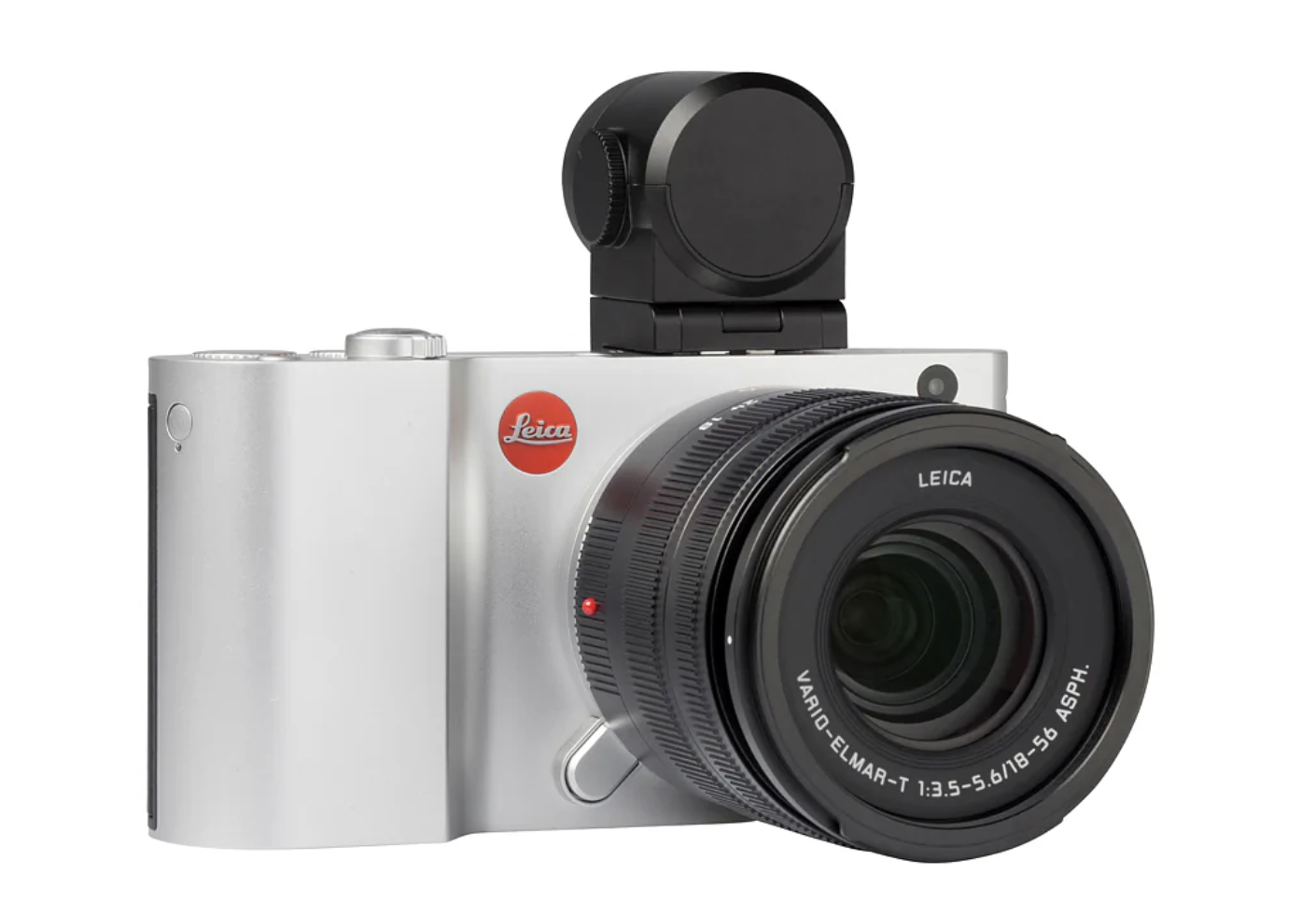
"The compact size of internal EVF module is very attractive and showing that it would be definitely possible to make this Visoflex few times smaller by repositioning of the GPS module and eye sensor. Perhaps engineers had to follow particular design of the frame. From the other side - larger frame is protecting internals more. Even though the shell is plastic but there are multi layers of it inside, which is making this Visoflex Typ 020 more resistant to shakes and accidental hits."
p.1 #2 · Disassembly: Why is the Visoflex 020 So Big? Could It Be Made Smaller?
If it were possible to design an external EVF that's half the size of the Visoflex 020 but without GPS or tilting features, would this be desirable? I do think Leica should have made it as compact as possible, especially since it was originally designed for the super compact Leica T (Typ 701).
p.1 #4 · Disassembly: Why is the Visoflex 020 So Big? Could It Be Made Smaller?
The tilting feature is super handy given that Leica does not offer a flip out rear screen. GPS I could totally do without. Not once in my shooting career have I ever wanted or needed that.
I sometimes think the size thing is driven by marketing departments. To make it seem that you are getting ‘value’. If that thing was tiny, maybe people would think that it’s not worth $800?
Leica isn’t the only one that does that. When Zeiss updated the Nikon mount ZF.2 lenses as the Milvus line, most of them retained the exact same optics, but the body shell literally doubled in size.
Nikon’s F mount 58 1.4G is unnecessarily large when you compare the optical structure to the lens case, as well as to their older 50 1.4. The size is meant to impress and differentiate it from the lowly, smaller and 1/3 the price 50…
p.1 #7 · Disassembly: Why is the Visoflex 020 So Big? Could It Be Made Smaller?
It would be cool if a company could provide an option to rehouse it into a metal viewfinder, only using the EVF and omitting the GPS/Tilt feature, thereby effectively halving its size!
p.1 #9 · Disassembly: Why is the Visoflex 020 So Big? Could It Be Made Smaller?
I think if EVF is double-smaller, it would be still not very often used on M body, but yeah would deliver much better overall experience on Leica T.
I may experiment one day if Typ 020 is still operating if GPS module is disconnected (missed to try it during CLA, and now it's assembled). In that case it should not be too complex to design 3D printable shell with lower profile on top of stock tilting base. The large round protective glass though would need to be replaced with custom cut rectangular one.
p.1 #10 · Disassembly: Why is the Visoflex 020 So Big? Could It Be Made Smaller?
The inclusion of GPS always seemed so odd to me anyway. I don't even know how many working pros still use that. It could have been way smaller and more attractive.
p.1 #12 · Disassembly: Why is the Visoflex 020 So Big? Could It Be Made Smaller?
While I don't find it particularly ugly, it's clear that it wasn't optimized for the M10, as it blocks the numbers on the shutter dial. It seems like it was originally designed for the Leica T and then adapted for the M10 without much consideration.
The new version is shorter (perhaps because it lacks GPS) but also fatter. At least since it lacks GPS transmission, Leica could make it all metal.
p.1 #13 · Disassembly: Why is the Visoflex 020 So Big? Could It Be Made Smaller?
Fred Miranda wrote:
If it were possible to design an external EVF that's half the size of the Visoflex 020 but without GPS or tilting features, would this be desirable?
In my case with the M240's EVF, the tilt feature is extremely useful and I'd be very reluctant to give it up. I actually find the tilt EVF much more user-friendly than the flip-out screens on my other system, especially in brighter ambient light conditions.
Removal of GPS would be fine with me. If I want it, I add it manually to my photos.
p.1 #16 · Disassembly: Why is the Visoflex 020 So Big? Could It Be Made Smaller?
Desmolicious wrote:
The tilting feature is super handy given that Leica does not offer a flip out rear screen. GPS I could totally do without. Not once in my shooting career have I ever wanted or needed that.
I sometimes think the size thing is driven by marketing departments. To make it seem that you are getting ‘value’. If that thing was tiny, maybe people would think that it’s not worth $800?
Leica isn’t the only one that does that. When Zeiss updated the Nikon mount ZF.2 lenses as the Milvus line, most of them retained the exact same optics, but the body shell literally doubled in size.
Nikon’s F mount 58 1.4G is unnecessarily large when you compare the optical structure to the lens case, as well as to their older 50 1.4. The size is meant to impress and differentiate it from the lowly, smaller and 1/3 the price 50…...Show more →
There are electronic features that add unnecessary weight, volume and cost to current camera designs. GPS, WiFi and HDMI outputs are good examples of things that I've never used. To me AF takes up a lot of unnecessary space and adds unnecessary cost.
I prefer the haptics of the Classic ZF.2 over the Milvus because the new 'tulip' packaging is just ridiculously large and odd-looking. Not only is the new packaging too big, but the Milvus and Otus lenses look like they were designed by Dr. Seuss. Now that the designs have been with us for so many years we've come to accept them and to forget how funny looking they were when they were first introduced.
I also see the bloated size trend occurring in Nikon's lineup. For a while I thought that Nikon had to do it to accommodate the AF drive system, but now I'm having doubts about whether everyone is just making things bigger to justify an increased price tag.
I don't like the trend of gear becoming larger and heavier. I'm trying to simplify and move in the other direction.
p.1 #17 · Disassembly: Why is the Visoflex 020 So Big? Could It Be Made Smaller?
BPsmith511 wrote:
The inclusion of GPS always seemed so odd to me anyway. I don't even know how many working pros still use that. It could have been way smaller and more attractive.
How/why is it that GPS has fallen out of favor with some, in your opinion?
p.1 #18 · Disassembly: Why is the Visoflex 020 So Big? Could It Be Made Smaller?
I'm not sure why GPS was ever added as a feature in the first place. Most photographers know where they are, and don't need to rely on GPS to tell them. I'm thinking that it was just another electronic gadget that was added to enhance user perception that they were getting lots of features for their money, even features that aren't necessarily all that useful. As others have mentioned, all kinds of add-ons add bulk to the system, which may or may not be desirable.
p.1 #19 · Disassembly: Why is the Visoflex 020 So Big? Could It Be Made Smaller?
coralnut wrote:
I'm not sure why GPS was ever added as a feature in the first place. Most photographers know where they are, and don't need to rely on GPS to tell them. I'm thinking that it was just another electronic gadget that was added to enhance user perception that they were getting lots of features for their money, even features that aren't necessarily all that useful. As others have mentioned, all kinds of add-ons add bulk to the system, which may or may not be desirable.
I use it while scouting for landscape locations. I would capture an initial image at a new spot and then return later under optimal lighting. Checking the exact location was simple thanks to GPS tagging on the image. Alternatively, I could use my phone to capture the GPS location and later transfer it to the image, but the built-in feature is more convenient. It's also cool for traveling the taking pictures knowing exactly what it was taken.
p.1 #20 · Disassembly: Why is the Visoflex 020 So Big? Could It Be Made Smaller?
You're the first person I'm aware of who's mentioned using GPS. So it turns out that you have redundant ways to get GPS data, since it's both in your phone and your add-on viewfinder. To me, that's a great reason to eliminate the GPS from the viewfinder and reduce it's cost, size and weight. To me there's no point in paying for GPS to exist in every device, or to add unnecessary weight and bulk to the camera.
I can't help but think that to some degree all of the bells and whistles that they design into cameras is similar to the luxury accouterments that the Big3 pack into cars. It's just not possible to buy a base model car today without power windows, auto transmission, and power door locks. The Big3 do this because stuffing the car with add-on features as standard equipment increases the average unit selling price, in turn increasing profitability of car manufacturing when people are forced to pay for features that they might not buy as options.
But to be fair, I'm the kind of guy who doesn't like autofocus either.