p.4 #1 · Call for help - building sensor readout speed database
snapsy wrote:
There are two factors at play here. First, by using a slower shutter speed relative to the light cycling frequency, each sensor row is capturing multiple cycles of light. This means the brightness difference of the bands between rows receiving +1 or -1 cycles vs other rows is less noticeable. For example, on a light source cycling 1,000 times/sec, a 1/8000 shutter will capture on average 1 cycle of light, meaning some rows will have 100% and others 0% - a very noticeable 100% difference. Drop the shutter down to 1/250 and some rows get 4 cycles while others get 3 - much less noticeable 33% difference. This is why bands become less noticeable at slower shutter speeds. They start to blend together and fill in the black gaps since the brightness difference of missing a light cycle becomes less and less. ...Show more →
To demonstrate this effect of shutter speed more clearly I've set up my Arduino with two LEDs, a red and a green, and alternate between the two every millisecond (1/1000).
p.4 #2 · Call for help - building sensor readout speed database
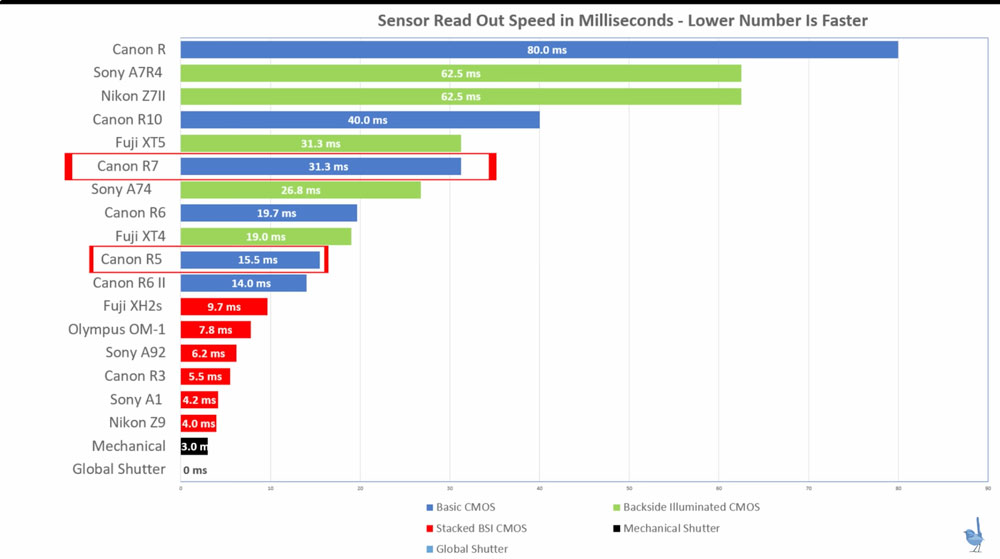
Add Canon R5 and R7 - huge thanks to @RAF09 for some setup issues that were my fault, including some missing video measurements that will be filled in later
I also added per-row sensor readout rates, in addition to the existing full-sensor rates. The per-row rates make it easier to compare readout speeds across sensors with different resolutions.
p.4 #6 · Call for help - building sensor readout speed database
snapsy wrote:
Add Canon R5 and R7 - huge thanks to @RAF09@ for some setup issues that were my fault, including some missing video measurements that will be filled in later
I also added per-row sensor readout rates, in addition to the existing full-sensor rates. The per-row rates make it easier to compare readout speeds across sensors with different resolutions.
Regarding pre-row readout, I think one thing worth mentioning is that stacked sensors tend to read a group of rows at the same time but I don't remember the details...
p.4 #7 · Call for help - building sensor readout speed database
j4nu wrote:
Regarding pre-row readout, I think one thing worth mentioning is that stacked sensors tend to read a group of rows at the same time but I don't remember the details...
Yep, I'm working on ideas on how to measure multi-row readouts.
p.4 #8 · Call for help - building sensor readout speed database
Good project. Have you thought about adding milliseconds as well? Not sure if that would be of any help to anyone. From Duade Patton and just estimates so not intended to be added to your project.
p.4 #9 · Call for help - building sensor readout speed database
Zenon Char wrote:
Good project. Have you thought about adding milliseconds as well? Not sure if that would be of any help to anyone. From Duade Patton and just estimates so not intended to be added to your project.
The live results table lets you switch between milliseconds and seconds. Under that are static tables for both seconds and milliseconds.
The built-in LED on the Arduino board I'm using isn't bright enough for this capture - the noise averages out the 12-row segments. This image was captured with two discrete LED's (red+blue) plugged into GPIO pins through a 220 Ohm resistor.
Jim Kasson has previously measured the same on both the Z9 and A9.
p.4 #13 · Call for help - building sensor readout speed database
Sony reads out 12 rows and Canon 8 rows, and can produce noticeable image artifacts. https://www.fredmiranda.com/forum/topic/1663827/0
It would be interesting to see if the Canon R3 is still using 8 rows.
p.4 #14 · Call for help - building sensor readout speed database
j4nu wrote:
Regarding pre-row readout, I think one thing worth mentioning is that stacked sensors tend to read a group of rows at the same time but I don't remember the details...
I don't think it's just stacked sensors. I believe the below was shot with the non-stacked Canon R6 and definitely in e-shutter. The higher magnification screen grab shows the readout rows more clearly. The original image was a vertical, which is why the bands are vertical.