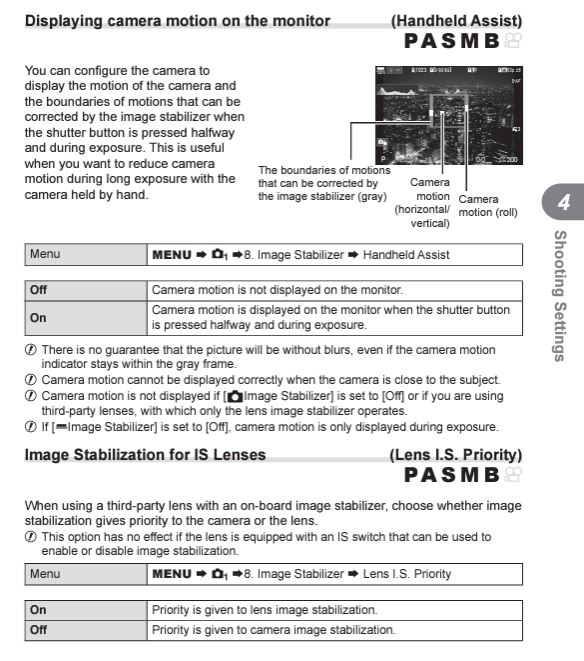
"Image Stabilizer Handheld Assist (Shooting Menu 1, 8th Sub-menu)
New for the OM-1, Image Stabilizer Handheld Assist will display an image stabilization square when you half press the shutter to focus. A smaller square within the larger square will move indicating how much you are moving while handholding the camera."
i did 'try that out' for kicks very early on just for a minute after reading the manual.
i may be remembering/interpreting it wrong...is that utility indicating if one's handholding 'skills', or lack thereof, are beyond what the IS system is capable of correcting?
if the smaller square (indicating the user's hand shake) hits and/or goes outside the IS square...does that indicate the handshake movement is outside of what the IS system can correct (move the IS/IBIS)?
Colin F wrote:
Yes, but it wasn't super warm inside the vehicle, the camera was cool to the touch, but yes, there was still quite a drop in temperature from that to outside. Not sure how long it takes for the lens temp to reach an unaffected level.
Yes, but you can't do that in -40 C for very long, unless you want to die.
*if it's +5C in the car and -40C outside of it...that's a 45 degree temp difference.
jeffbuzz wrote:
Isn't the 150-400mm hood made of carbon? That should have a very minimal thermal effect. Much less than alloy would.
iirc..it was explained to me that the heat coming from the inside of the lens is dissipating/radiating through the front element which heats the air directly in front of the element. the air at the front of the lens hood is a lot cooler...two different atmospheric temps inside the lens hood.
i don't know how much, if any, of that holds any water but i do know that i never suffered with as temp issues with the smaller 4/300 (same issue but not as noticeable until in colder temps than with the bigger lens/hood).
Right, but there are 2 different ways a hood can have a thermal effect. One is by trapping the warm air from the lens itself as shown in that video. The other is due to warmth of the hood. Metal hoods are going to retain heat longer than carbon hence creating this kind of issue.
10-15 minutes to acclimate he mentioned. i'd guess that required time would be more/less depending on temp/humidity?
still...i can for sure say that even (very shortly after I've exited the vehicle) upon noticing the IQ sucks...taking the hood off doesn't always 'immediately' and 100% rectify the problem. i will often see an improvement straight away but not the greatest IQ until more time has passed.
I guess the only way to do this sort of shooting is to store the camera & lens (without battery) in a cooler with an ice-pack, and get the warm battery in it ASAP when a bird is sighted. The only trouble with that is the time it takes to get ready, as the bird will likely depart.
It's odd though, when I was out yesterday for that owl, my camera & lens were outside with me for almost three hours, yet the images were still poor. Perhaps it was that IS setting.
molson wrote:
If you actually think the lens hood is the problem because it's trapping warm air - take it off, count to three, and put it back on. Problem solved.
maybe.
if the internal temp of the lens is still dissipating heat through the front element then the issue will as quickly return i'd guess.
Paul_100A wrote:
maybe.
if the internal temp of the lens is still dissipating heat through the front element then the issue will as quickly return i'd guess.
If the eternal temperature of the lens is the problem, the lens hood will have little or no effect. Heat will dissipate much faster through the metal lens barrel than it will through the glass element at the front.
molson wrote:
If the eternal temperature of the lens is the problem, the lens hood will have little or no effect. Heat will dissipate much faster through the metal lens barrel than it will through the glass element at the front.
Erm, I dunno. Did you watch the video by Steve Perry? It's not the faster rate that the heat may be leaving the lens body, it's the fact that heat haze is occurring in the hood. In Alberta last week, I had the hood off at all times when shooting, and got well away from the car.
When it is cold there are many variables that can cause grief.
Lens hood swirling cold to hot air until all is stabilized. Includes the inside of the lens. Even if you remove the hood in that temperature the front element might still be putting off heat from inside lens.
If I'm in that cold of temperatures using a car or snow coach, I'll have a blanket or something that I can put over it to help keep the camera and lens cold longer between using it.
I made the mistake years ago shooting out a car window. Made the mistake shooting over a hood. Now very aware not to be around any hear sources, not even next to a vehicle while outside. Learned the hard way.
Depending on the temperature and humidity in the air... there can be cold shimmer in the air making the image soft. Also to add how much are you zoomed in. The more you compress a far away subject the more softness due to magnification factors. If you have subject way out there in crappy air and shooting high magnification then might be crappy air, crappy image.
One could have too slow shutter speed causing motion blur, but that is not the case here.
Other factors is auto focus settings and other settings that work together (or against) telling the computer what you want.
Interesting subject about IS (image stabilization).
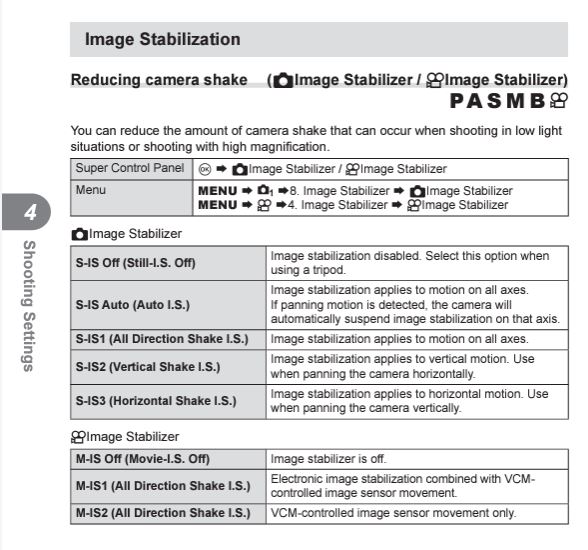
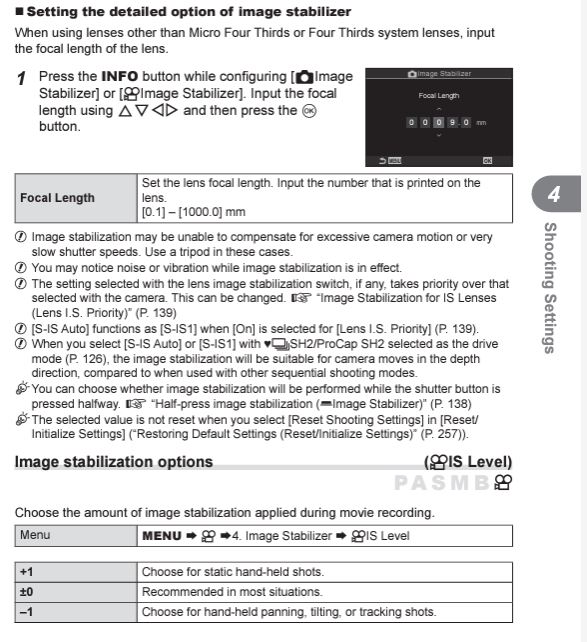
There has been some talk about maybe S-IS Auto is not the best selection to use, perhaps S-IS1 better choice? . I have not had a chance to work on that. You mentioned you worked off a tripod for a series of images. One could work off tripod and shoot a series with S-IS Auto, S-IS1 and IS turned off and review images. If working on higher shutter speeds might be best.
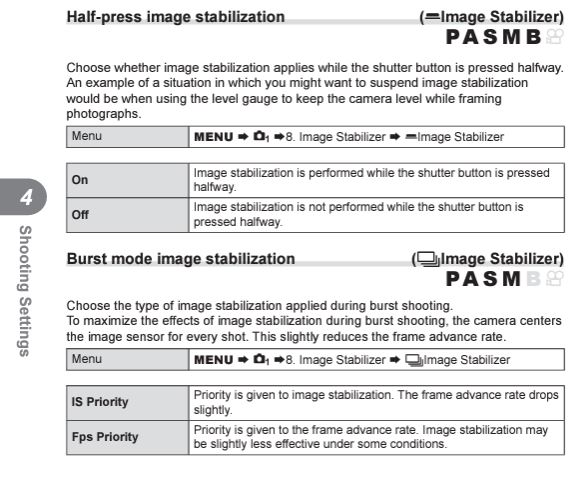
I attached pages 136 -139 of the manual that covers the IS settings and descriptions. Might be good to read all the cautions.
When I owned the EM1X the auto focus on a still subject would drift in and out of focus. Shooting burst would get something in focus. Ended up switching to S-AF for perched birds. I still do that with the OM-1 having a custom mode with a button assigned to quickly get a sharp image with S-AF then back to C-AF for higher shutter speeds for action.
The OM-1, I do select smaller target pattern when on perched birds as I find the focus will jump around and not always be on what I intend it to be. Subject detection does well and keeps the eye until the bird turns it's head or puts the head under water then it losses lock. SH2 will find and hold focus faster than Electronic shutter I have found.
Too many variables. But seeing Colin F work and how he knows his way around a camera, I'm interested in his thought process questioning the different IS modes, as am I.
Colin F wrote:
But.....he showed how he did a test. That's evidence, and just because it's on YouTube doesn't mean it's not correct.
yep.
years ago I met Keith at a local pond (about +5C spring time).
he had a 4/600 FF rig and I had my Oly 4/300 rig.
we walked from the parking lot to the pond and I immediately started gunning all the ducks.
i noticed he wasn't doing anything.
after a few minutes i asked him what the problem was and he explained acclimation to me. "no use shooting yet because everything will be soft" is exactly what he said.
this issue is not new.
-like i said before though...with the smaller 4/300 I did not have to concern myself with the issue at temperatures when the larger lens owners did.
molson wrote:
If the eternal temperature of the lens is the problem, the lens hood will have little or no effect. Heat will dissipate much faster through the metal lens barrel than it will through the glass element at the front.
isn't the lens paint actually a multi-layered coating system designed to reflect external heat away and would that not also reflect internal heat back inside?
i think i'll go with Steve Perry's logic.
even if most of the internal heat is dissipated out of the lens barrel, perhaps some heat (enough to cause an issue) is still dissipated out the front element.
molson wrote:
I think physics trumps YouTube - sorry.
would that be the physics of heat is dissipated through metal easier or more effectively than through glass?
conduction i would agree with but I'm not sure about radiant or convection heat.