I’d like to get some input from people who have experience with the A1 and small birds in flight.
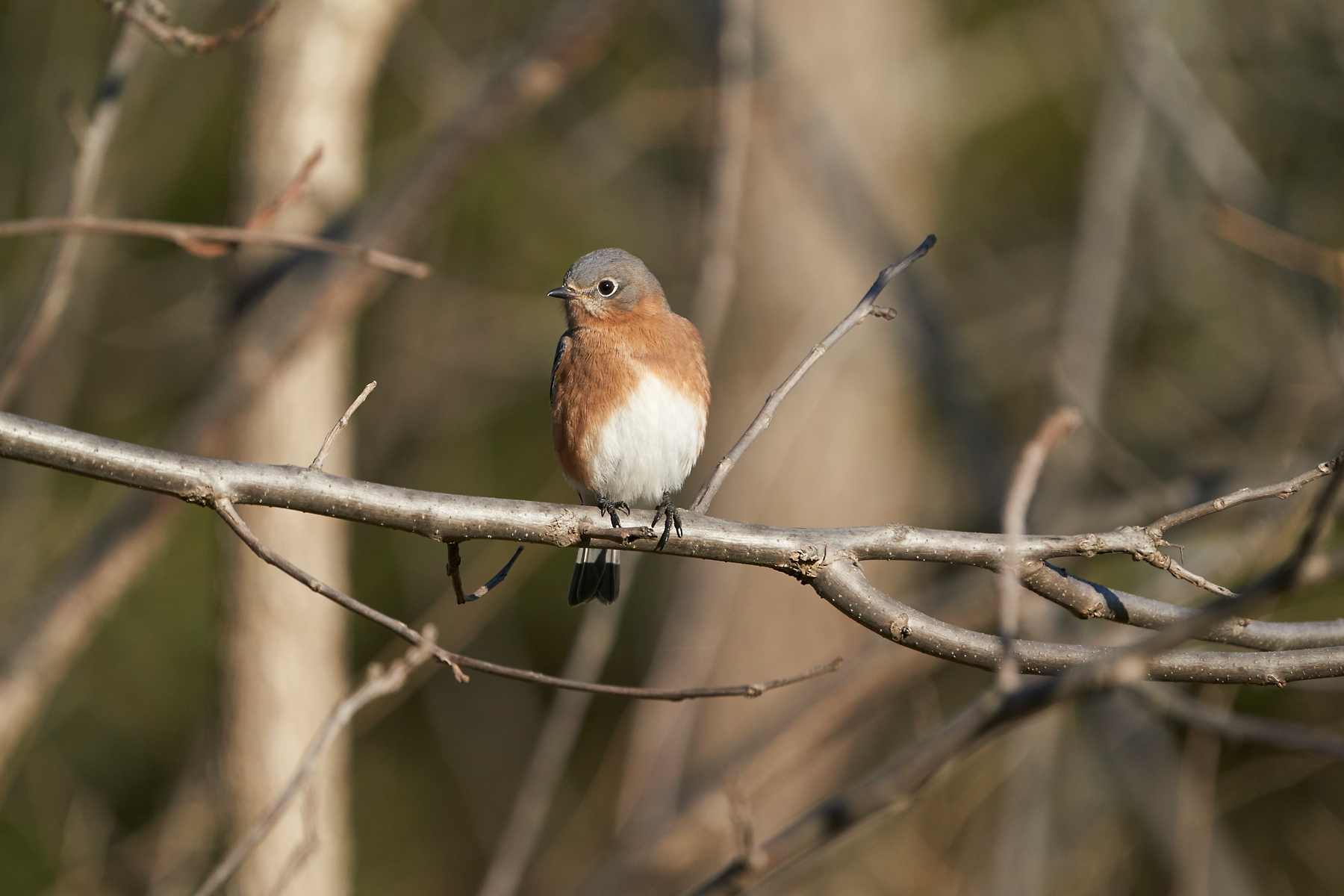
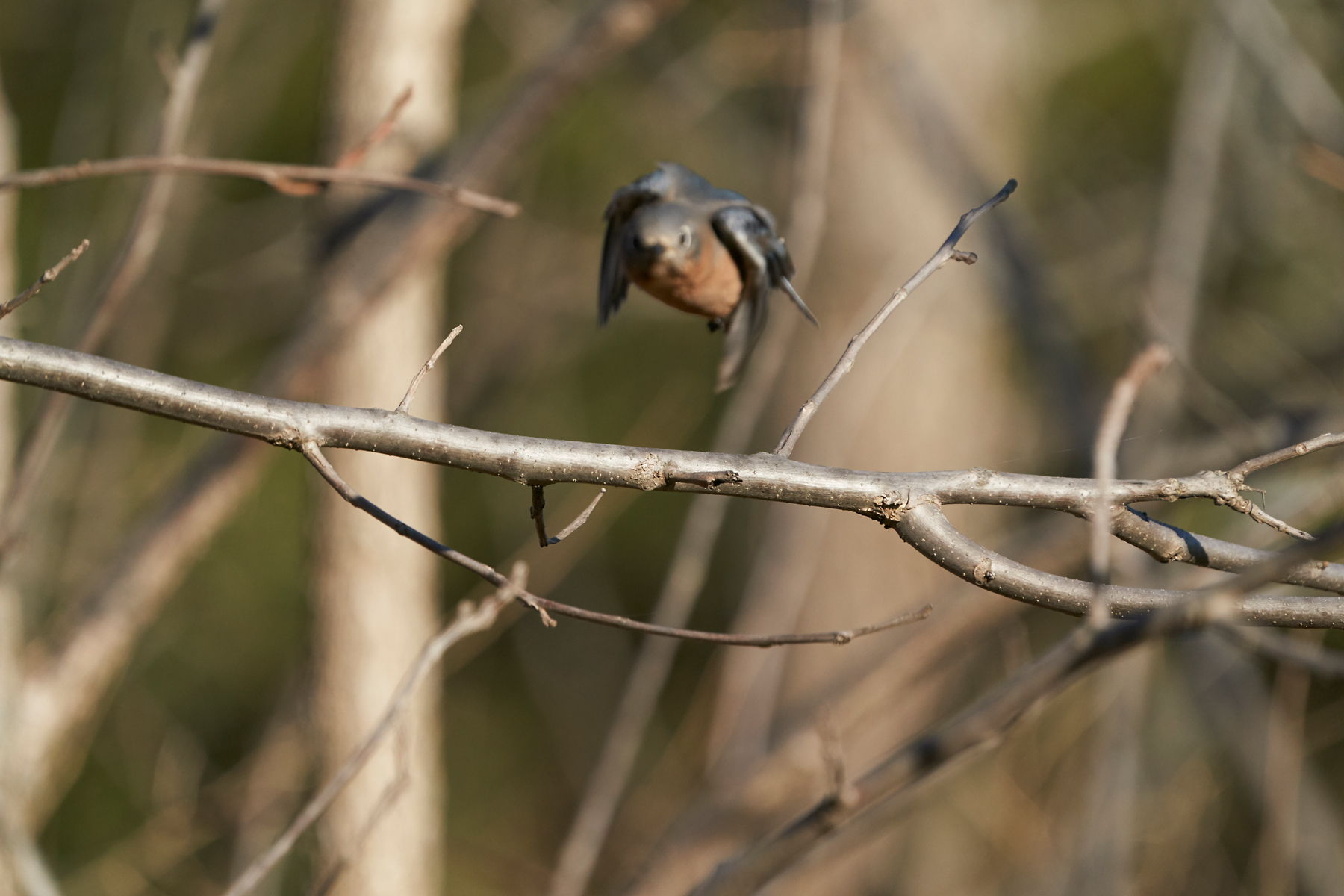
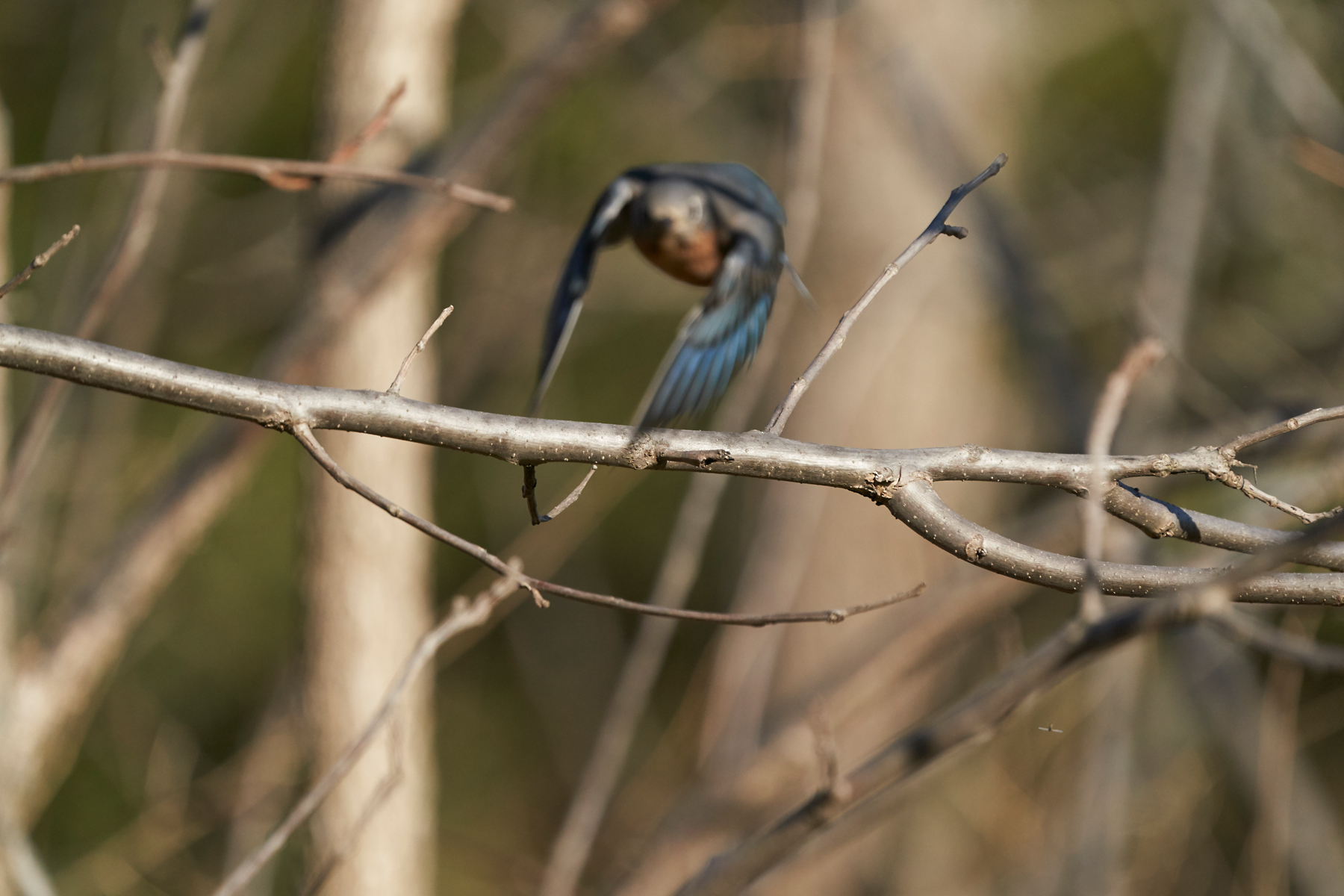
I have the A9, which I use with the 200-600 + 1.4TC. Subject is 95% small birds (migratory warblers, vireos, etc). Mostly it works great and gets the images I want. There is one scenario, though, that arises frequently and the autofocus just can’t keep up. Here are three consecutive images in a sequence at 20fps of a bluebird launching. In this case I had the focus on the perched bird and the focus setting was Lock-on AF expand Flexible Spot.
Obviously the focus remained nailed to the branch. It doesn’t seem to matter what AF setting I use (wide, tracking or no tracking, etc.), it never follows the bird since they move so fast. The only time I’m successful with these types of images is if the bird flies parallel, i.e. stays in the plane of focus, and not even slightly towards or away from me.
I’m just curious if the A1 (+ the 200-600, with or without the TC; if it takes the 600/4 that's not an option) can handle this situation. Large birds are easy – the issue is these little ones when the background is close and busy (these birds try hard to stay in the brush for safety!).
I’ve seen some great images here and can manage ok myself when the bird is flying against a distant background. The specific issue is when they are among branches or launching, and the AF stays nailed to some static feature (usually the branch it was perched on). So, I’m curious if the A1 eye detection plus tracking solves the problem, or not.
berimbolo wrote:
I think you're being limited by the lens here and not the A9.
Thanks - yes this is what I'm wondering. It could be the AF mechanical movement just can't keep up. Maybe it can in the 600/4, but that's out of my league, so I'm trying to see if moving up from the A9 to the A1 buys me very much when I'm restricted to the 200-600+TC.
this is operator error, A9 can nail shots like this if done right.
for starters the environment is way too busy and distracting, it will result in a delete even if the bird was in focus. Next time try to setup a perch against a descent BG to reduce the distraction for AF so it can actually pick up the bird, with that busy BG bird is just noise to the AF system. Use non-tracking zone AF not spot, take off the TC from the zoom lens
photonoclast wrote:
I've tried all these. The performance is exactly the same, which is why I'm curious if it's even possible
I think its possible, but you have to make sure the camera is tracking the bird not the branch.
From some experience messing with tracking algorithms like GOTURN, I think cameras which can process the tracking at a higher frame rate should have a better chance of success.
The A9 and A1 probably use classical vision algorithms given that they do not have AI co-processors.
It is possible that the A9iii uses deep learning based tracking but sony has not really talked about it.
Change AF Tracking Sensitivity to 5. That makes AF react very quickly to any forward/backward movements, which is exactly what you need in these situations. 1 will stick like glue to the subject no matter how often something gets in front of it, at the expense of quick reactions to foward/backward subject movement. 3 is default and gives you a bit of both stickiness and responsiveness, which is fine for most situations outside of fast moving, overlapping sports (hockey, basketball, etc.) and birds flying right at you.
berimbolo wrote:
I think you're being limited by the lens here and not the A9.
I do similar kind of small and fast bird photography with the same combo. berimbolo is right about the lens. 200-600 G af is not the fastest focusing lens, and in closer distances (closer than 10m) it gets downright slow. Even more so when 1.4x TC. This is something one just have to live with. Not using TC improves things considerably if you can live with the possible cropping.
I also have 100-400mm GM which is a much faster focusing lens. Even with 1.4x TC it focuses faster to close distace birds than 200-600 G without TC. I also find the 200-600 G size problematic for any length of hiking but 100-400 GM bokeh is slight problematic, making the 200-600 my preferred birding lens. Besides, I shoot most of the time @600mm
Changing tacking sensitivity to 5 is good idea - I think I have 4 now. Using just the center af point is also more reliable than the more advanced focus modes. I have fn button dialled so that I can change focus modes quickly.
I have never found the tracking modes to work in this situation with either the A9II or A1. That's despite some reviews suggesting that this situation is exactly what they can be used for. I have always found that the AF sticks to the branch or the tracking can't keep up with the bird.
I would probably use vanilla Zone or Wide in this situation. The AF is much faster than the tracking processing so if the bird is the foreground subject (i.e. closest), there is some chance that the AF will follow it. It is not a dead certainty though. I find the A1 to be much better at this than the A9II, partly because of its speed and also because the higher resolution provides a greater ability to crop which means the shot could be taken further away and cropped. That makes it easier to follow the bird and keep it in the frame. Also on the A1, I would have bird-eye AF switched on which will usually ensure that AF is on the bird before it launches.
somersettr wrote:
I have never found the tracking modes to work in this situation with either the A9II or A1. That's despite some reviews suggesting that this situation is exactly what they can be used for. I have always found that the AF sticks to the branch or the tracking can't keep up with the bird.
I would probably use vanilla Zone or Wide in this situation. The AF is much faster than the tracking processing so if the bird is the foreground subject (i.e. closest), there is some chance that the AF will follow it. It is not a dead certainty though. I find the A1 to be much better at this than the A9II, partly because of its speed and also because the higher resolution provides a greater ability to crop which means the shot could be taken further away and cropped. That makes it easier to follow the bird and keep it in the frame. Also on the A1, I would have bird-eye AF switched on which will usually ensure that AF is on the bird before it launches....Show more →
The problem with wide area, and to some degree with zone, is that it is difficult to avoid af catching a branch or something unwanted. Even the basic Sony tracking mode is sometimes a little too wide. A9 does not have bird eye af, and when distance is only a few meters, it is really important (or at least much better) to have a focus in eye/head, not in the body of the bird.
And since we are now complaining, although not a problem in general photography, A9 image pipeline lag is obvious when shooting fast and small birds. Lack of precapture makes things even worse. But on the other had, A9 prices are not so high anymore. For the price it is a very good camera for this kind of photography.
I've experienced the problem you're having with both A9 and A1 with 200-600+1.4. I agree with Speedmaster20d; tracking with that BG clutter is asking a lot of any AF. I found the bird-eye focus on the A1 useful but the cropability with small birds was the main advantage.
speedmaster20d wrote:
this is operator error, A9 can nail shots like this if done right.
for starters the environment is way too busy and distracting, it will result in a delete even if the bird was in focus. Next time try to setup a perch against a descent BG to reduce the distraction for AF so it can actually pick up the bird, with that busy BG bird is just noise to the AF system. Use non-tracking zone AF not spot, take off the TC from the zoom lens
Good luck
I have no doubt there's plenty of operator error! The thing is, I do have thousands of successful images against clean backgrounds. That's a piece of cake with the A9.
But what I'm trying to do now is move more into showing the bird as part of its habitat, maybe even moving in its habitat. Isolated "portraits" against clean backgrounds are getting a bit boring to me - I think I've got at least a few dozen clean portraits of every species that comes through my area, and I'm trying go beyond that. I agree the images I posted are complete rubbish, but I posted them to show the challenge.
Your suggestion of removing the TC is exactly what I'm wondering. If I were to upgrade to the A1 and take off the TC, after cropping I would get about the same number of pixels per bird, as I've seen Arbitrage put it here, so that would be OK, but then the question is how much AF capability I gain with (1) the extra light available since the TC is off and (2) the increased AF speed of the A1.
BlueBomberTurbo wrote:
Change AF Tracking Sensitivity to 5. That makes AF react very quickly to any forward/backward movements, which is exactly what you need in these situations. 1 will stick like glue to the subject no matter how often something gets in front of it, at the expense of quick reactions to foward/backward subject movement. 3 is default and gives you a bit of both stickiness and responsiveness, which is fine for most situations outside of fast moving, overlapping sports (hockey, basketball, etc.) and birds flying right at you.
aCuria wrote:
I think its possible, but you have to make sure the camera is tracking the bird not the branch.
From some experience messing with tracking algorithms like GOTURN, I think cameras which can process the tracking at a higher frame rate should have a better chance of success.
The A9 and A1 probably use classical vision algorithms given that they do not have AI co-processors.
It is possible that the A9iii uses deep learning based tracking but sony has not really talked about it.
Yes, when the BG isn't clean it is often hard to tell if the focus is actually on the bird and not something very close by. So, part of the question is if I remove the TC so the bird is optically smaller on the sensor, can the A1 eye-detect still find it even in a busy background.
psharvic wrote:
I've experienced the problem you're having with both A9 and A1 with 200-600+1.4. I agree with Speedmaster20d; tracking with that BG clutter is asking a lot of any AF. I found the bird-eye focus on the A1 useful but the cropability with small birds was the main advantage.
photonoclast wrote:
So, part of the question is if I remove the TC so the bird is optically smaller on the sensor, can the A1 eye-detect still find it even in a busy background.
Short answer: no. BEAF (bird eye AF) is a fantastic feature when it works, alas it works only if the eye is reasonable in size. For estimating the eye position without having a decently sized eye you'd need the new A7RV or A9III with the AI chip. Of course the A7RV is too slow for this and the A9III lacks resolution. Besides, BEAF works like tracking and hence incurs a small delay. Which is already a no-go for what you attempt to do. I'm shooting the A1 with the 600GM these days. Even that lens without TC can't usually keep up with a song bird jumping into the camera.
There a lots of small things that can help. I'd certainly loose the TC. Disable tracking, too, if the background allows it. Maybe close the aperture a bit, increasing the DOF. Just a little though, as the DOF increases only linearly while the exposure time increases squared. Cleaner background obviously helps, but there will always be the branch the bird sits on. Leaving more distance (or zooming out) helps with the AF speed and DOF, but also makes it less likely that the camera still considers the increasingly smaller blob as the actual subject.
What really helps is: if the bird sits on the tip of a soft branch and launches your way, the acceleration is *much* smaller as the branch is pushed away, sometimes allowing the lens to follow the bird.
Both A9 and A1 can do what you want but rarely with the lens/TC combo you are using. A1 is better but unless you are going to upgrade the lens to 100-400GM, 400GM or 600GM I don't think the A1 will be enough to give you the edge. I'd try without the TC on the 200-600 as that should sometimes work but the AF motors are just so much faster in the GM lenses.
Agree, I use Zone, no tracking and sensitivity set to 5 on the A1 for these situations and it does well with the 200-600G
somersettr wrote:
I have never found the tracking modes to work in this situation with either the A9II or A1. That's despite some reviews suggesting that this situation is exactly what they can be used for. I have always found that the AF sticks to the branch or the tracking can't keep up with the bird.
I would probably use vanilla Zone or Wide in this situation. The AF is much faster than the tracking processing so if the bird is the foreground subject (i.e. closest), there is some chance that the AF will follow it. It is not a dead certainty though. I find the A1 to be much better at this than the A9II, partly because of its speed and also because the higher resolution provides a greater ability to crop which means the shot could be taken further away and cropped. That makes it easier to follow the bird and keep it in the frame. Also on the A1, I would have bird-eye AF switched on which will usually ensure that AF is on the bird before it launches....Show more →
I also wanted to add that when I've done these types of shots I use Wide (no tracking). Of course I do 90% of my BIF in Wide (no tracking) and the other 10% in Zone (no tracking).
These examples were all coming off a perch in a messy Arbutus tree...