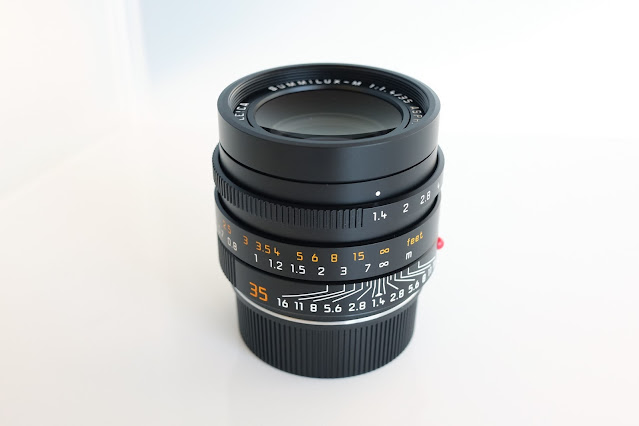
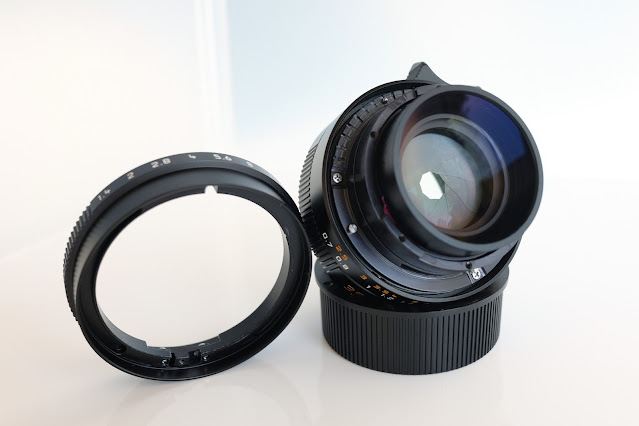
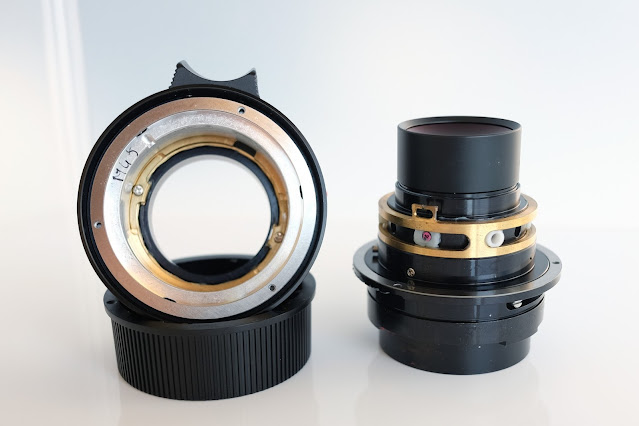
@yukosteel has published a teardown of the Leica Summilux-M 35mm F1.4 ASPH FLE lens designed for the Leica M mount.
One excerpt from the article's conclusion is as follows:
"Leica 35mm F1.4 Summilux-M ASPH. FLE lens is built with many precisely machined brass parts combined with lighter metal to reduce overall weight. It's not a surprise to see large number of precision calibration solutions for mechanics and optics made in Germany following highest quality standards."
" think this is most interesting mechanical area of lens design - large brass ring around optical core is a FLE helicoid. It is moving three white plastic cylinders inside slightly angled sockets in cylinder walls. That white cylinders are holding FLE optical group."
Use of plastic in this role (as cam follower) is the reason many Canon FD lenses are crippled or unusable due to the plastic crumbling to pieces. In contrast, Canon's latest EF 35/1.4L II shows how to do it right, as quoted by Roger Ciala: "Nobody, and I do mean nobody, else is engineering lens mechanics like the newer Canon lenses". Of course, the Canon allowance for EF design weight is somewhat higher than the Leica M.
" think this is most interesting mechanical area of lens design - large brass ring around optical core is a FLE helicoid. It is moving three white plastic cylinders inside slightly angled sockets in cylinder walls. That white cylinders are holding FLE optical group."
Use of plastic in this role (as cam follower) is the reason many Canon FD lenses are crippled or unusable due to the plastic crumbling to pieces. In contrast, Canon's latest EF 35/1.4L II shows how to do it right, as quoted by Roger Ciala: "Nobody, and I do mean nobody, else is engineering lens mechanics like the newer Canon lenses". Of course, the Canon allowance for EF design weight is somewhat higher than the Leica M.
Gary Clennan wrote:
Plastic components is also the source of the issue with the focus wobble in ZM lenses.
It's also the source of focus wobble in the Midland 'cron-M 35 v4 which, unfortunately, I own. E Leitz was in financial straits in those days. This plastic was eliminated in the later German production. My v4 is a shelf queen (that appreciates in value) while I simply use the nicer v3 or the awesome Summaron 35/2.8.
rico wrote:
It's also the source of focus wobble in the Midland 'cron-M 35 v4 which, unfortunately, I own. E Leitz was in financial straits in those days. This plastic was eliminated in the later German production. My v4 is a shelf queen (that appreciates in value) while I simply use the nicer v3 or the awesome Summaron 35/2.8.
Ah - I didn't know that about the Midland cron! Interesting.
Gary Clennan wrote:
I've been out of touch with things regarding the M6 issues. Other than film scratching, what are the complaints? You own one - correct?
Yes I own one. Not being able to set ISO dials is the other big one. But film scratching is a huge/game over type issue.
Desmolicious wrote:
Crappy pressure plates. I guess they forgot how to make them in a $5500 camera. Even though a $15 plastic disposable camera seems to have it nailed.
Good god. So the scratches are not on the emulsion side - correct? Could you polish out the burr(s) on the pressure plate somehow?
Gary Clennan wrote:
Good god. So the scratches are not on the emulsion side - correct? Could you polish out the burr(s) on the pressure plate somehow?
Mine was eventually fixed after multiple attempts (due to Leica's techs basically being incompetent). So yes, you could polish it down yourself. But that may grenade the warranty. And the fact that you just dropped $5500 on a camera..
Desmolicious wrote:
Mine was eventually fixed after multiple attempts (due to Leica's techs basically being incompetent). So yes, you could polish it down yourself. But that may grenade the warranty. And the fact that you just dropped $5500 on a camera..
Desmolicious wrote:
Crappy pressure plates. I guess they forgot how to make them in a $5500 camera. Even though a $15 plastic disposable camera seems to have it nailed.
It's a further testament to Nikon's skill in traditional engineering that they were able to resurrect the S3 as a saleable product—42 years after its intro. That included the period 50/1.4 and (remarkably) the self-timer.
It was no easy task, so I don't fault Leica Camera AG for their attempt. In fact, I hope they continue to revive old bodies and lenses. I'm first in line for a reborn Barnack.
rico wrote:
It's a further testament to Nikon's skill in traditional engineering that they were able to resurrect the S3 as a saleable product—42 years after its intro. That included the period 50/1.4 and (remarkably) the self-timer.
It was no easy task, so I don't fault Leica Camera AG for their attempt. In fact, I hope they continue to revive old bodies and lenses. I'm first in line for a reborn Barnack.
Yeah but you do know that all Leica did to 'revive' the M6 was essentially re-badge the current production MP, right?
@Desmolicious Ah, that's a bit sad. But we know that cameras are no longer made with that hand-crafted attention and heavy-metal parts. No M6 of any vintage will touch the build quality of my M4 or prewar IIIb. Although, I have read about scratching backplates from even M3 owners.
rico, thanks for sharing.
That is very interesting point. From what I see Canon roller is few times wider in much larger diameter frame, which has quite large movement range and perhaps holding quite heavy component.
With Lux 35 FLE, that module is quite small with minimal pressure on brass sockets which also have wider walls.
I saw brass rollers inside of CV 35/1.4 II (one above green arrow on picture). I think Leica engineers took into account mechanical wear, pressure and grease combination when deciding on nylon over brass.
I heard from one friend that Lux 35/1.4 intentionally has F1.4 aperture stop not at the very end of ring rotation, to address potential metal temperature expansion. I'm wondering if using nylon is related to the material thermal expansion difference as well
Perhaps it's just cost optimization, that nylon cylinders are durable enough. I've serviced couple of Nikkor 100-300mm Ai-s lenses, that have similarly sized nylon guiders in much more heavy moving areas, and they hold quite well there over long time until zoom creep start to show up. I think in Leica FLE case, guiders can remain in good shape hundred times longer.