Pixelpuffin wrote:
I know nothing about canons R line
But can I ask do you have both lens IS and ibis running simultaneously?
Only I read mixed comments online that they sometimes react badly?? Not sure if there’s any truth in that.
With cameras with IBIS, IBIS and IS can only work simultaneously. You can't disable one without disabling both. With that said, the IBIS/IS combo has been amazing for me—can hand hold in almost any situation and get sharp photos—not the case with IS only. The only situation IBIS and IS has reacted badly for me is when using ultra wide lenses for video: IBIS produces a wobble artifact especially apparent in corners when panning. No problem with stills or lenses longer than 24mm on FF.
Gochugogi wrote:
With cameras with IBIS, IBIS and IS can only work simultaneously. You can't disable one without disabling both. With that said, the IBIS/IS combo has been amazing for me—can hand hold in almost any situation and get sharp photos—not the case with IS only. The only situation IBIS and IS has reacted badly for me is when using ultra wide lenses for video: IBIS produces a wobble artifact especially apparent in corners when panning. No problem with stills or lenses longer than 24mm on FF.
Thank you for clarifying
I only asked as I still have the 6dii and I read that if you turn on sensor stability with lens IS they fight against each other. I know it’s old tech, just wondered if canon had addressed the issue with the R line
Pixelpuffin wrote:
I know nothing about canons R line
But can I ask do you have both lens IS and ibis running simultaneously?
Only I read mixed comments online that they sometimes react badly?? Not sure if there’s any truth in that.
Gochugogi wrote: With cameras with IBIS, IBIS and IS can only work simultaneously. You can't disable one without disabling both. With that said, the IBIS/IS combo has been amazing for me—can hand hold in almost any situation and get sharp photos—not the case with IS only. The only situation IBIS and IS has reacted badly for me is when using ultra wide lenses for video: IBIS produces a wobble artifact especially apparent in corners when panning. No problem with stills or lenses longer than 24mm on FF.
Isn't that just a Canon implementation because the IBIS by itself is weaker than the lens IS? There should not be a technical reason that lens IS requires the IBID, for example IS lenses have IS mode on the R8. OTOH, a 50/1.4 non-IS lens will function with the IBIDs.
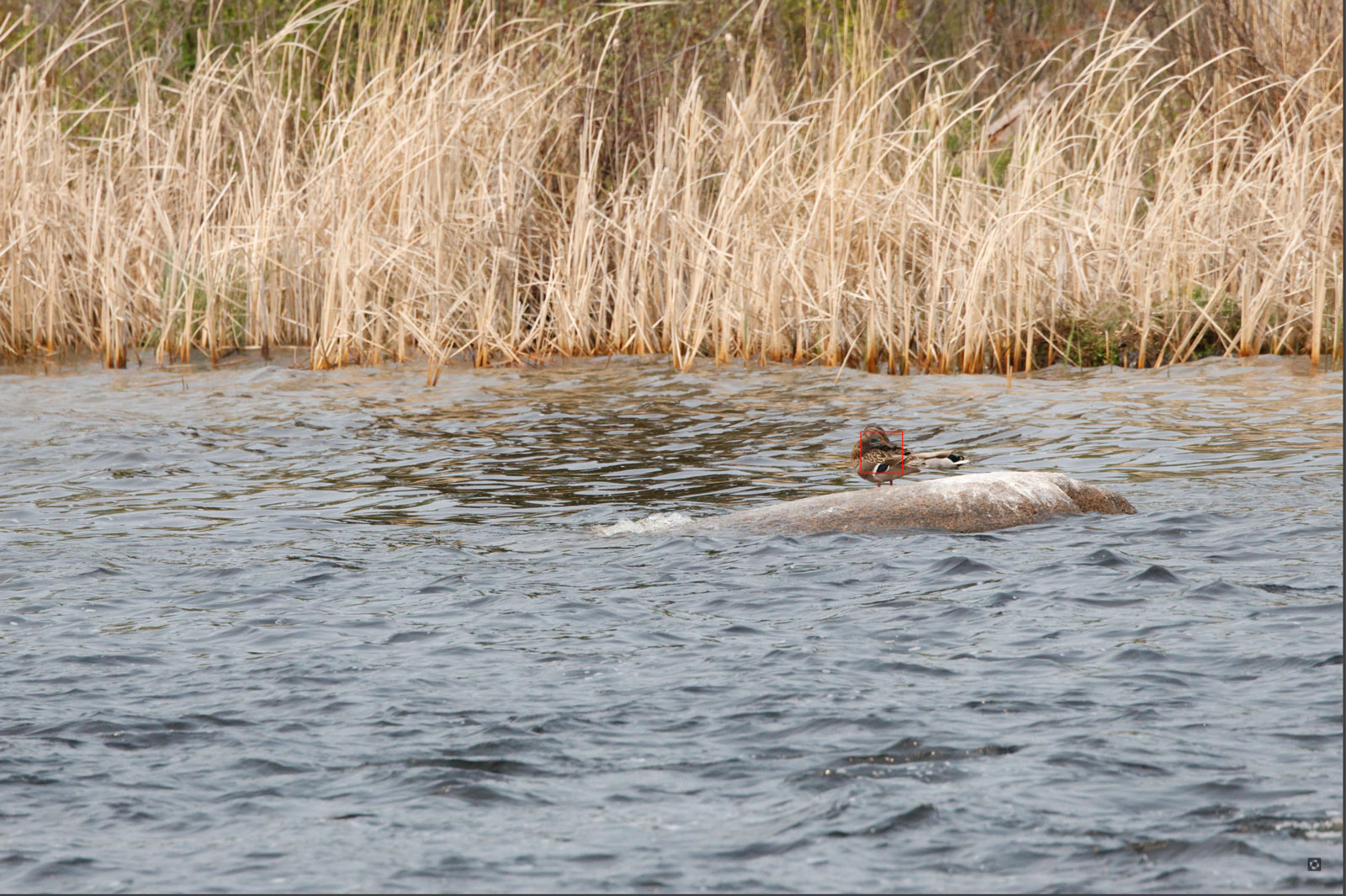
It's normal that you won't get a good eye focus of the bird at that distance.
Plus the movement and contrast of the wave will mess up the AF.
I would switch the eye focus to a another zone AF that fit with the size of that bird and work on that ( single point, 5 point or 9 point AF for example ).
EB-1 wrote:
Isn't that just a Canon implementation because the IBIS by itself is weaker than the lens IS? There should not be a technical reason that lens IS requires the IBID, for example IS lenses have IS mode on the R8. OTOH, a 50/1.4 non-IS lens will function with the IBIDs.
EBH
It simplifies the UI to have both systems controlled by the lens switch, if present. There's also likely little benefit to controlling them separately.
Maybe to some people, but there are whole sections of practically useless options in the Canon menus. Control of IS modes would be a nice option and perhaps improve IQ in certain situations.
Pixelpuffin wrote:
Thank you for clarifying
I only asked as I still have the 6dii and I read that if you turn on sensor stability with lens IS they fight against each other. I know it’s old tech, just wondered if canon had addressed the issue with the R line
The 6D didn’t have IBIS, it has a digital stabilization but isn’t the same thing.
Pixelpuffin wrote:
Thank you for clarifying
I only asked as I still have the 6dii and I read that if you turn on sensor stability with lens IS they fight against each other. I know it’s old tech, just wondered if canon had addressed the issue with the R line
I recently sold my 6D MK II and I am 100% positive it has a fixed CMOS—no IBIS or any sort of built in mechanical stabilization. It has digital stabilization in video mode, but not for stills. As I recall, the video digital stabilization feature was horrid and I got better results digital stabilizing it in PP. On my R7 and R6 MK II, IS and IBIS work beautifully and are well integrated, albeit it would be nice to be able to enable/disable them separately for video use with ultra wide lenses.
bobbytan wrote:
I am having the same issue. The image jumps from the very first shot, but sometimes it works just fine. I took the lens to Canon but they want to charge me $100 just for the diagnostics, and repairs will cost upwards of $500 so I didn't get it fixed. I am hoping the next firmware upgrade may resolve the issue. As I don't have any important shoot coming up I am reluctant to fork out $500+ to fix this issue. It only jumps when IS is turned on.
How is this for an image-stabilized shot? The clock face filled the whole frame before I pressed the shutter ... and then it jumps when I press the shutter....Show more →
Dumb question but do you have the latest FM? There was a previous update to address that issue.
I agree with many of the comments:
- Eye AF from that distance on that subject of bird is not going to be reliable.
- Faster shutter speeds with animals on waves in the distance is usually warranted.
However as long as the camera was able to track the bird as an object (my AF is such that it first uses Eye AF, then moves to object tracking), the DOF at that distance should be MORE than able to cover the bird in focus.
Therefore in this case, softness of focus is likely due to shutter speed and maybe atmospheric haze. I would also turn off IS, I see no reason for that at faster shutter speeds. IS is there to stop your own action and shake, and 1/800+ should be more than sufficient for most people. Turning that off eliminates one factor out of several.
Thanks for all the thoughts. Didn't mean to get people wound up about animal eye detection. I've taken thousands of shots with this combo with some great results. Mostly birds, many smaller and farther away, frequently in focus. The method I use is eye detection first, if it doesn't lock then are there at least focus points on the target? If not I use single point focus and try for the eye or the bird. All using back buttons.
Here are the better shots from a recent birding trip to Ecuador for example: https://www.flickr.com/photos/28171498@N00/albums/72177720306961472
That method works fine most of the time, but sometimes I'll get a run of say 10 or 20 shots that are slightly out of focus. Seems to me that some setting is wrong or there is something wrong with the camera or lens.
Btw yes I do use ibis and IS - maybe I'll try turning off the lens IS and check on that result. Other ideas welcome!
I guess I missed where people were getting wound up.
I saw some very useful comments:
- Don't count on Eye AF (which you are not)
- Try to make sure your settings go to object tracking next after Eye AF (should surround bird with a box)
- Up your shutter speeds
- Turn off IBIS/IS, likely not needed and could actually maybe interfere from time to time
- When a subject is only about 12% of the overall frame, and about 1/15th of that is an eye, Eye AF is going to be a bit tricky.
Some birds have black patches around their eyes, making the Eye AF algorithms a bit more problematic, but then again, as long as the AF system then goes to object tracking, hopefully at 500mm at f7.1, the DOF is more than enough to get a bird into focus. Once you have a bird that is over 40' away, your DOF is at least 1ft.
Thanks TeamSpeed.
I don't think I do this one - any hint on the settings? "- Try to make sure your settings go to object tracking next after Eye AF (should surround bird with a box)
"
Also are you saying turn of both IBIS and IS?
TeamSpeed wrote:
I agree with many of the comments:
- Eye AF from that distance on that subject of bird is not going to be reliable.
- Faster shutter speeds with animals on waves in the distance is usually warranted.
However as long as the camera was able to track the bird as an object (my AF is such that it first uses Eye AF, then moves to object tracking), the DOF at that distance should be MORE than able to cover the bird in focus.
Therefore in this case, softness of focus is likely due to shutter speed and maybe atmospheric haze. I would also turn off IS, I see no reason for that at faster shutter speeds. IS is there to stop your own action and shake, and 1/800+ should be more than sufficient for most people. Turning that off eliminates one factor out of several....Show more →
It is but it will find the head. Sometimes I'm stunned at how far and small the subject is and it will find it.
bobbytan wrote:
I am having the same issue. The image jumps from the very first shot, but sometimes it works just fine. I took the lens to Canon but they want to charge me $100 just for the diagnostics, and repairs will cost upwards of $500 so I didn't get it fixed. I am hoping the next firmware upgrade may resolve the issue. As I don't have any important shoot coming up I am reluctant to fork out $500+ to fix this issue. It only jumps when IS is turned on.
How is this for an image-stabilized shot? The clock face filled the whole frame before I pressed the shutter ... and then it jumps when I press the shutter....Show more →
This is or was a fairly well-known issue. At least, I found several reports of it when I started searching, after I noticed the same behavior with my copy. Apparently, it was finally solved by a firmware update for the camera.
At that time, I had already sent my lens in for repair under warranty. They needed 3 months to replace a lens group. I was not convinced that the problem was completely gone, but I did get a few useful pictures - until one of the internal lens elements spontaneously cracked. (Also a fairly well-known issue with this lens.) I just received it back from another repair. This time they replaced two lens groups. Hopefully I can finally start to trust and use this lens. I'll throw it off a cliff if it breaks again .